Why dental assistants need insurance verification & billing basics (now more than ever)
A dental appointment can be clinically perfect and still end with a patient feeling frustrated. It happens all the time. The crown prep went smoothly, the assistant was on it, the doctor was efficient, the patient even said thank you on the way out.
Then the bill hits. Or the claim denies. Or the estimate was off by a few hundred dollars. And suddenly that great visit is the one they complain about online.
That is why insurance verification and billing basics are not “front desk only” skills anymore.
In a real practice, dental assistants support the flow constantly, even if they are not the primary biller. You are collecting insurance cards, confirming subscriber details, helping the team plan treatment (like oral surgery, orthodontics, or periodontics), documenting what was done, and answering those in-the-room questions patients ask when they feel nervous about money. Sometimes you are also the person who catches the mistake before it turns into a denial.
And practices are paying attention. Modern offices want team members who are thoroughly trained, legally compliant, and clinically confident, especially around documentation and money conversations. Because insurance is where small errors turn into big problems.
This article walks through the practical side of it. The verification workflow, the core billing terms, the most common claim issues, compliance basics, and how advanced training helps you thrive in a high-performance dental practice. Consider pursuing some certifications or exploring courses offered by reputable institutions to enhance your skills in these areas.
Insurance verification: what it is (and what it isn’t)
Insurance verification is simply confirming the patient’s eligibility and plan details before treatment.
In plain language, you are checking things like:
- Is the coverage active on the date of service?
- What is the deductible and how much is left?
- What percent does the plan cover for preventive, basic, major?
- What limitations apply? Frequency limits, waiting periods, missing tooth clauses, downgrades, exclusions.
What verification is not is a promise of payment.
Even if the plan says “80% basic,” that does not guarantee the claim will pay 80%. Payment depends on correct coding, accurate clinical documentation, frequency rules, plan exclusions, medical necessity language in the policy, and sometimes whether the plan considers a procedure “alternate” and pays a downgraded amount.
When verification is done well, it protects everyone.
- Patients get fewer surprises and better trust.
- The office has fewer write-offs and fewer uncomfortable collection moments.
- The team avoids rework cycles like resubmitting claims, chasing missing info, rewriting narratives, or re-taking images.
Where assistants help most often is at the touchpoints that determine accuracy later: collecting correct subscriber info, scanning cards clearly, noting plan limitations, and communicating clinical details that support claims.
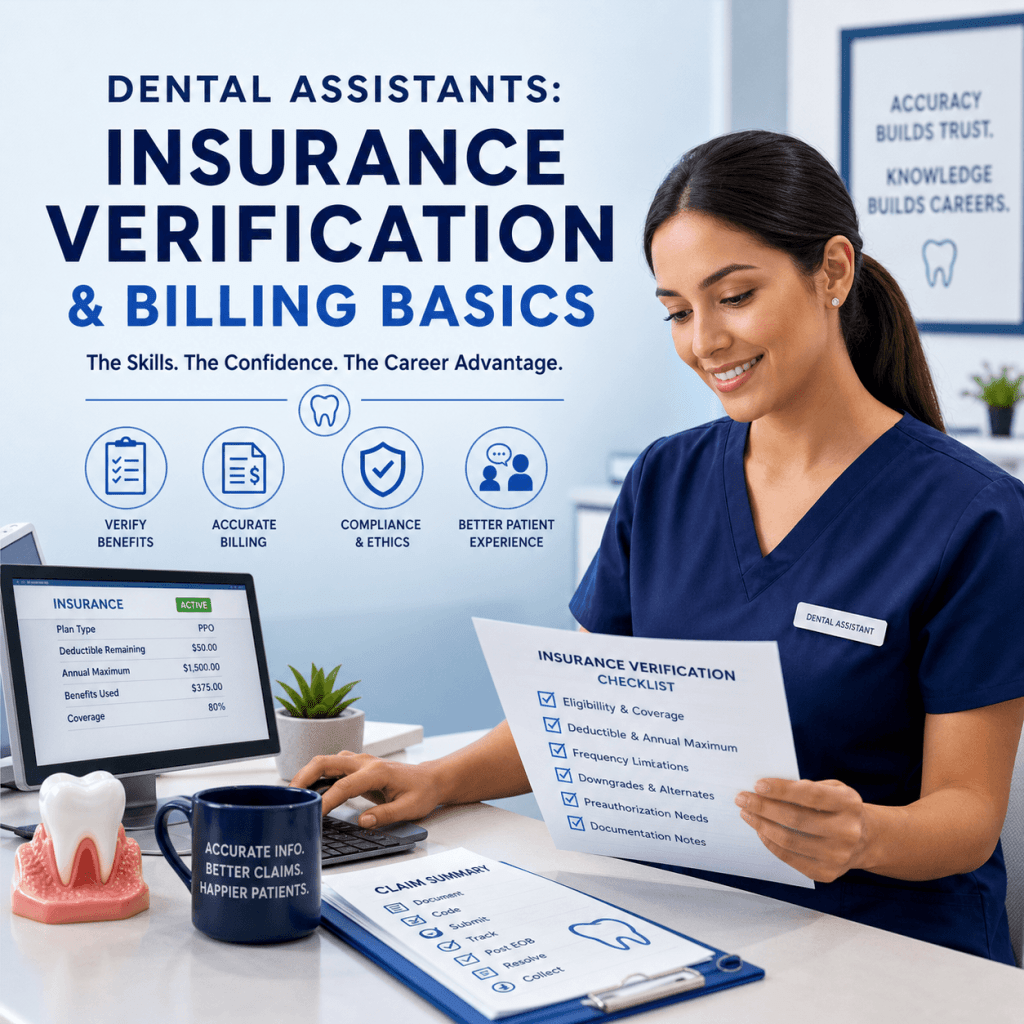
The verification checklist dental assistants should know (step-by-step)
You do not need to memorize every plan. You do need a repeatable checklist. Same order, every time, so nothing slips.
1) Patient and subscriber basics
Start with what the insurance company uses to find the policy.
- Patient name spelling (exactly as on the plan)
- Date of birth
- Subscriber name (if different)
- Subscriber date of birth (often required)
- Relationship to subscriber
- Member ID
- Group number
- Employer (if relevant for plan lookup)
- Correct address on file, sometimes matters for out of area plans
This is where tiny errors happen. One wrong digit in the ID, one transposed DOB. A claim can deny or get routed into “cannot identify patient.”
2) Coverage and network status
Next, confirm the big eligibility pieces.
- Active or inactive coverage
- Effective date and termination date (if any)
- In network vs out of network status for your office
- Waiting periods (especially for basic and major)
- Missing tooth clause (when applicable, often tied to replacement rules)
If treatment is planned weeks out, do not assume it will still be active. People change jobs. Benefits reset. Plans get terminated. Same day recheck matters for bigger appointments.
3) Downgrades and alternate benefits
This part is where estimates get messy if nobody brings it up.
Common examples:
- Posterior composites downgraded to amalgam
- Crown material downgrades (plan pays as a cheaper crown type)
- Alternate procedure allowances where the plan pays for the least expensive option
Even when a procedure is “covered,” the plan may cover it at the alternate benefit rate, which means the patient portion goes up.
4) Preauthorization or predetermination expectations
Not every plan requires preauthorization, but many expect it for higher dollar work. It also helps the office and the patient feel more certain before starting.
Procedures that commonly trigger a preauth or predetermination request:
- Crowns
- Bridges
- Periodontal treatment
- Endodontics
- Implants and implant related prosthetics
Common attachments the plan may want:
- Current radiographs (and sometimes older ones too)
- Intraoral photos
- Perio charting
- Detailed narratives (why this tooth, why now, why this option)
As an assistant, you often help capture the images and clinical notes that make or break approval. This is where understanding your role as a dental assistant becomes crucial.
5) Documenting verification (do not skip this)
Verification that is not documented basically does not exist.
In your practice management system or EHR, make sure the note includes:
- Date and time of verification
- Method (phone, portal, clearinghouse)
- Name or ID of the representative (if phone)
- Call reference number
- Details learned and any plan specific caveats
- Your initials or name (office policy)
And include the warnings that matter, like downgrade risk, replacement limitations, waiting periods, missing tooth clause language, or frequency limits.
Common dental insurance terms (translated into assistant-friendly language)
If you can explain these simply, you will help patients relax. Most people are not trying to be difficult. They just do not speak insurance.
Premium, deductible, copay, coinsurance
- Premium: what they pay monthly to have the plan. Not paid to the dental office.
- Deductible: what they must pay out of pocket before the plan starts paying for certain services (often applies to basic and major, usually not preventive).
- Copay: a fixed amount per service (less common in dental than medical, but some plans use it).
- Coinsurance: a percentage split. Example: insurance pays 80%, patient pays 20%.
In estimates, the deductible is the part patients forget. They hear “insurance covers 80%” and miss the “after deductible” part.
Annual maximum
This is the most important number for treatment planning conversations.
The annual maximum is the most the plan will pay in a benefit year. Once it is used, the patient still can get treatment, but insurance will not pay more until the plan resets.
This is why patients “still owe” even with insurance. They did not do anything wrong. They just hit the cap.
UCR, fee schedule, allowable amount, write-offs
- UCR (usual, customary, reasonable): a plan’s benchmark for what it considers a typical fee in an area.
- Fee schedule/allowable amount: what the plan will reimburse for a code, regardless of the office fee.
- Write-off: the difference between the office fee and the allowable amount, when the office is contracted in network and must adjust it per the agreement.
This is also why an office fee is not always the reimbursed fee.
Coordination of benefits (COB)
COB is the process of deciding which plan pays first when a patient has two plans.
- Primary pays first.
- Secondary may pay some of the remaining balance, depending on its rules.
A basic rule you will hear is the birthday rule for dependents: the parent whose birthday falls earlier in the calendar year is often primary. Not always, but it is a common default.
Missing COB details can stall a claim fast. The plan might request a COB form, or the secondary might require the primary EOB before it will process.
EOB (Explanation of Benefits)
An EOB is the claim result summary.
At a high level, you are looking at:
- Amount billed
- Allowed amount
- Amount paid by insurance
- Patient responsibility
- Denial reason codes or remarks
If you can scan an EOB and spot why it did not pay, you are already helping the office move faster.
Dental billing basics: how claims actually get paid
Most assistants do better with billing once they see the whole lifecycle. It is not magic. It is steps.
Here is the big picture:
- Verify benefits
- Document clinically
- Code accurately
- Submit claim
- Track claim status
- Post EOB
- Appeal or correct issues
- Collect remaining patient balance
Codes that matter (and why accuracy matters)
- CDT codes: dental procedure codes. These are the backbone of dental claims.
- ICD-10: diagnosis codes, mainly relevant when medical billing applies or when a payer requests diagnosis support.
The wrong code, tooth number, quadrant, or surface can cause denials, delays, or reduced payment. And sometimes it triggers compliance issues. Which nobody wants.
Attachments that get requested all the time
Plans often want proof that supports the treatment.
Common attachments:
- Radiographs (BWX, PA, pano, as appropriate)
- Intraoral photos
- Periodontal charting
- Narratives explaining the clinical need
- Prior images for comparison (fractures, recurrent decay, failing restorations)
If the attachment is missing or unclear, the claim can pend for “additional information,” then deny if not provided by the deadline.
Timely filing limits
Every plan has a time limit for submitting claims. Miss it and you can get an automatic denial.
This is why delays in documentation, missing tooth numbers, missing provider info, or “we will do it later” habits cost real money.
Electronic claims vs paper claims
Electronic claims are faster, easier to track, and usually the standard now. Paper claims still exist, but they are slower and harder to monitor.
The big difference in the real world is attachments and tracking. With electronic claims, you need to know how your system sends images and narratives, and how to confirm they actually went through.
Building accurate patient estimates (without overpromising)
An estimate is a planning tool. It is not a guarantee.
The goal is to give the patient a realistic range based on verified benefits, common limitations, and office policy. So they can say yes or no with their eyes open.
What to include in an estimate:
- Office fee
- Expected coverage percentage (by category)
- Deductible remaining
- Annual maximum remaining (when relevant)
- Replacement rules and missing tooth clauses (if applicable)
- Downgrade risk (especially posterior composites, crown material)
- Patient portion and when it is due (office policy)
How to phrase it ethically, and confidently:
- Use “estimated” and “based on the information we received today”
- Avoid “your insurance will pay” unless it is already paid
- Do not sound scared or vague. Just honest.
Special scenarios you will see:
- Phasing treatment to maximize annual benefits when clinically appropriate
- Splitting treatment across benefit years when it makes sense and the dentist agrees
- Major services with secondary insurance, which can look simple and then turn complex fast
When it gets complicated, loop in the financial coordinator or office manager early. That is not weakness. That is good teamwork.
In such cases where provider information might be missing or unclear, it’s essential to have a clear communication strategy in place. This could involve confirming details directly with the provider or utilizing resources that help clarify such situations.
Top claim denials and delays dental assistants should recognize (and prevent)
You do not have to be the biller to spot the patterns.
Eligibility inactive on date of service
Prevention: recheck eligibility the day of service for long treatment windows or when coverage is questionable.
Missing information
Common missing items:
- Member ID or DOB mismatch
- Provider NPI or TIN issues
- Tooth number or surfaces
- Date of prior service when frequency is in play
Prevention: slow down for the double check. One digit off creates weeks of delay.
Not a covered benefit or plan exclusion
Sometimes the plan simply does not cover it. Or it covers an alternate.
Prevention: identify exclusions during verification, document it, and help the patient understand the options. Covered alternative, patient pay, or a different plan of care. No drama, just clarity.
Coordination of benefits issues
- Incorrect primary plan listed
- Missing secondary information
- Secondary requires primary EOB
Prevention: confirm who is primary before submission, and make sure both plans are entered correctly.
Coding mismatches
- Wrong CDT code
- Wrong quadrant or tooth
- Incorrect modifiers or missing details (varies by scenario)
Prevention: match the clinical notes, images, and the code. If it is not documented, it is hard to defend.
Compliance and ethics: protecting the patient, the provider, and your career
Compliance is not just “office policy.” Billing mistakes can become legal and ethical issues, even when accidental.
A few basics that matter every day:
- Avoid upcoding and misrepresentation. Only bill what was actually performed and documented. Never change a code to get a higher reimbursement.
- Document truthfully and clearly. If a narrative is needed, it should match the chart. If an image is needed, it should be diagnostic and relevant.
- HIPAA and privacy. Be careful on insurance calls, with voicemails, and when sending documentation. Use secure methods approved by your office.
- Scope and supervision. Know what you can handle as an assistant and what must be handled by the dentist or office leadership. If you are unsure, escalate. Quiet confusion leads to loud problems later.
In financial conversations, professionalism matters. Empathy, clarity, no pressure, no guarantees. Patients remember how you spoke to them when they were stressed.
How to get confident fast: practical skills to practice in a real dental office
Confidence comes from reps. Not from reading one more definition.
A few practical ways assistants build skill quickly:
Role play scripts (seriously, it works)
- Calling to verify benefits, staying organized, asking the right questions
- Explaining deductible and annual maximum in normal language
- Responding to “Why wasn’t this covered?” without blaming the patient or the plan
Keep it calm. Keep it factual. Then offer next steps.
Daily habits that prevent mistakes
- Use a verification checklist every time
- Follow documentation standards, consistently
- Do a quick end of day review of claims that need attachments
- Confirm images are actually attached and readable
Get comfortable in the practice management system
Learn how your office:
- Enters insurance plans and subscribers correctly
- Stores verification notes
- Attaches radiographs and photos
- Tracks claims and sees statuses
If you can help keep the digital side clean, you make everyone faster.
Tight team handoffs
The cleanest practices have clear handoffs between assistant, hygienist, dentist, and front desk.
- Clinical notes support the code
- The code matches the tooth and surfaces
- The attachments match the narrative
- The estimate matches the verified benefits
Less rework. Less friction. Better days.
Quality control mindset
Build a personal double check routine. Name spelling, DOB, member ID, tooth number, surfaces, dates. It feels small until it saves a claim.
For those new to dental assisting or even seasoned professionals seeking to refresh their knowledge on certain aspects of the job, it’s normal to have questions. This is where resources like Broward Dental Academy’s FAQ section come in handy. It’s a treasure trove of information that can clarify common doubts and enhance your understanding of various dental procedures and practices.
Where advanced training fits in (and why practices value it)
Assistants who understand insurance verification and billing basics are more versatile. In busy practices, versatility turns into trust. And trust turns into more hours, better roles, and real career mobility.
Dental is also one of the fastest-growing healthcare industries. It offers stable income, flexible schedules, and a respected position in healthcare. But the assistants who move up are usually the ones who can do more than chairside tasks. They can communicate well, document well, and handle the realities of modern dentistry, including insurance.
A modern, high-performance dental practice expects speed plus accuracy plus compliance, without losing the patient centered feel.
This is where advanced training from institutions like the Broward Dental Academy makes a difference. They offer a wide range of dental courses and advanced dental training designed to prepare students to thrive, not just pass an exam. Training is built around immediate immersion in online and clinical settings, incorporates the latest eLearning lesson plans for remote learning, and includes in-office internships so skills translate to real practice flow. The focus is not only on tasks but on critical thinking, ethics, and confidence.
If you are on an expanded functions pathway, billing and verification knowledge also complements your clinical skills. The more you understand how documentation and benefits connect to treatment, the more valuable you become.
Next steps: become the assistant every office wants to hire
When you master insurance verification and billing basics, a lot improves at once.
- Fewer claim issues and fewer delays
- Smoother schedules and fewer awkward surprises
- Better patient trust because you can explain things clearly
- Stronger team performance because your documentation and handoffs are clean
If you want structured training that builds real confidence, explore Advanced Dental Assistant Training – Level 02 at Broward Dental Academy or consider their Level 03 program for even more advanced training. Flexible financing is available for these programs which are designed to help you thrive in a modern dental practice, not just get through a test.
Demand for skilled, compliant, confident dental professionals continues to rise.
Don’t delay, enroll today. You will be glad that you did.
FAQs (Frequently Asked Questions)
Why is insurance verification and billing knowledge important for dental assistants today?
Insurance verification and billing basics are essential skills for dental assistants because they support the patient flow beyond clinical care, help prevent billing errors, reduce claim denials, and improve patient trust by managing financial expectations effectively. Modern dental practices value team members who are trained, compliant, and confident in handling documentation and money conversations to avoid costly mistakes.
What exactly is insurance verification in a dental practice?
Insurance verification involves confirming a patient’s eligibility and plan details before treatment. This includes checking if coverage is active on the date of service, understanding deductibles, coverage percentages for preventive, basic, and major procedures, as well as any limitations like frequency limits or waiting periods. It is not a guarantee of payment but helps minimize surprises for patients and reduces claim denials.
What are the key steps dental assistants should follow during insurance verification?
Dental assistants should use a repeatable checklist that includes: 1) Confirming patient and subscriber information such as exact name spelling, dates of birth, member ID, group number, and address; 2) Verifying coverage status including active coverage dates, network status, waiting periods, and missing tooth clauses; 3) Identifying any downgrades or alternate benefits that affect payment amounts; 4) Checking preauthorization or predetermination requirements for higher-cost procedures like crowns or periodontal treatments.
How do downgrades and alternate benefits affect dental insurance claims?
Downgrades occur when insurance plans pay for a less expensive procedure than what was performed—for example, paying for an amalgam filling instead of a posterior composite. Alternate benefits mean the plan covers the least expensive option available. These factors can increase the patient’s out-of-pocket costs even if the procedure is technically covered by insurance.
What role do dental assistants play in preventing claim denials related to insurance?
Dental assistants help prevent claim denials by accurately collecting subscriber information, scanning insurance cards clearly, noting plan limitations during verification, documenting clinical details properly to support claims, and communicating effectively with patients about their financial responsibilities. Their vigilance at these touchpoints ensures smoother billing processes and fewer rework cycles.
Why should dental assistants consider additional certifications or courses in insurance verification and billing?
Pursuing certifications or specialized courses enhances dental assistants’ skills in insurance verification and billing compliance. This advanced training equips them to thrive in high-performance dental practices by improving accuracy in documentation, reducing errors that lead to denied claims, fostering legal compliance, and boosting confidence when discussing money matters with patients.