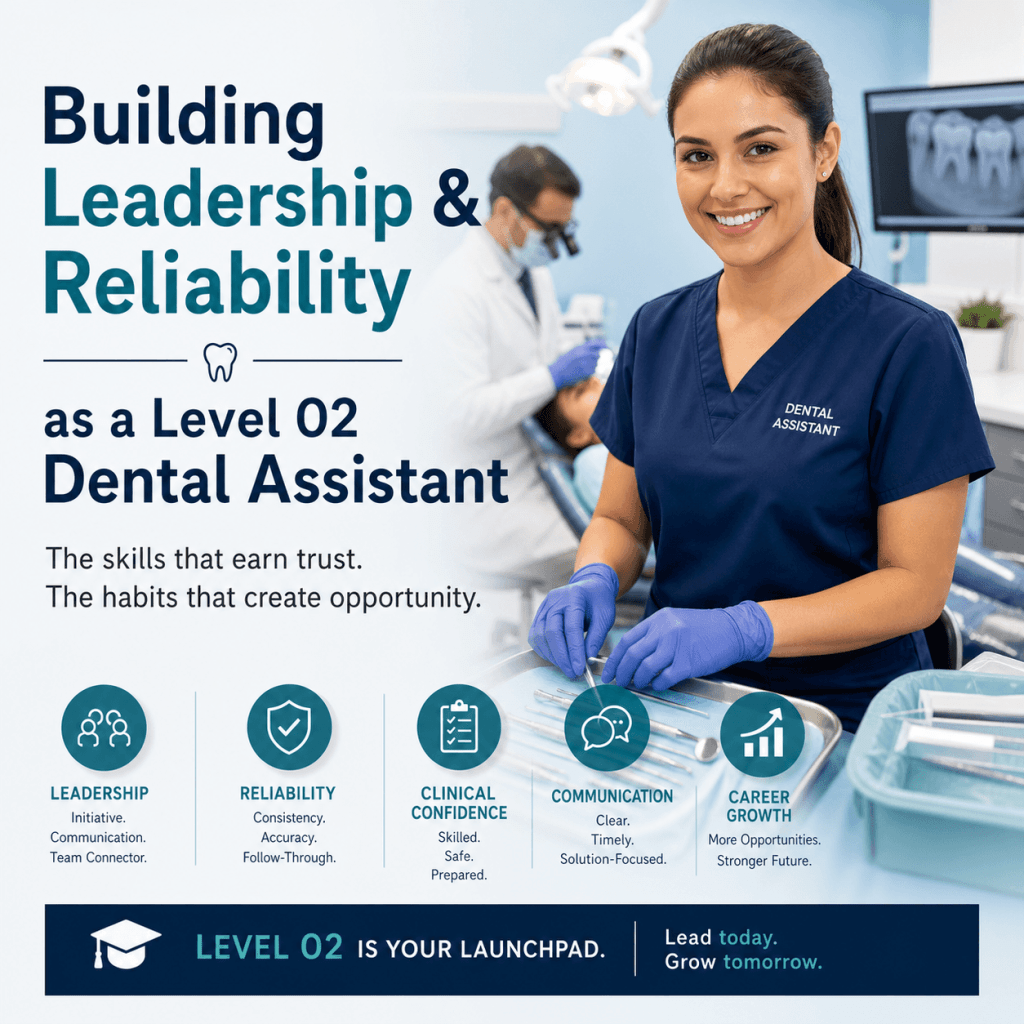
You are no longer just supporting basic chairside tasks. You are stepping into expanded functions such as oral surgery, orthodontics, endodontics, and periodontics. With these advanced duties comes higher expectations, and a level of trust that directly affects patient safety, schedule flow, and the doctor’s ability to stay on time.
That is why leadership and reliability become career-defining at Level 02.
Modern dental practices want team members who are thoroughly trained, legally compliant, and clinically confident, especially when advanced duties are part of the day. When hiring managers say they want a “strong assistant,” they often mean someone who can be counted on without constant reminders, who protects standards under pressure, and who makes the operatory run predictably.
Leadership does not require a title. In dentistry, it often looks like calm initiative, clear communication, protecting patient safety, and supporting the doctor and team before small issues become big problems.
Reliability also means more than showing up. It means consistency, accuracy, follow-through, and being the person the team trusts when it is busy.
And the bigger picture matters, too. The dental industry is one of the fastest-growing healthcare industries, with stable income potential, flexible schedules, and real career mobility. According to a report from the World Economic Forum on the future of jobs in 2025, building leadership and reliability early in your career can lead to faster progression into better roles, improved shifts, and expanded opportunities.
Why leadership and reliability matter for a Level 02 dental assistant
Level 02 responsibilities come with expanded functions, faster operatory pace, and higher clinical trust. That is exactly where leadership and reliability stand out, because your actions influence:
- Procedure efficiency (how smoothly the appointment runs)
- Patient experience (comfort, confidence, and clarity)
- Compliance and risk (infection control, documentation, and scope)
- Team stability (fewer fires, fewer surprises, fewer delays)
If you want to be the assistant practices invest in, promote, and protect, these two traits are the foundation.
To become a Level 02 dental assistant, it’s essential to understand what leadership and reliability entail in this role.
What leadership looks like in a dental operatory (even when you’re not “the lead”)
Leadership in a dental operatory is practical. It is not about being the loudest person in the room. It is about reducing friction and protecting outcomes.
Clinical leadership
Clinical leadership shows up in the small, unglamorous moments:
- Anticipating next steps during procedures
- Keeping asepsis tight, even when the schedule slips
- Having instruments and materials ready before the doctor asks
- Making clean, consistent handoffs during suctioning, retraction, curing, and passing
A Level 02 assistant who leads clinically makes the doctor feel supported and makes the patient feel safe.
Patient-centered leadership
Patients often judge the entire appointment by how they felt in the first five minutes. Leadership here can look like:
- Noticing anxiety and responding calmly
- Explaining what happens next within your scope
- Checking comfort and advocating for breaks, bite adjustments, or suction positioning
- Protecting dignity and privacy during vulnerable moments
The importance of these leadership qualities cannot be overstated when you’re working towards achieving your Level 02 certification. Such certifications equip you with necessary skills and knowledge that enhance your reliability as a dental assistant.
Moreover, understanding the specific dynamics of different dental practices can further bolster your effectiveness. This knowledge can be gained through practical exposure in various dental locations, each offering unique experiences that contribute to your professional growth.
Team leadership
Practices run on coordination. A strong Level 02 assistant often becomes the “connector” between the front office, hygienists, assistants, and doctor.
This leadership prevents schedule-killers like:
- A procedure change that was not communicated up front
- A missing lab case
- A radiograph need discovered too late
- A medical alert that should have been flagged earlier
Situational leadership examples
Leadership is often situational, such as when you:
- Step in and stabilize flow during a late patient
- Help a new team member learn room turnover standards
- Catch a charting discrepancy before it creates confusion or liability
- Flag a supply gap before it hits the next patient
The mindset shift: from “task-doer” to “practice protector”
At Level 02, the mindset shift is simple but powerful.
You are not just completing tasks. You are helping the practice run predictably and safely.
Reliability isn’t just “showing up”: the 5 pillars practices notice immediately
Reliability is visible. Teams feel it within the first week.
Pillar 1: Punctuality and readiness
Being on time is not the standard. Being ready is the standard.
Reliability looks like arriving early enough to:
- Review the schedule and note long procedures
- Confirm room turnover needs
- Prepare your setup before the patient is seated
Pillar 2: Accuracy and consistency
Trust grows when your performance is repeatable.
That includes:
- Correct tray setups
- Correct materials and expiration awareness
- Correct documentation and labeling
- Consistent imaging readiness when radiographs are needed
A practice can work with many personality types. It cannot work with unpredictable clinical execution.
Pillar 3: Legal compliance and scope awareness
Level 02 assistants, such as those in the dental assisting field, must be especially careful about scope.
Reliability means:
- Doing what you are trained and allowed to do
- Asking before acting when you are unsure
- Documenting appropriately and escalating when needed
Practices value assistants who protect the license, the patient, and the standard of care.
Pillar 4: Sterilization and infection control discipline
Infection control is where reliable professionals refuse to cut corners, especially under time pressure.
Consistency in sterilization and barrier protocols protects:
- Patients
- The team
- The practice’s reputation
- Compliance expectations
Pillar 5: Follow-through under stress
Busy days do not create unreliability. They reveal it.
Follow-through includes closing loops on:
- Call-backs and post-op notes (as assigned)
- Lab cases and due dates
- Supply notes and reorder triggers
- Re-care scheduling flags and next-visit needs
- End-of-day operatory reset so tomorrow starts clean
Habits that build trust fast in a high-performance dental practice
If you want trust quickly, focus on habits that reduce the team’s mental load.
Own the schedule, not just your chair
Scan the day for:
- Long procedures and turnaround time
- Anesthesia timing and when the doctor will be tied up
- Lab returns and seat appointments
- Room needs if multiple ops are running
When you see conflicts early, you can prevent bottlenecks instead of reacting to them.
Use checklists that don’t slow you down
Checklists do not mean you are inexperienced. They mean you are consistent.
Three that work well in real practices:
- Room turnover checklist
- Sterile setup checklist
- End-of-day checklist
Confirm details before the patient is seated
This single habit prevents mistakes.
Confirm:
- Procedure type and provider preference
- Required materials and shades
- Radiographs needed
- Allergies and medical alerts
Be quietly proactive
Proactive assistants prevent downtime and protect flow:
- Restock before it is empty
- Flag a dull instrument before it affects a procedure
- Replace barriers correctly and consistently
- Prep the next room when you have a window
Communicate early, not late
If something will delay the doctor, say it early and attach a solution.
Example: “The lab case isn’t here yet. I’m calling now, and I can seat the patient, update medical history, and take the needed radiograph while we confirm delivery.”
Communication skills that signal leadership (and prevent mistakes)
Communication is a safety tool in dentistry. The best assistants communicate clearly without creating drama.
Chairside communication with the dentist
Aim for concise, timed updates:
- Confirm preferences for setup and sequence
- Repeat critical details when needed (tooth number, material, shade, time)
- Speak in a calm tone that does not alarm the patient
Patient communication
Patients do not need jargon. They need clarity and calm.
Strong chairside communication includes:
- Simple language
- A steady tone
- Clear next steps
- Reassurance without overpromising
Front office coordination
Your notes and messages significantly influence scheduling and treatment acceptance.
Communicate:
- Procedure changes during the visit
- Next-visit needs (time, materials, planned imaging)
- Insurance-sensitive notes when applicable, with clarity and accuracy
Hand-off communication (SBAR adapted for dentistry)
A quick structure reduces confusion:
- Situation: What is happening right now?
- Background: Relevant context (medical alert, late start, change in procedure)
- Assessment: What you see (missing item, pain concern, occlusion issue)
- Recommendation: What you suggest next (confirm with doctor, reschedule, call lab)
Conflict-proofing
Leadership is also about how you ask questions and correct potential mistakes.
- Ask without sounding defensive: “Just to confirm, are we restoring #19 today or #30? The note shows both.”
- Correct respectfully and quickly: “Before we seat, I want to verify the allergy note. It lists latex sensitivity.”
Clinical confidence: the bridge between advanced training and real leadership
Clinical confidence is not ego. It is controlled competence.
Confident assistants:
- Reduce procedure time
- Improve patient comfort
- Lower stress across the team
- Help the doctor stay focused
How to build confidence safely
Confidence grows through:
- Repetition
- Supervision
- Feedback
- Staying within training and legal scope
“Confidence moments” for Level 02 assistants
Depending on what your training and state allow, confidence often shows up in:
- Setting up complex procedures with correct sequencing
- Radiography readiness and efficient imaging flow
- Impression and material handling with consistent results
- Supporting expanded functions duties as permitted and trained
For further insights into frequently asked questions that can enhance your understanding of these processes, it’s also beneficial to explore more about the role of clinical confidence in dentistry which can provide valuable perspective on bridging advanced training with real leadership.
Confidence vs. rushing
Rushing is fast and sloppy. Confidence is controlled and accurate.
A reliable Level 02 assistant moves with pace, but never sacrifices infection control, documentation, or patient comfort to “catch up.”
Critical thinking that looks like leadership
Critical thinking shows up when you notice patterns and suggest improvements, such as:
- Frequent remakes or impression re-dos
- Supply gaps that repeat every week
- Bottlenecks during room turnover
- Steps in procedures that can be standardized safely
Accountability systems: how reliable Level 02 assistants manage details without overwhelm
Reliable assistants do not “remember everything.” They build systems that make follow-through automatic.
Build a simple loop-closing system
Use one place to capture tasks, and one process to verify completion, especially for:
- Lab cases (sent date, due date, tracking, arrival confirmation)
- Patient follow-ups (post-op check, sensitivity, adjustments)
- Referrals and next steps assigned by the doctor
Documentation habits
Strong documentation is part of reliability:
- Accurate notes that help the next person
- Clarity on materials, shades, tooth numbers, and outcomes
- Timestamps when relevant to workflow and care
Supply reliability
Supplies affect patient care directly.
A reliable approach includes:
- Par levels
- Reorder triggers
- Communicating shortages before they impact appointments
Mistake management
Leaders do not hide mistakes.
They respond by:
- Owning it quickly
- Reporting it to the right person
- Fixing what is fixable
- Preventing repeat issues with a process change, often through partnership in a just culture
Consistency across rooms and providers
Many practices have multiple doctors and preferences.
Leadership is adapting to provider preferences while maintaining universal standards for:
- Infection control
- Documentation
- Patient safety checks
- Quality of setup and turnover
Professionalism that sets you apart: ethics, discretion, and patient-first decisions
Professionalism is not a “soft skill” in healthcare. It is clinical leadership.
Ethical behavior as leadership
Ethics show up when you:
- Protect patient privacy
- Respect boundaries
- Keep communication professional and appropriate
Discretion and trust
Patients share sensitive information, and practices handle sensitive operations.
Reliable professionals do not gossip, speculate, or share internal issues in public spaces.
Patient-first decisions
Patient-first assistants:
- Offer comfort measures and explain what they are doing
- Double-check safety steps and medical alerts
- Speak up when something seems off, even if it is inconvenient
Growth attitude
Practices invest more in assistants who:
- Ask for feedback
- Accept coaching
- Improve without ego
Professionalism supports career mobility and a respected position in healthcare because it signals maturity and trustworthiness.
How Level 02 leadership creates real career momentum (and better opportunities)
Leadership and reliability create outcomes that hiring managers care about:
- More responsibility and expanded functions opportunities
- Better shifts and more stable scheduling
- Stronger references and long-term mentorship
- Eligibility for roles that require consistent clinical performance
Demand for skilled dental professionals continues to rise, and practices value predictable, well-trained team members who perform confidently and legally.
What hiring managers notice most is simple:
- Consistency
- Calm under pressure
- Initiative
- Compliance-minded performance
Level 02 should be viewed as a launchpad, not a finish line.
Patient safety checks are also a critical aspect of maintaining professionalism and consistency across different providers in a healthcare setting.
Training that builds leadership and reliability (not just test-passing)
The strongest assistants are not just trained to pass tests. They are trained to perform.
Broward Dental Academy is built around career preparation for modern, high-performance dental practices, with training that supports becoming thoroughly trained, legally compliant, and clinically confident.
Students receive a complex educational experience through immediate immersion in online and clinical settings, with the latest eLearning lesson plans incorporated for remote training. Training also includes in-office internships that build real-world pacing, communication habits, and hands-on confidence.
Broward Dental Academy offers 07 courses and flexible financing to make training accessible, while keeping the focus on developing well-rounded professionals who think critically, act ethically, and perform confidently.
Putting it into practice: a simple 30-day plan to become the assistant everyone trusts
You do not need a new job title to change your reputation. You need a plan.
Week 1: Reliability foundations
- Be early enough to set up, not just clock in
- Standardize setup consistency
- Follow an infection control checklist every time
- Build an end-of-day reset routine
Week 2: Communication upgrades
- Start each day with a quick schedule scan or huddle
- Use clear handoffs between rooms and teammates
- Build a confirm-critical-details habit before seating
Week 3: Clinical confidence reps
- Practice core setups and common procedure flows
- Improve materials handling through repetition
- Request targeted feedback from the doctor or lead assistant
Week 4: Leadership behaviors
- Anticipate bottlenecks and prevent them early
- Propose one workflow improvement (simple and realistic)
- Mentor or assist a teammate without being asked
- Track loop-closures for lab cases and follow-ups
How to measure progress
You will see results when you notice:
- Fewer remakes or re-dos
- Smoother room turnovers
- Fewer “where is ___?” moments
- Better patient comfort feedback and calmer appointments
Conclusion: become the Level 02 assistant practices don’t want to lose
Leadership and reliability are what make a Level 02 dental assistant indispensable.
If you focus on consistency, legal compliance, strong communication, and calm initiative, you will stand out in a fast-growing industry that offers stable income potential, flexible schedules, and real career mobility.
The right advanced training, plus real clinical immersion, builds the confidence to lead without guessing. This could be achieved through programs like the Advanced Dental Assistant Training – Level 02 offered by institutions such as Broward Dental Academy, which also provide options for further advancement into roles like Dental Hygienists – Level 03 or foundational courses like Dental Assistant – Level 01.
Don’t delay, enroll today – you will be glad that you did!
FAQs (Frequently Asked Questions)
What expanded functions does a Level 02 dental assistant perform beyond basic chairside tasks?
A Level 02 dental assistant performs expanded functions including oral surgery, orthodontics, endodontics, and periodontics. These advanced duties require higher clinical trust and directly impact patient safety and procedure efficiency.
Why are leadership and reliability crucial traits for a Level 02 dental assistant?
Leadership and reliability are essential because they influence procedure efficiency, patient experience, compliance with legal standards, and team stability. A Level 02 assistant who demonstrates these traits helps the practice run smoothly, safely, and predictably under pressure.
How does clinical leadership manifest in a dental operatory for a Level 02 assistant?
Clinical leadership involves anticipating next steps during procedures, maintaining strict asepsis even when the schedule is tight, preparing instruments before the doctor requests them, and executing clean handoffs during suctioning, retraction, curing, and passing. This support enhances both doctor confidence and patient safety.
What does patient-centered leadership look like for a Level 02 dental assistant?
Patient-centered leadership includes recognizing patient anxiety and responding calmly, explaining upcoming steps within scope, checking patient comfort by advocating for breaks or adjustments, and protecting patient dignity and privacy during vulnerable moments to improve overall patient experience.
In what ways can a Level 02 dental assistant demonstrate team leadership within a dental practice?
A Level 02 assistant often acts as the connector between front office staff, hygienists, other assistants, and the doctor. They prevent scheduling issues by communicating procedure changes upfront, ensuring lab cases are accounted for, identifying radiograph needs early, and flagging medical alerts promptly to maintain smooth practice operations.
What are the five pillars of reliability that practices notice immediately in a Level 02 dental assistant?
The five pillars include punctuality and readiness (arriving early to prepare), accuracy and consistency (correct tray setups and repeatable performance), follow-through on tasks without reminders, maintaining compliance with infection control and documentation standards, and being trusted by the team to manage busy periods effectively.