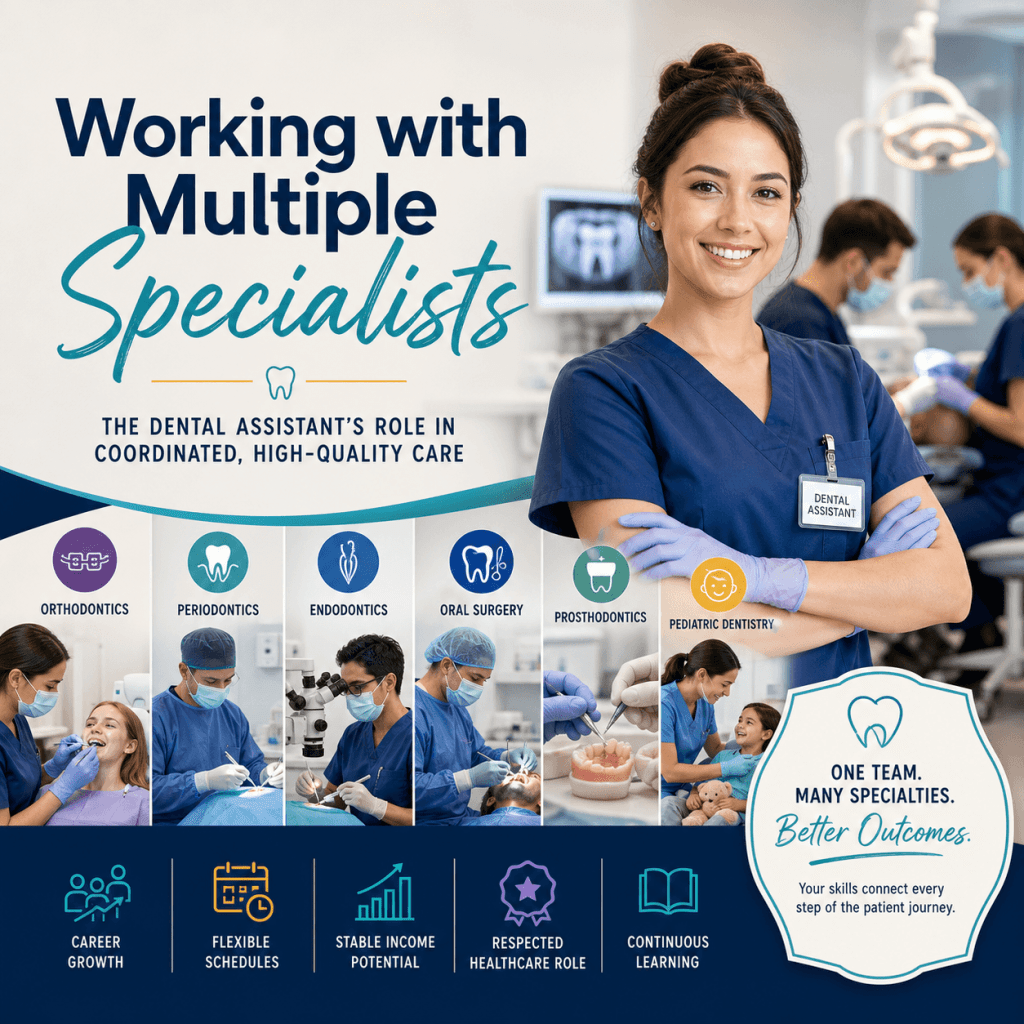
It is now common to support more than one provider in a single shift, or to coordinate information between offices when a patient moves from general care to ortho, perio, prosth, or pediatrics. The upside is real. Multi-specialty workflows create strong demand for assistants who are trained, compliant, and confident. That often translates into more stability, flexible schedules, better career mobility, opportunities to grow into expanded functions (where permitted), and a respected role in healthcare that keeps gaining value as the dental industry grows.
Why working with multiple specialists is a big deal in today’s dental offices
When a practice offers specialty services in-house, patients can move through treatment faster and with fewer gaps in care. When specialties are handled through referrals, the expectation is still the same: the patient experience should feel connected and organized. As a dental assistant, you are often the person who makes that continuity possible by:
- Preparing rooms and materials for different procedures across the day
- Keeping documentation clear so providers can step in confidently
- Reinforcing instructions so patients understand what happens next
- Coordinating records, images, and referral notes when care spans offices
This is also a career reality check: many employers are not just hiring “a chairside assistant.” They are hiring someone who can switch between clinical styles without cutting corners, follow protocols, and communicate clearly in a multi-provider environment.
The ability to adapt to various specialties such as [oral surgery or endodontics is becoming increasingly important. Furthermore, with the right training and skills acquired through specialized courses offered by institutions like Broward Dental Academy, dental assistants can significantly enhance their career prospects and contribute more effectively to patient care.
Moreover, as highlighted in research on improving operational efficiency in multi-specialty dental clinics, these skills also play a crucial role in streamlining processes within such practices.
Meet the specialists you’ll most often work with (and what changes in your role)
Most multi-specialty offices rely on a core group of specialists. Your responsibilities will vary by state regulations and office protocols, so legal compliance and proper training always come first. With that said, here is what typically changes by specialty.
Orthodontist
Ortho appointments are often high-volume and rhythm-based. Your role may include:
- Setting up for brackets, bands, bonding, and debonding
- Taking impressions or supporting intraoral scans (as allowed)
- Assisting with ligatures, chains, and adjustment visits
- Patient education on hygiene, elastics, foods to avoid, and discomfort management
- Knowing the specialist’s instrument setup preferences, which can differ greatly from general dentistry
Periodontist
In the periodontics specialty, you will feel the difference between “routine” and “surgical.” Your role may include:
- Supporting periodontal charting and documentation accuracy
- Setting up surgical trays and maintaining a clean, organized field
- Supporting soft tissue grafting, osseous procedures, laser appointments, and suture removal visits
- Reinforcing post-op instructions and red flags based on the provider’s guidance
- Staying alert to medical history risks that affect healing and bleeding
Prosthodontist
Prosth workflows are detail-heavy, lab-driven, and very dependent on precision. Your role may include:
- Supporting crown and bridge steps, full-arch cases, and complex bite records
- Helping with shade selection support and photo documentation
- Communicating precisely with the lab, including timelines and material details
- Tracking cases so nothing gets delayed or delivered without the right records
Pediatric dentist
Peds moves fast and depends on communication and behavior guidance as much as clinical skill. Your role may include:
- Supporting behavior guidance and keeping appointments calm and efficient
- Faster room turnover and tight organization for preventive services
- Helping communicate with parents or caregivers clearly and respectfully
- Reinforcing prevention, home care, and follow-up needs
The dental assistant’s “specialty switch” skillset: what stays the same vs. what changes
When you move between providers, it helps to separate what is non-negotiable from what is preference-based.
What stays the same
No matter the specialty, the foundation is consistent:
- Infection control and patient safety
- HIPAA and privacy
- Documentation basics and accurate charting
- Radiography fundamentals and image quality principles
- Professionalism, empathy, and clear communication
What changes
Specialty-specific differences typically show up in:
- Tray setups and instrument selection
- Materials and mixing/handling preferences
- Appointment pacing and room turnover expectations
- Anesthesia or sedation-related protocols (where used and permitted)
- Post-op instructions and follow-up timelines
- Instrument naming conventions and “favorite tools” by provider
The core competency here is adaptability without shortcuts. Speed matters, but not at the expense of compliance or patient safety. Critical thinking becomes essential when one specialist’s protocol differs from the last provider you assisted.
Communication that prevents mistakes when multiple providers are involved
When more than one provider touches a case, communication becomes a safety tool.
Clean handoffs
A strong handoff is short, structured, and useful. Aim to cover:
- Chief concern and why the patient is here today
- Where they are in treatment (phase, stage, or sequence)
- What was completed today and any complications or patient concerns
- What happens next and what the provider should confirm
Closed-loop communication
Closed-loop communication helps prevent errors. If a provider gives a medication order, a lab instruction, or an implant/ortho detail, repeat it back to confirm accuracy. This is especially important when the room is busy or the schedule is tight.
Charting clarity
Multi-provider charts need consistency:
- Use office-approved abbreviations
- Time stamp important events when required
- Document specialist-specific notes clearly so the next clinician is not guessing
Patient communication without contradictions
Patients will ask you everything, especially when they are nervous. Your job is to explain next steps in plain language, reinforce what the provider said, and escalate questions that require clinical judgment. Never contradict the provider in the operatory. If something seems off, step out and clarify.
Coordination across offices
If care spans locations, good coordination includes:
- Requesting referral notes and treatment plans promptly
- Confirming images and scans are properly routed and labeled
- Tracking what has been received and what is still missing before the next visit
For patients seeking answers to common queries related to their dental care or understanding procedures better, resources like frequently asked questions can be beneficial. Moreover, for those who need to navigate through multiple locations for their treatments, it’s essential to ensure proper coordination across offices to streamline the process.
It’s also worth noting that effective communication plays a crucial role in preventing medical errors when multiple providers are involved in a patient’s care. According to research from NCBI, clear and structured communication can significantly reduce the risk of mistakes during handoffs between providers. Furthermore, studies published in JAMA Network highlight that implementing closed-loop communication strategies can further enhance patient safety by ensuring that critical information is accurately conveyed and understood among healthcare providers.
Scheduling, operatory flow, and room turnover in a multi-specialty environment
Specialty schedules can feel very different from general dentistry. Procedures may be longer, set-ups may be more involved, and documentation requirements can increase. Supply needs also tend to be higher, especially for surgical and prosthetic cases.
Block scheduling basics
If the office allows it, grouping similar procedures can reduce constant setup changes. For example, clustering ortho adjustments or grouping surgical follow-ups can make the day smoother and reduce missed steps.
Turnover checklists
A consistent turnover checklist protects patients and your time. It helps you avoid:
- Missed sterilization steps
- Missing disposables or instruments in the next setup
- Incomplete surface disinfection or incorrect barrier placement
Managing interruptions professionally
Multi-specialty days come with consults, emergencies, and add-on patients. The goal is to stay calm and prioritize:
- Patient safety
- Provider readiness and time-sensitive steps
- Clear communication to the front desk
When delays happen, notify the front desk early with a realistic update so patients are not left guessing.
Instruments, materials, and equipment: staying ready for different specialties
Being “ready” is not luck. It is a system.
Create specialty-specific setup templates
Templates save time and reduce stress. Build a standard for each specialty that includes:
- Tray lists and cassette contents
- Specialty burs, sutures, hemostats, and impression or scan kits
- Rubber dam armamentarium when used
- A short note about common variations for that provider
Labeling and organization strategies
Multi-specialty operatories run best with visual structure:
- Color-coding for drawers or tubs
- Drawer maps so anyone can restock correctly
- Par levels for high-use items so you do not run out mid-procedure
Digital tools and routing images correctly
Many offices rely on intraoral scanners, digital radiography, and sometimes CBCT. The key is not just capturing the image, but routing it correctly:
- Confirm the correct patient and provider
- Label series clearly in the software
- Ensure scans, photos, and radiographs are accessible to the right clinician and location
Lab cases and deadlines
Prosth cases often rise or fall based on lab communication. Support accuracy by:
- Writing precise lab slips with clear instructions
- Capturing shade photos when the office uses them
- Including bite registrations and verifying they are complete
- Tracking deadlines so cases do not delay seating appointments
Patient experience across specialties: how assistants keep care consistent
Patients do not separate care into “specialties” the way clinicians do. They experience one treatment journey. Dental assistants help that journey feel steady and understandable.
Build trust quickly
Simple habits matter:
- Introduce yourself and your role
- Confirm what the patient is here for today
- Ask about comfort needs and anxiety triggers early
Anxiety management basics
Within office protocol, help patients feel in control by explaining:
- What they may hear, feel, or smell
- When they can request a break
- What suction is doing and why it helps
- What “normal” post-procedure sensations can look like
Post-op clarity
Patients forget details when they are nervous. Reinforce instructions, verify understanding, and review the red flags the provider wants patients to watch for. If the patient is unsure, escalate and clarify before they leave.
Continuity across the treatment plan
Whenever appropriate, help connect the dots: how today’s specialist visit supports the overall plan and what to expect next. This reduces no-shows and builds trust.
Safety, compliance, and risk management when assisting different specialists
Multi-specialty assisting increases exposure to different procedure types, which means safety and compliance cannot be casual.
Infection control and surgical asepsis
Know when an appointment requires a sterile field versus standard precautions. Follow office protocol for:
- Surgical packs and sterile instruments
- Proper instrument transport and handling
- Correct donning and doffing steps
Radiation safety and image quality
Consistent positioning reduces retakes and protects patients. Follow office policy for documenting exposures and keep image labeling clean so the right provider sees the right series.
Medical history updates that matter
Specialty procedures often amplify medical risk. Be proactive about flagging conditions like:
- Anticoagulant use and bleeding risk
- Diabetes and healing concerns
- Pregnancy considerations
- Cardiac conditions and premedication status (per provider direction)
Remember, anxiety management during medical procedures is essential for patient comfort and compliance.
Emergency readiness
Every assistant should know where emergency supplies and protocols are. Syncope, allergic reactions, and post-op bleeding can happen quickly. In multi-specialty practices, preparation is not optional.
Staying within legal scope
If you are asked to perform something you are not authorized or trained to do, pause and speak up. Protecting the patient also protects your license, your role, and the practice.
How to build confidence fast: a practical learning plan for dental assistants
Confidence comes from repeated, structured reps, not guessing your way through a new specialty.
- Start with observation. Learn each specialist’s “standard appointment” from start to finish.
- Keep a preferences log. If allowed, note setup steps, tray lists, common materials, and what the provider hates or refuses to use.
- Master the language. Specialty terms help you anticipate the next step and respond faster.
- Ask for feedback. A quick end-of-day debrief can fix small issues before they become habits.
- Invest in advanced training. It reduces on-the-job stress and prepares you to perform confidently in real-world offices.
Career advantage: why multi-specialty experience opens doors (pay, roles, mobility)
Versatility makes you valuable. Practices that run at a high level want assistants who can support different providers without losing quality or composure.
Multi-specialty experience can also support:
- More stable income over time
- Flexible schedules depending on the practice model
- Upward mobility into lead roles
- Opportunities to pursue expanded functions where permitted
Common next steps include lead assistant, specialty-focused assistant (ortho, surgical, prosth), office trainer, or clinical coordinator. The most consistent differentiator is professionalism: being reliable across specialties builds a reputation that follows you.
Where advanced training fits in: preparing to thrive in a modern, multi-specialty practice
Many assistants can “get by” in a fast office. However, modern practices are increasingly looking for professionals who are thoroughly trained, legally compliant, and clinically confident.
This is where the Broward Dental Academy comes into play. The goal of the academy is not just to help students pass an exam, but to prepare them to thrive in a modern, high-performance dental practice. This is achieved by training students to think critically, act ethically, and perform confidently.
Students learn through immediate immersion in online and clinical settings, supported by updated eLearning lesson plans and in-office internships for real-world exposure. There are multiple course options (including Advanced Dental Assistant Training – Level 02, Dental Assistant Hygienists Level 03, Dental Assistant Level 02, and Dental Assistant Level 01) and flexible financing to support different goals and schedules.
Putting it all together: what to focus on in your next 30 days
If you are currently working in a multi-specialty environment, make the next month simple and measurable.
- Choose 2 to 3 specialties you see most often and standardize your setups and documentation habits.
- Improve one communication skill such as cleaner handoffs, repeat-back for orders, or clearer chart notes.
- Tighten one systems skill such as restocking par levels, building tray templates, or using a more consistent turnover checklist.
Multi-specialty assisting is one of the fastest ways to grow your clinical confidence and long-term career value, especially when you pair experience with the right training.
Don’t delay. Explore the training options at Broward Dental Academy today – you will be glad that you did!
FAQs (Frequently Asked Questions)
How have modern dental offices changed in terms of specialty care and dental assistant roles?
Modern dental offices often combine general dentistry with specialty care under one roof or maintain tight referral relationships to ensure coordinated treatment from start to finish. For dental assistants, this shift changes the pace of the day, requires a broader skill set, and increases responsibility as they may support multiple providers in a single shift and coordinate information across specialties like orthodontics, periodontics, prosthodontics, and pediatrics.
Why is working with multiple dental specialists important in today’s dental practices?
Working with multiple specialists in-house or through referrals allows patients to move through treatment faster and experience seamless, organized care. Dental assistants play a crucial role by preparing rooms for various procedures, maintaining clear documentation, reinforcing patient instructions, and coordinating records between offices, ensuring continuity and quality of care across specialties.
What are the typical responsibilities of a dental assistant when supporting an orthodontist?
When working with an orthodontist, dental assistants often set up for procedures involving brackets, bands, bonding, and debonding; take impressions or support intraoral scans (where permitted); assist with ligatures, chains, and adjustment visits; provide patient education on hygiene and appliance care; and adapt to the specialist’s unique instrument setup preferences.
How does assisting a periodontist differ from other specialties for dental assistants?
Assisting a periodontist involves handling both routine and surgical procedures. Dental assistants support periodontal charting and documentation accuracy; prepare surgical trays; assist with soft tissue grafting, osseous procedures, laser treatments, and suture removal; reinforce post-operative instructions; and remain vigilant about medical history factors that affect healing and bleeding.
What skills remain consistent for dental assistants when switching between different specialties?
Regardless of specialty, foundational skills such as infection control, patient safety protocols, HIPAA compliance and privacy standards, accurate documentation and charting practices, radiography fundamentals including image quality principles, professionalism, empathy, and clear communication remain constant for dental assistants.
How can specialized training enhance a dental assistant’s career in multi-specialty practices?
Specialized training through courses offered by institutions like Broward Dental Academy equips dental assistants with the skills to adapt to various clinical styles without cutting corners. This training improves compliance with protocols in multi-provider environments, enhances their ability to contribute effectively to patient care across specialties such as oral surgery or endodontics, increases career mobility opportunities including expanded functions where permitted, and supports operational efficiency within multi-specialty clinics.