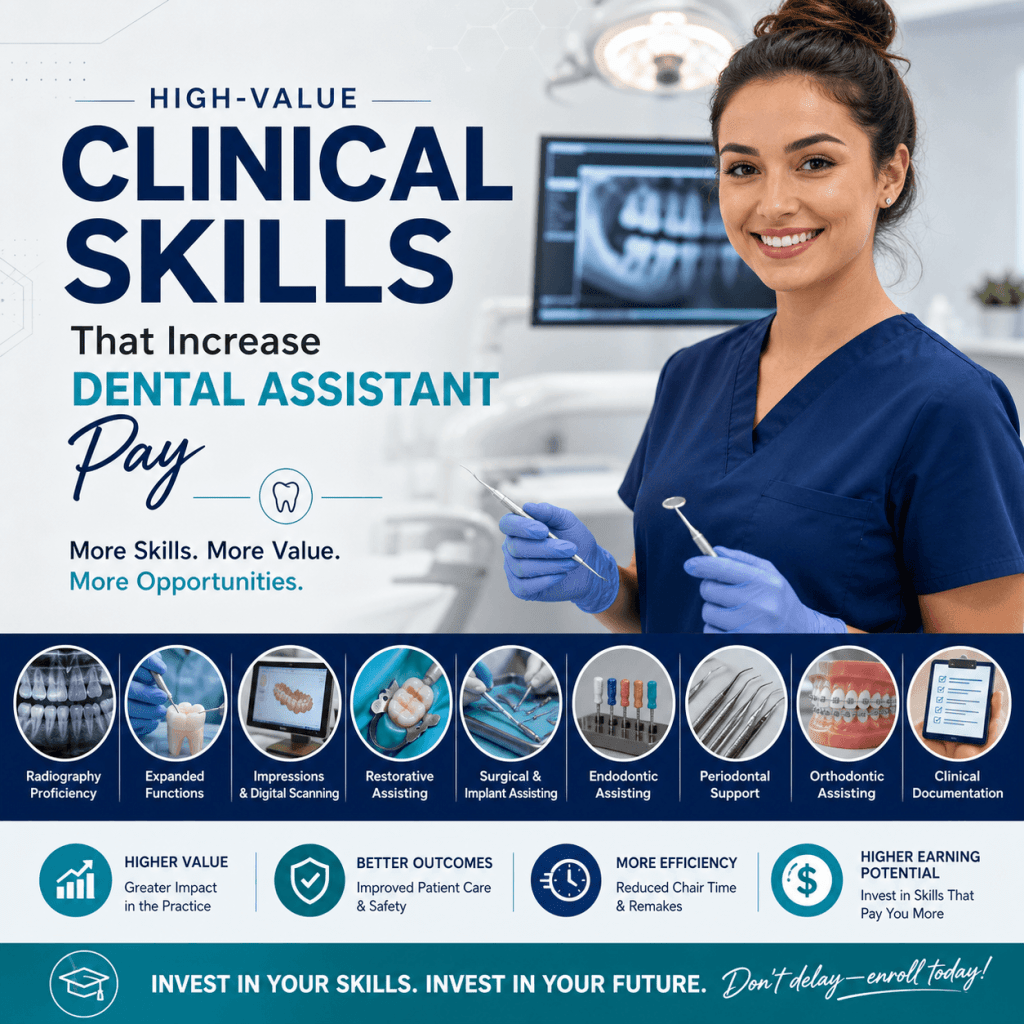
Below are the clinical skills that most often increase earning power, plus a practical plan to build them the right way.
Why some dental assistants get paid more (even in the same city)
Most dental practices pay more for assistants who reduce stress and increase production without sacrificing quality. The real drivers usually look like this:
- Speed plus accuracy: Quick turnover means nothing if there are remakes, retakes, or errors. High earners are efficient and precise.
- Better patient experience: Calm, organized chairside support reduces anxiety, increases trust, and improves case acceptance.
- Reduced chair time: When the dentist or hygienist is not waiting on instruments, materials, or imaging, the schedule stays on track.
- Ability to take on expanded functions (where legal): When an assistant can legally perform more clinical duties such as orthodontics, endodontics, or periodontics, the provider can focus on doctor-only tasks.
- Compliance and safety: Offices pay more for assistants who protect the practice from avoidable risk through strong infection control, documentation, and scope-of-practice awareness.
In a modern practice, pay increases typically connect to outcomes a manager can see and measure: smoother turnover, fewer remakes, more predictable procedures, cleaner handoffs, stronger case acceptance, and fewer disruptions during high-production blocks.
A quick reality check: pay varies by state scope-of-practice, certifications (which can significantly enhance earning potential – see here), practice type (general vs specialty), and your willingness to keep learning. In this article, “high-value clinical skills” means hard clinical skills that directly improve workflow and outcomes. For instance, pursuing additional training through various courses offered could be beneficial in this regard.
The baseline: dental assistant basic knowledge you need before leveling up
Before advanced skills make sense, most practices expect strong fundamentals from day one:
- Infection control and sterilization flow
- Chairside assisting fundamentals (four-handed dentistry, transfer zones, retraction, evacuation)
- Dental materials basics (mixing, working times, setting times, storage, contamination prevention)
- Radiography basics (where permitted), plus patient positioning and safety principles
- Clinical documentation and charting
- Instrument identification and tray setup
- Patient communication (comfort cues, explanations, post-op reinforcement)
Strong “practical dental assisting” fundamentals make advanced skills easier and safer. If isolation is inconsistent, impressions are harder. If instrument setup is sloppy, surgical assisting is stressful. If infection control is weak, everything is a liability.
Just as important is legal compliance. Every state defines what a dental assistant can do, under what level of supervision, and what training is required. Practices want assistants who are thoroughly trained, legally compliant, and confident enough to contribute without putting the office at risk.
Once the basics are solid, these are the clinical skills that most often raise earning power.
High-value clinical skills that increase dental assistant pay (and why they matter)
For each skill below, think in a simple structure:
- What it is
- How it helps the practice
- Where it is used
- How people typically train for it (depending on state rules)
A common theme across all higher-paying clinical skills is patient safety, quality, and confidence. Always verify your state dental board requirements before performing any expanded function.
For those looking for answers to their questions about dental assistant training or specific regulations in their state, resources like Broward Dental Academy’s FAQ page can be incredibly helpful.
1) Dental radiography proficiency (faster, cleaner, diagnostic-quality images)
What it includes:
Consistently producing diagnostic-quality images with minimal retakes. This involves accurate positioning, good sensor handling, infection control with imaging equipment, and recognizing common errors such as cone cuts, overlap, elongation, and foreshortening.
How it increases your value:
Radiography is one of the fastest ways to save provider time. When images are clean the first time, the dentist can diagnose quickly and move toward treatment. Fewer retakes also reduce patient frustration and keeps appointments on schedule.
Where it shows up:
- New patient exams
- Emergency visits
- Endo and perio assessments
- Post-op and surgical follow-ups
Compliance and safety:
Radiation safety principles, proper documentation, and consistent protocols matter. Offices notice assistants who follow standards without reminders.
Resume angle (measurable):
“Captured diagnostic-quality FMX/BWX with minimal retakes; consistent positioning and infection control compliance.”
2) Expanded Functions Dental Assistant (EFDA) or expanded functions support
What it is:
Expanded functions vary by state, but may include assisting with restorative steps and procedures such as placing or removing temporary restorations, sealants, retraction cord assistance, or other delegated intraoral tasks.
Why practices pay more:
Expanded functions often translate into higher provider productivity. When legally delegated tasks are done confidently and correctly, restorative days run smoother with fewer bottlenecks. That improved flow can raise production without adding hours.
Scope boundaries matter:
This is not “learning to do the dentist’s job.” It is learning exactly what is legally delegated, how it must be supervised, and how to perform it safely and predictably. Offices pay more when they trust your training and compliance.
Confidence piece:
High-value expanded function assistants can anticipate materials, instruments, isolation needs, and timing. They reduce the provider’s mental load.
Documentation tip:
Track competencies, checkoffs, and supervised clinical hours when applicable. It strengthens your credibility during interviews and reviews.
3) Impression-taking and digital scanning (accuracy that prevents remakes)
What it includes (traditional impressions):
- Tray selection and fit
- Material prep and timing
- Patient management and gag reflex control
- Bite registrations
- Disinfection, labeling, and packaging
What it includes (digital scanning):
- Scanner handling and scan strategies
- Capturing margins and anatomy clearly
- Managing saliva and soft tissue
- Recognizing missing data before submission
How it increases pay potential:
Impressions and scans directly impact remakes, lab delays, and crown seat stress. Assistants who consistently deliver accurate records save the office time and money while improving the patient experience. In practices with same-day dentistry or aligner volume, scanning skill becomes a clear production driver.
Where used:
Crowns and bridges, night guards, dentures and partials, clear aligners, whitening trays.
Quality mindset:
Learn to spot pulls, voids, bubbles, drag marks, incomplete margins, and bite registration problems before the case leaves the office.
4) Restorative assisting at a high level (isolation, matrixing, bonding workflow)
What it is:
This is the difference between “assisting” and truly supporting a high-production restorative schedule. Key skills include:
- Predictable isolation support (rubber dam assistance, cotton roll placement, suction mastery)
- Basic hemostasis support and moisture control
- Matrix and wedge setup, including anticipating contour needs
- Curing light readiness and basic equipment checks
- Staying ahead of bonding steps so the doctor is never waiting
Value to the practice:
Restorative procedures are sensitive to timing and contamination. A strong assistant reduces chair time, improves restoration quality, and keeps the schedule intact. That combination is directly tied to revenue and patient satisfaction.
Patient experience:
Better isolation and smoother flow usually means fewer interruptions, less water pooling, and a calmer appointment.
Materials knowledge (practical level):
Understand composites, etch and bond systems, liners and bases, temporary materials, and cements well enough to set up correctly and avoid cross-contamination.
Resume framing:
“Supported high-volume restorative schedule with predictable isolation, efficient setup/turnover, and smooth bonding workflow support.”
5) Surgical and implant assisting fundamentals (sterile technique plus calm under pressure)
What it can include:
- Sterile field setup and maintenance
- Instrument passing and safe sharps handling
- Surgical suctioning and clear visibility support
- Tray setups for extractions and implant procedures
- Post-op instructions reinforcement and documentation support
Why it is higher value:
Fewer staff can do surgical assisting well. Procedures are time-sensitive and higher risk, and the provider relies heavily on a skilled assistant. When you can support surgery confidently, you become harder to replace.
Safety emphasis:
Sterile technique, documentation, and consistent protocols are non-negotiable. Small lapses can create big problems.
Where used:
Surgical extractions, grafting support, implant placement workflows, specialty referrals coordination (role varies by practice).
Soft skills that matter here:
Composure, clear communication, and the ability to anticipate steps without panicking when the pace increases.
6) Endodontic assisting (efficient root canal workflow)
Core competencies:
- Rubber dam support and isolation consistency
- File organization and workflow readiness
- Irrigation setup and safe handling
- Familiarity with apex locator workflow and timing
- Supporting microscope or loupes flow if used
- Radiograph timing that does not stall momentum
- Material readiness for obturation steps
Value to the practice:
Endo can fall apart if isolation is inconsistent or instruments are not organized. A strong endo assistant reduces contamination risk, improves patient comfort, and keeps the procedure moving.
Where it is most valued:
Endo-heavy general practices and specialty endodontic offices.
Precision note:
In endo, small mistakes cause big delays. Training and repetition matter, and offices reward assistants who can perform calmly and consistently.
7) Periodontal and hygiene-adjacent assisting (supporting perio therapy and patient retention)
Assistant role clarity:
In many offices, assistants support hygiene and perio systems rather than performing hygiene duties. High-value contributions can include:
- Perio charting support and accuracy
- Reinforcing patient education and home care
- Instrument processing efficiency and setup
- Supporting periodontal maintenance scheduling and follow-ups
Why it raises value:
Perio treatment success depends on patient understanding and consistency. Assistants who communicate clearly and chart accurately help improve case acceptance and reduce no-shows.
Where used:
SRP support workflows, perio maintenance visits, perio re-evaluations, referral coordination.
Practice growth tie-in:
Retention and compliance stabilize revenue. A team member who strengthens recall systems and patient follow-through becomes extremely valuable.
8) Orthodontic assisting basics (brackets, wires, impressions and scans, aligner workflows)
Skills that raise value in ortho settings:
- Tray setup and efficient room turnover
- Bonding assistance support
- Wire change support and organization
- Retainer and aligner delivery support
- Patient instructions and coaching
In general practices offering aligners:
Scan quality and attachment appointment efficiency matter a lot. If you can capture clean scans and support predictable attachment visits, you directly reduce delays and refinements.
Why it can increase pay:
Ortho is often high-volume with tight appointment timing. Detail-oriented assistants who can coach patients well are in demand.
Where detail matters most:
Bracket hygiene coaching, aligner compliance guidance, and consistent patient communication.
9) Clinical documentation and treatment coordination accuracy (the underrated pay booster)
This one is not flashy, but it affects revenue and risk.
How strong charting supports the practice:
- Cleaner billing and coding support
- Fewer claim denials and fewer corrections
- Clear clinical records that protect the practice
- Smoother handoffs between back office and front desk
Clinical notes that matter:
Materials used, relevant anesthetic details (where applicable), consent documentation, post-op instructions given, and medical history updates.
Why it affects pay:
Practices trust assistants who reduce administrative back-and-forth and lower compliance risk. Trust is a pay driver.
Teamwork angle:
Clear communication with the front desk and providers prevents scheduling mistakes and improves patient experience.
What to put on your resume: dental assistant skills for resume (that employers actually notice)
Most resumes list generic tasks. Hiring managers notice proof of performance.
Bucket 1: Hard clinical skills
Examples to list only if you are trained and allowed to perform them:
- Dental radiography (FMX/BWX, pano/CBCT exposure familiarity if applicable)
- Digital impressions and intraoral scanning systems
- Traditional impressions and bite registrations
- High-level restorative assisting (isolation, matrixing support, bonding workflow readiness)
- Surgical setup and sterile technique fundamentals
- Endodontic assisting workflow support
- Ortho workflow support (bonding assist, aligner delivery support)
- Charting and documentation (software and imaging systems you know)
To acquire these essential skills, consider enrolling in a dental program that offers comprehensive training. Additionally, gaining experience in charting and documentation can significantly enhance your employability.
Bucket 2: Chairside performance skills
These are the habits that keep schedules on time:
- Fast, consistent room turnover and setup
- Reliable infection control and sterilization flow
- Anticipation of materials and instruments
- Patient comfort and communication under time pressure
Strong bullet phrasing examples
- “Consistently captured diagnostic-quality bitewings with minimal retakes; reduced imaging delays during exams.”
- “Supported high-volume restorative schedule through predictable isolation and efficient bonding workflow setup.”
- “Produced accurate digital scans for crowns and aligners; identified defects before submission to reduce remakes.”
- “Maintained sterile field and assisted with surgical extractions; reliable sharps safety and post-op documentation.”
- “Accurate clinical notes and clear handoffs with front desk; reduced chart corrections and scheduling confusion.”
Consider adding a section titled Expanded Functions/Advanced Clinical Skills to stand out quickly. Also tailor each application by matching the “dental assistant skills required” in the job posting to your verified competencies.
How to choose the right high-value skill based on your goals (and your local job market)
Use three filters.
1) Your state’s allowable duties
Start with what is permitted and what requires certification or supervision. This prevents wasted effort and keeps you compliant.
2) The practice type you want
- General: radiography, restorative workflow, impressions/scans, documentation
- Oral surgery/implants: sterile technique, surgical flow
- Endo: rubber dam and precision workflow support
- Perio: charting accuracy and patient education systems
- Ortho: high-volume detail work and patient coaching
3) Time-to-payoff
Some skills show value quickly, especially:
- Radiography proficiency
- Impressions and digital scanning
- High-level restorative assisting
Others can have a longer ramp but strong payoff:
- Surgical and implant assisting
- Endo-heavy assisting
Confidence matters too. Choose one skill to master first, then stack the next. If possible, ask for an informational interview or shadowing conversation and simply ask: “What skills increase dental assistant pay in your office?”
Where advanced training fits in: becoming clinically confident, compliant, and job-ready
Many assistants try to learn advanced skills informally, but practices increasingly want people who are thoroughly trained, legally compliant, and clinically confident from the start.
High-quality advanced dental assistant training should include:
- Hands-on clinical immersion, not just theory
- Modern workflows used in real practices
- Ethical decision-making and critical thinking
- Structured repetition with skills checkoffs
- Hybrid learning that supports in-clinic performance
- Internship or in-office exposure that builds confidence fast
When you can walk into a new office and contribute quickly, you gain leverage. That is when pay increases become more realistic.
Advanced Dental Assistant Training – Level 02 at Broward Dental Academy (how it supports higher-paying clinical skills)
If your goal is to increase earning power by adding high-value clinical skills, Broward Dental Academy’s program is designed to help you get there with real-world readiness.
The Advanced Dental Assistant Training – Level 02 supports assistants who want more than test prep. The focus is on becoming the kind of professional modern practices are actively looking for: trained thoroughly, legally compliant, and clinically confident.
Key differentiators include:
- A wide range of dental courses (07 courses available)
- Immediate immersion in online and clinical settings
- Modern eLearning lesson plans that support remote training
- In-office internships that build practical dental assisting confidence
- Training that develops critical thinking, ethical decision-making, and clinical performance
- Flexible financing options
The outcome is simple: you are not just learning tasks. You are building the clinical workflow skills that help practices run better and often justify higher pay.
For those seeking to further their career beyond the Level 02 training, Broward Dental Academy also offers an Advanced Dental Assistant Training – Level 03 program which delves even deeper into advanced training techniques.
Putting it all together: a simple plan to raise your dental assistant pay
Here is a straightforward roadmap you can follow:
- Strengthen dental assistant basic knowledge (infection control, chairside fundamentals, materials, documentation). Consider starting with the Dental Assistant Level 01 course to solidify your foundation.
- Pick one high-value clinical skill that matches your state rules and your target office type.
- Get training plus supervised practice until your performance is consistent under real scheduling pressure.
- Document your competency for your resume (skills checkoffs, hours, outcomes, software, procedure exposure).
- Interview with confidence and negotiate based on value: time saved, fewer remakes, fewer retakes, smoother flow, better patient experience.
When negotiating, talk outcomes instead of credentials. “I can reduce retakes and keep exams on time” is more compelling than “I took a class.”
The dental industry continues to grow, and it offers stable income, flexible schedules, and real career mobility for assistants who keep stacking skills.
If you are ready to level up with training built for modern, high-performance practices, explore Advanced Dental Assistant Training – Level 02 at Broward Dental Academy. Don’t delay, enroll today, you will be glad that you did.
FAQs (Frequently Asked Questions)
Why do dental assistants in the same city have different paychecks?
Dental assistants’ pay varies mainly due to measurable value they bring to the practice. Higher pay is often linked to skills that help the practice run faster, safer, and smoother while enhancing patient comfort and confidence. Factors include speed with accuracy, better patient experience, reduced chair time, ability to perform expanded functions legally, and strong compliance with safety protocols.
What baseline knowledge should dental assistants have before advancing their clinical skills?
Before leveling up, dental assistants need strong fundamentals including infection control and sterilization flow, chairside assisting basics (such as four-handed dentistry and transfer zones), dental materials knowledge, radiography basics where permitted, clinical documentation and charting skills, instrument identification and tray setup, and effective patient communication. These fundamentals ensure safety, efficiency, and legal compliance.
How does proficiency in dental radiography increase a dental assistant’s earning potential?
Proficiency in dental radiography means consistently producing diagnostic-quality images quickly with minimal retakes. This skill saves provider time by enabling faster diagnosis and treatment planning. It reduces patient frustration by minimizing retakes and keeps appointments on schedule. Assistants skilled in radiation safety principles and proper documentation are highly valued by practices.
What are some high-value clinical skills that can increase a dental assistant’s pay?
High-value clinical skills include advanced chairside assisting techniques, expanded functions like orthodontics or periodontics where legal, efficient instrument handling, strong infection control practices, accurate radiography proficiency, and excellent patient communication that enhances comfort and trust. These skills contribute directly to smoother workflow, fewer errors, improved case acceptance, and overall practice productivity.
How does state scope-of-practice affect a dental assistant’s pay?
State scope-of-practice laws define what clinical duties a dental assistant can perform legally under supervision. Assistants who pursue certifications and training aligned with their state’s regulations can perform expanded functions that allow dentists to focus on doctor-only tasks. This capability often leads to higher pay due to increased responsibilities and value added to the practice.
Where can dental assistants find resources for training and understanding state regulations?
Dental assistants can find valuable resources such as FAQs on training requirements and state-specific regulations at reputable institutions like Broward Dental Academy’s FAQ page. Additionally, pursuing courses offered by accredited programs helps build high-value clinical skills while ensuring compliance with legal standards in their state.