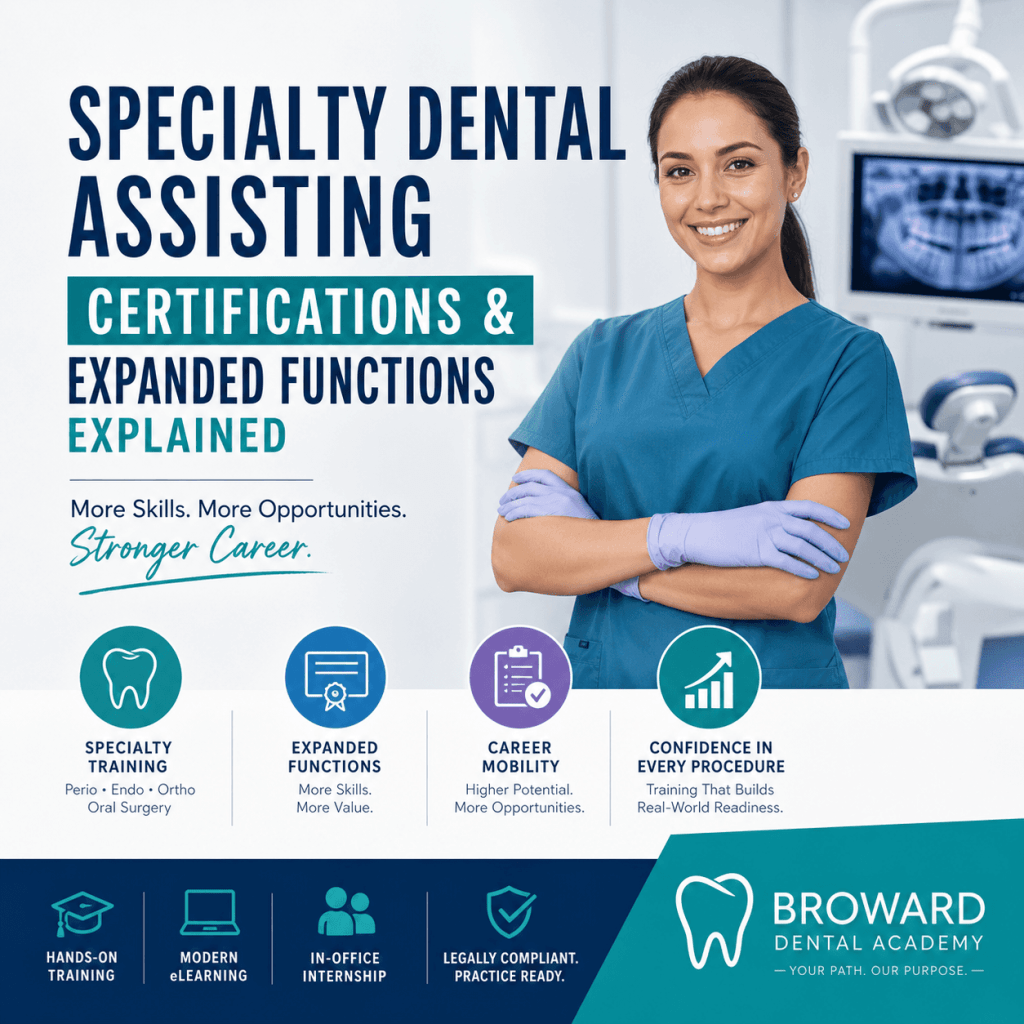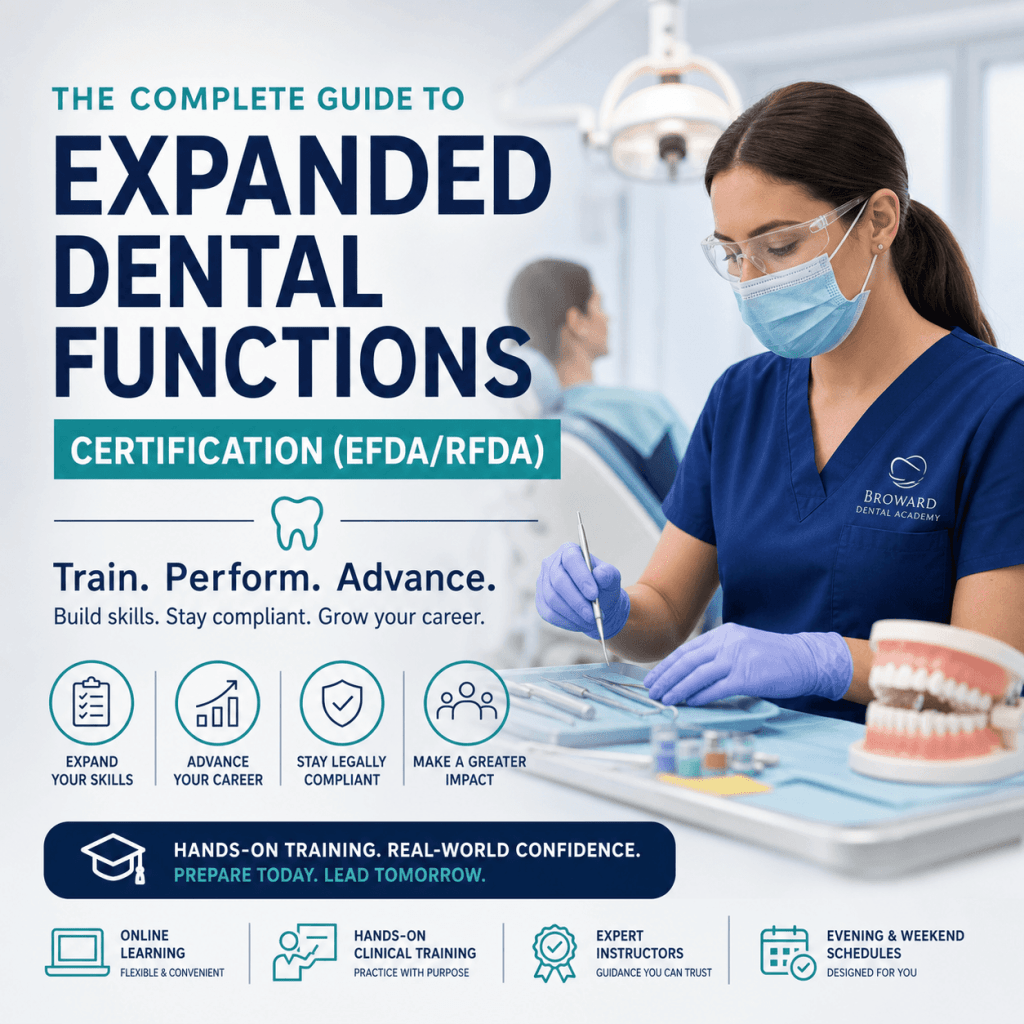
Obtaining an Expanded Dental Functions Certification is one of the most effective ways for a dental assistant to advance their career. This certification not only builds real clinical capability but also increases day-to-day value in the operatory. Moreover, it helps dental assistants stay aligned with state rules and modern practice expectations. This guide aims to break down what EFDA/RFDA commonly means, how to confirm your state’s regulations, what training usually includes, and how institutions like Broward Dental Academy prepare students to become thoroughly trained, legally compliant, and clinically confident professionals.
What EFDA/RFDA Certification Actually Means (and Why It Matters)
Understanding the Expanded Dental Functions Certification Process
The Expanded Dental Functions Certification is increasingly recognized for enhancing dental assistants’ skills and responsibilities.
Understanding the Expanded Dental Functions Certification process is crucial for aspiring dental professionals.
EFDA and RFDA are common labels used for expanded functions in dental assisting:
With the Expanded Dental Functions Certification, you can take on more responsibilities, enhancing your role as a dental assistant.
- EFDA often refers to Expanded Functions Dental Assistant.
- RFDA often refers to Registered/Restorative Functions Dental Assistant.
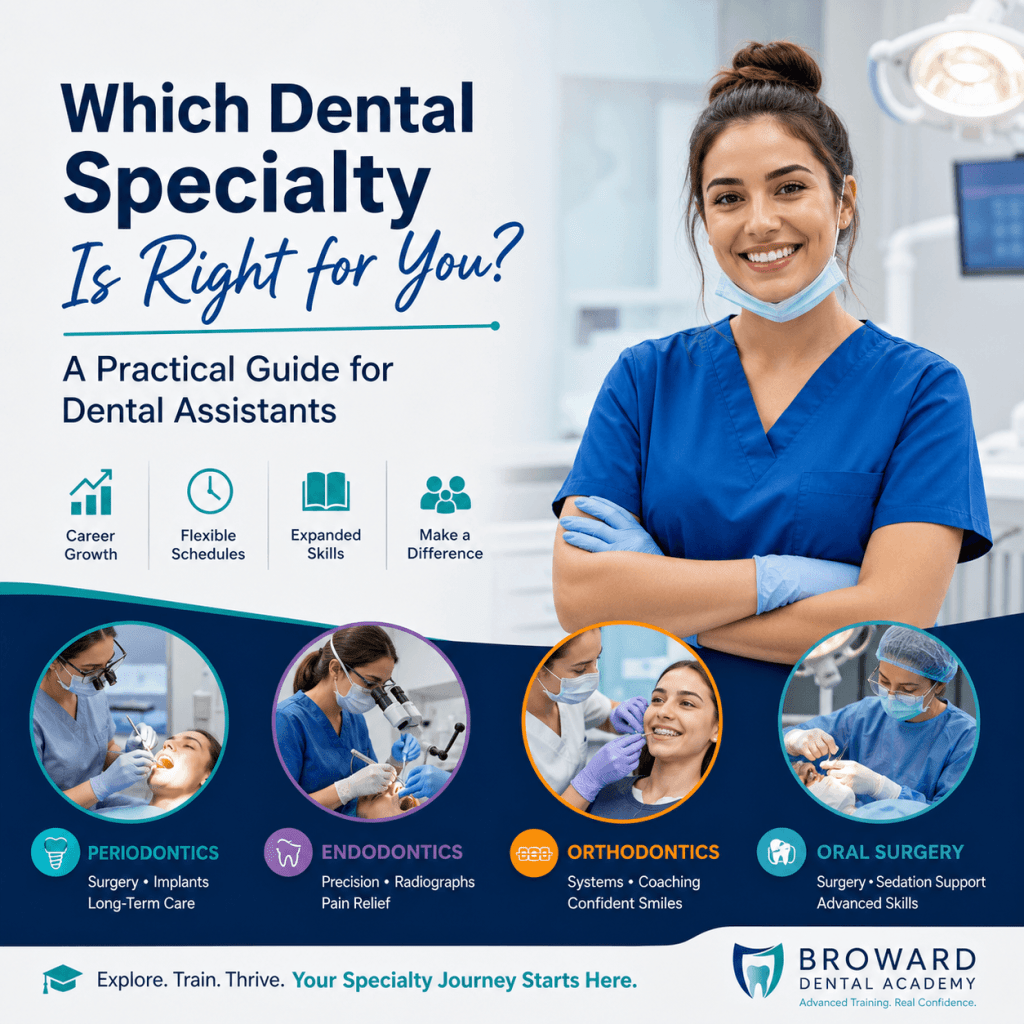
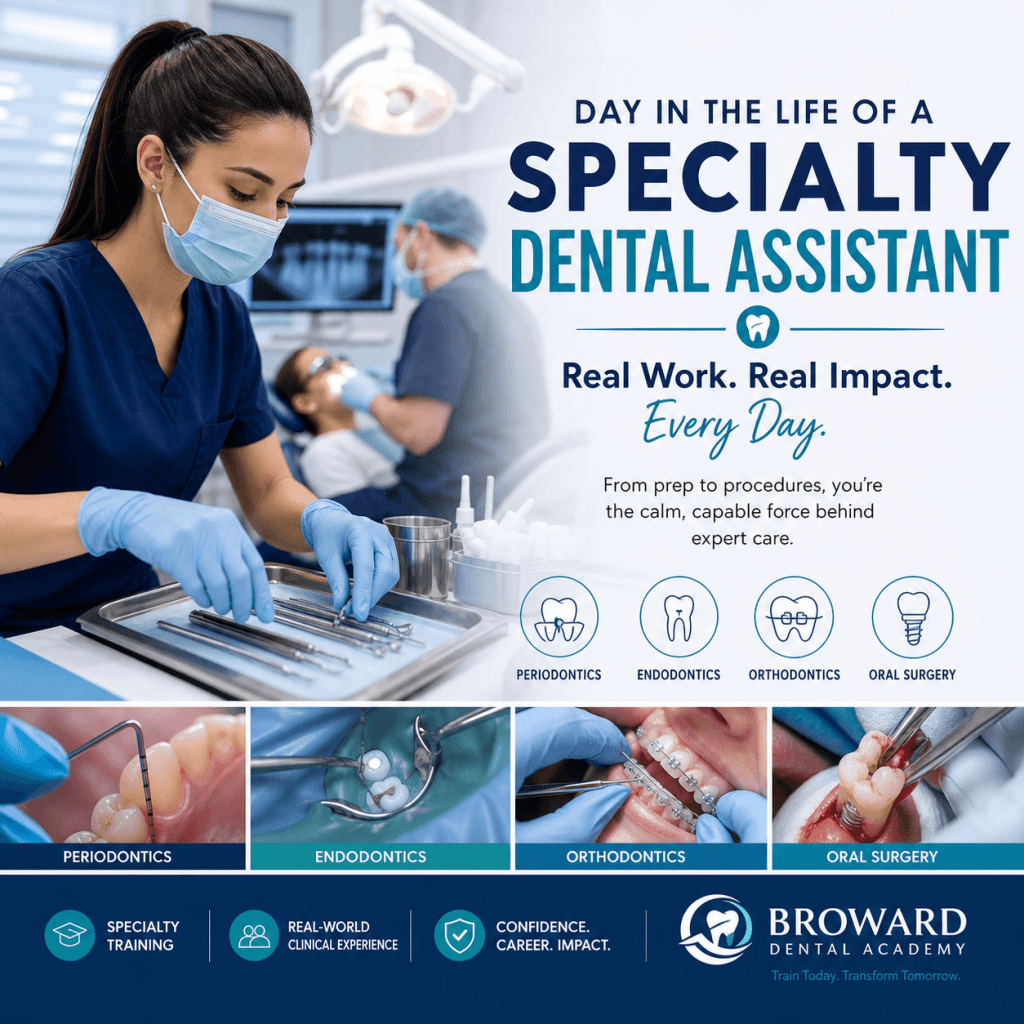
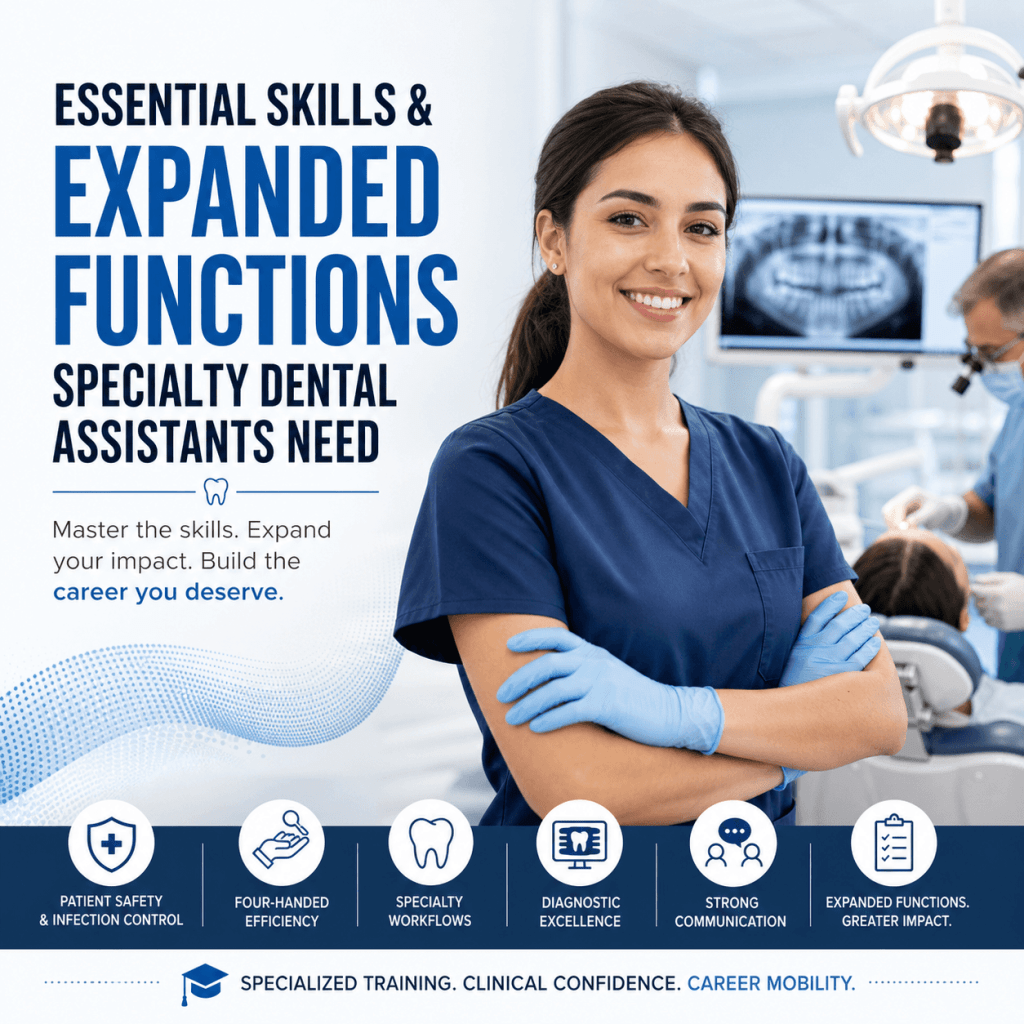
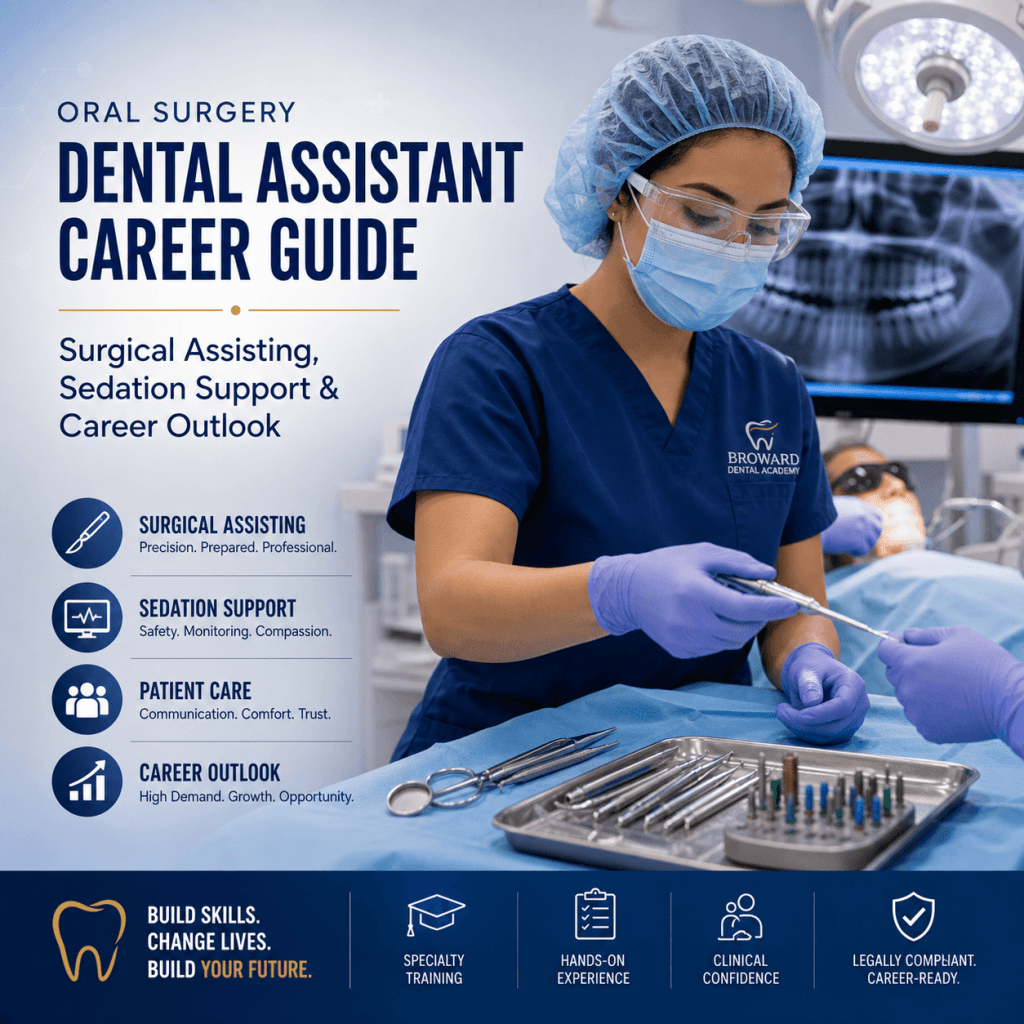
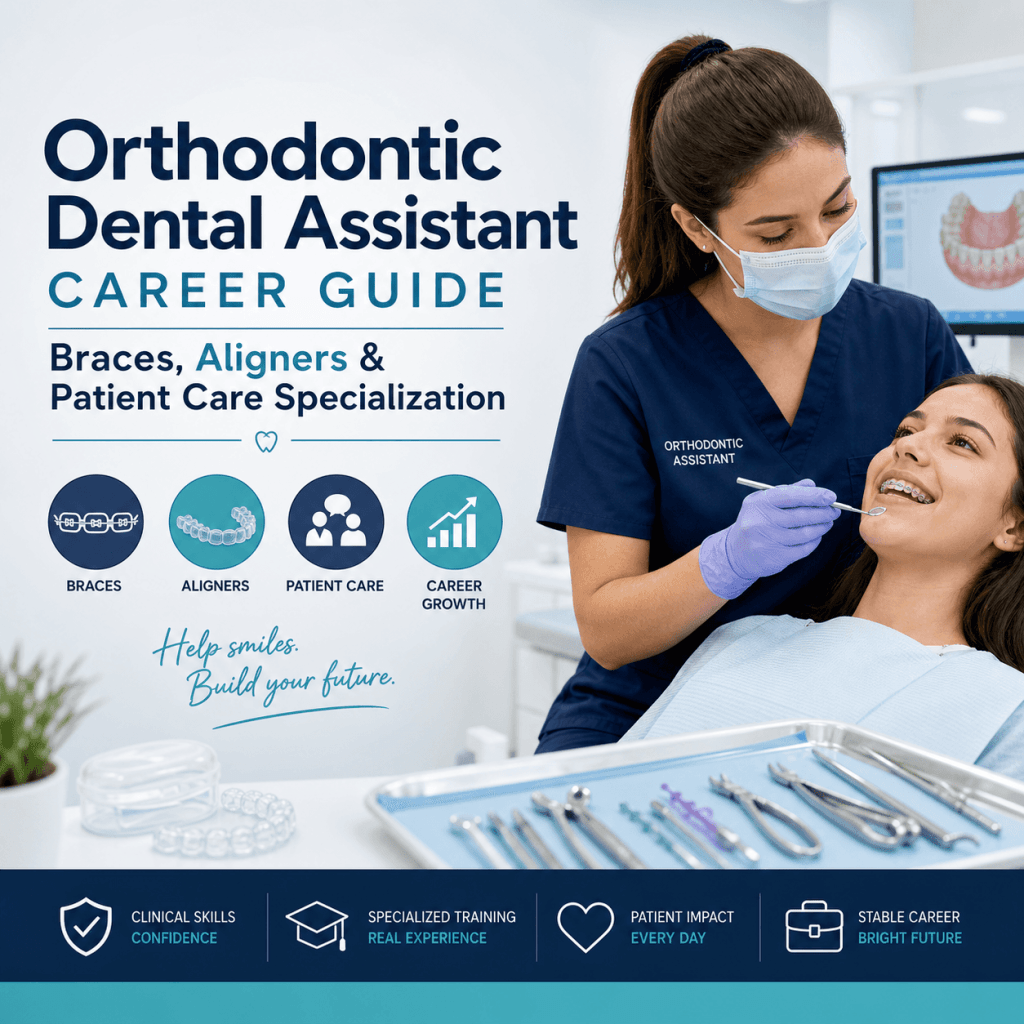
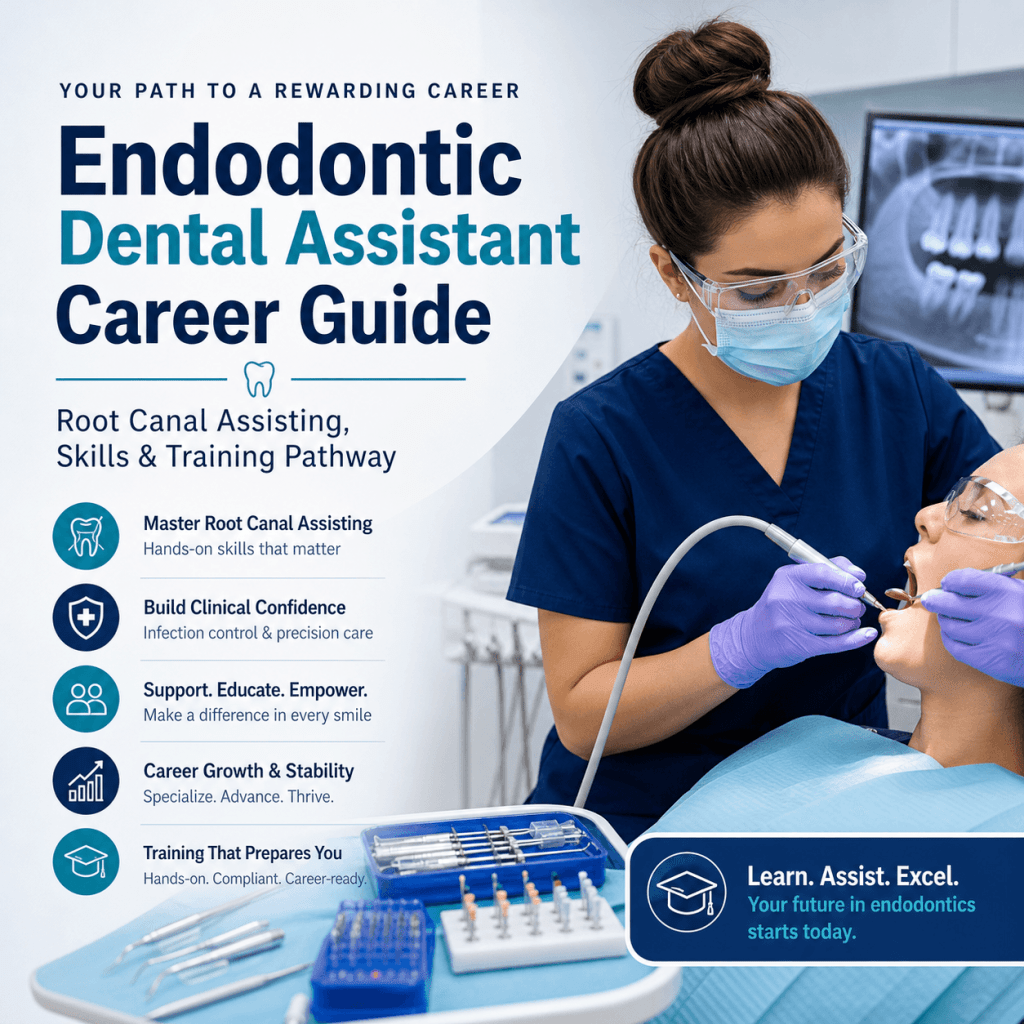
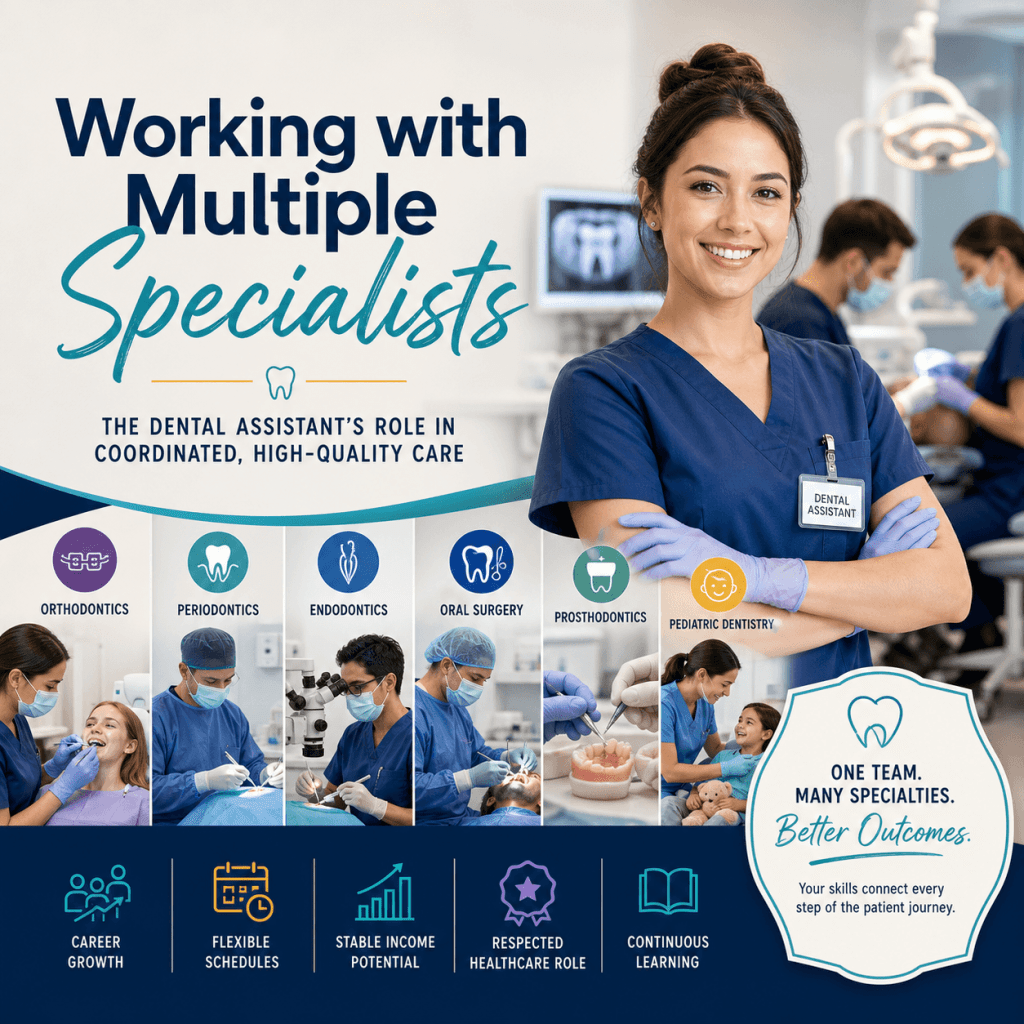
Here is the crucial part: the title and the allowed duties are not universal. Your state dental board and dental practice act determine what expanded functions are called, which duties are permitted, the supervision level required, and what training is accepted. Generally speaking, “expanded functions certification” means you have completed additional education and clinical competency validation that may authorize you to perform added clinical tasks under a dentist’s required supervision. It does not automatically mean you can perform a specific duty in every state, even if you completed a course elsewhere. At Broward Dental Academy, we offer specialized training programs that equip our students with the necessary skills to excel in various areas of dental assisting. Our comprehensive courses cover a range of specializations including oral surgery, orthodontics, and endodontics, ensuring our graduates are well-prepared for their roles in the dental field.
The Expanded Dental Functions Certification signifies that you have completed essential training to perform specific duties in accordance with state regulations.
A strong focus on the Expanded Dental Functions Certification can lead to exceptional career opportunities.
For many, earning the Expanded Dental Functions Certification opens doors to new career opportunities.
The Expanded Dental Functions Certification is essential for those looking to advance their skills.
Why practices value expanded-duty team members
High-performance practices care about expanded functions because they support:
- Efficiency: smoother appointments and fewer bottlenecks.
- Consistency: predictable outcomes when tasks are done the same way every time.
- Standardization: clearer clinical systems and better documentation habits.
- Improved patient flow: the team can maintain momentum without compromising quality.
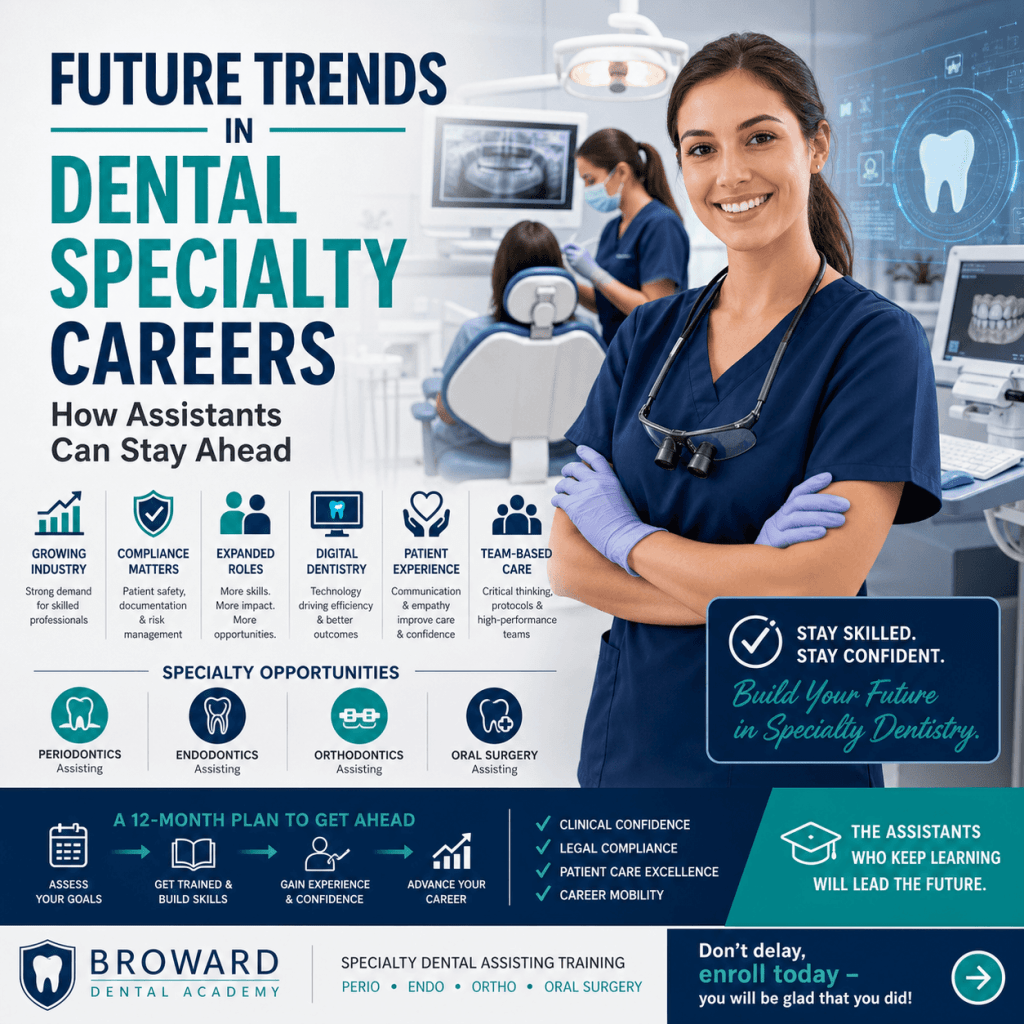
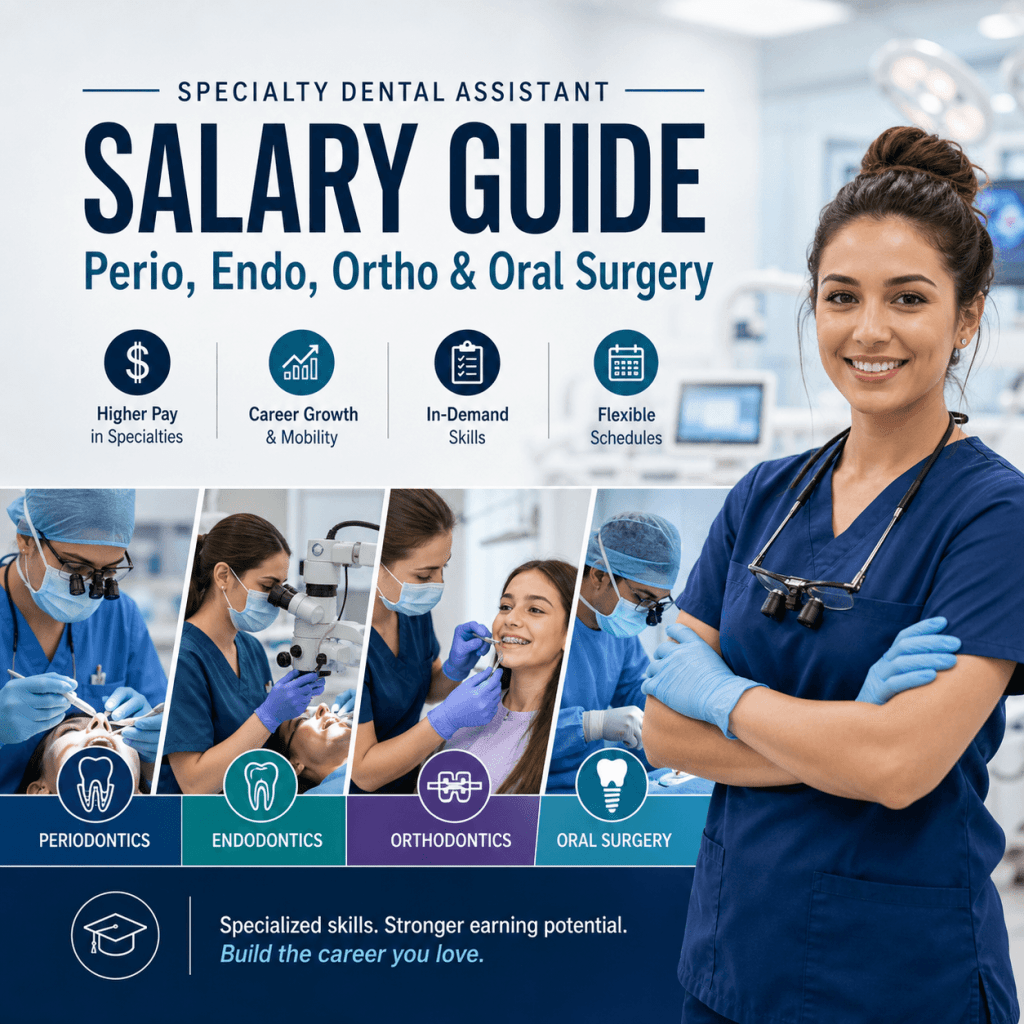
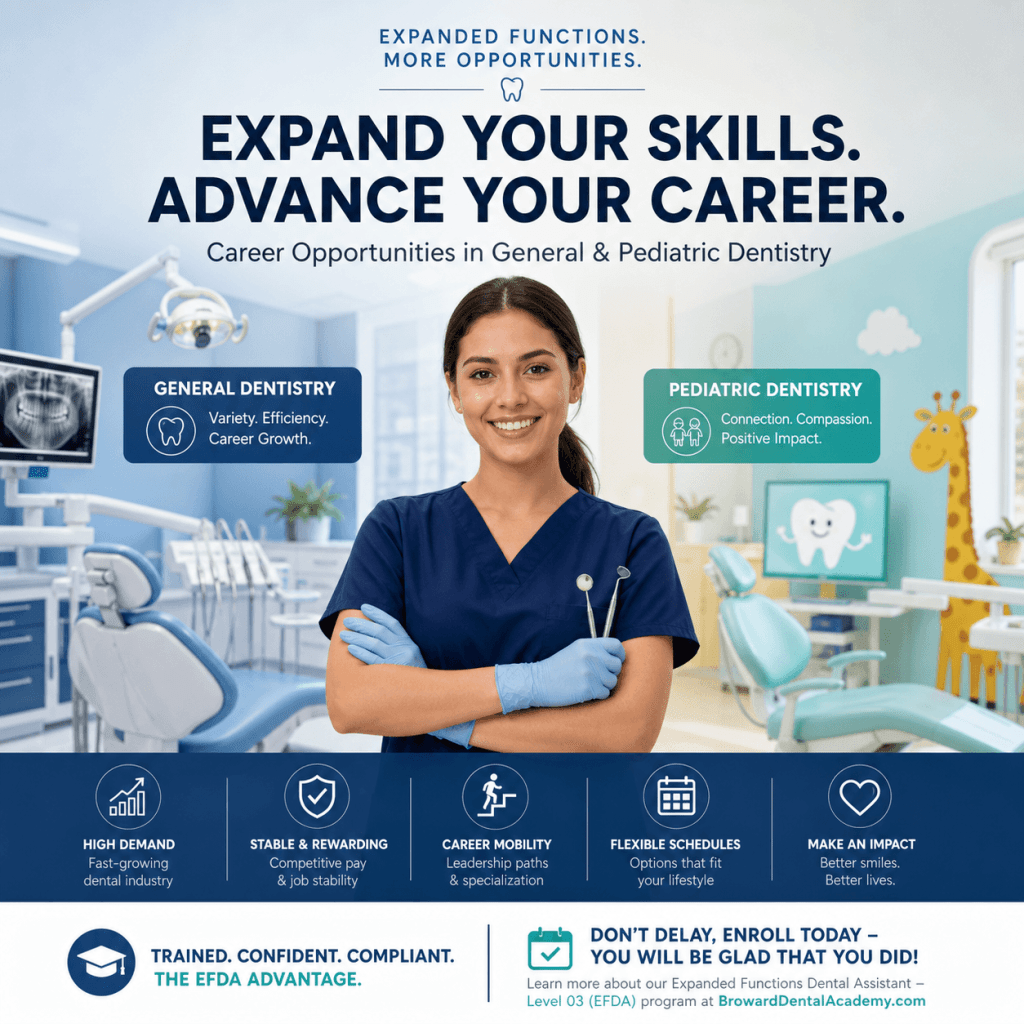
The dental sector, including areas like periodontics, is one of the fastest-growing healthcare industries. The demand for skilled, legally compliant, clinically confident professionals continues to rise. Expanded functions training fits that reality.
Who This Certification Is For (and Who Should Wait)
Expanded functions certification is typically a strong fit for:
- Dental assistants who want career mobility
- Assistants who want to develop stronger clinical skills
- Professionals aiming for roles where expanded functions opportunities are part of the job expectation
Obtaining the Expanded Dental Functions Certification can enhance your professional standing in the dental community.
Common prerequisites (varies by state/program)
Many states or programs require some combination of:
- Dental assisting education and/or verified work experience
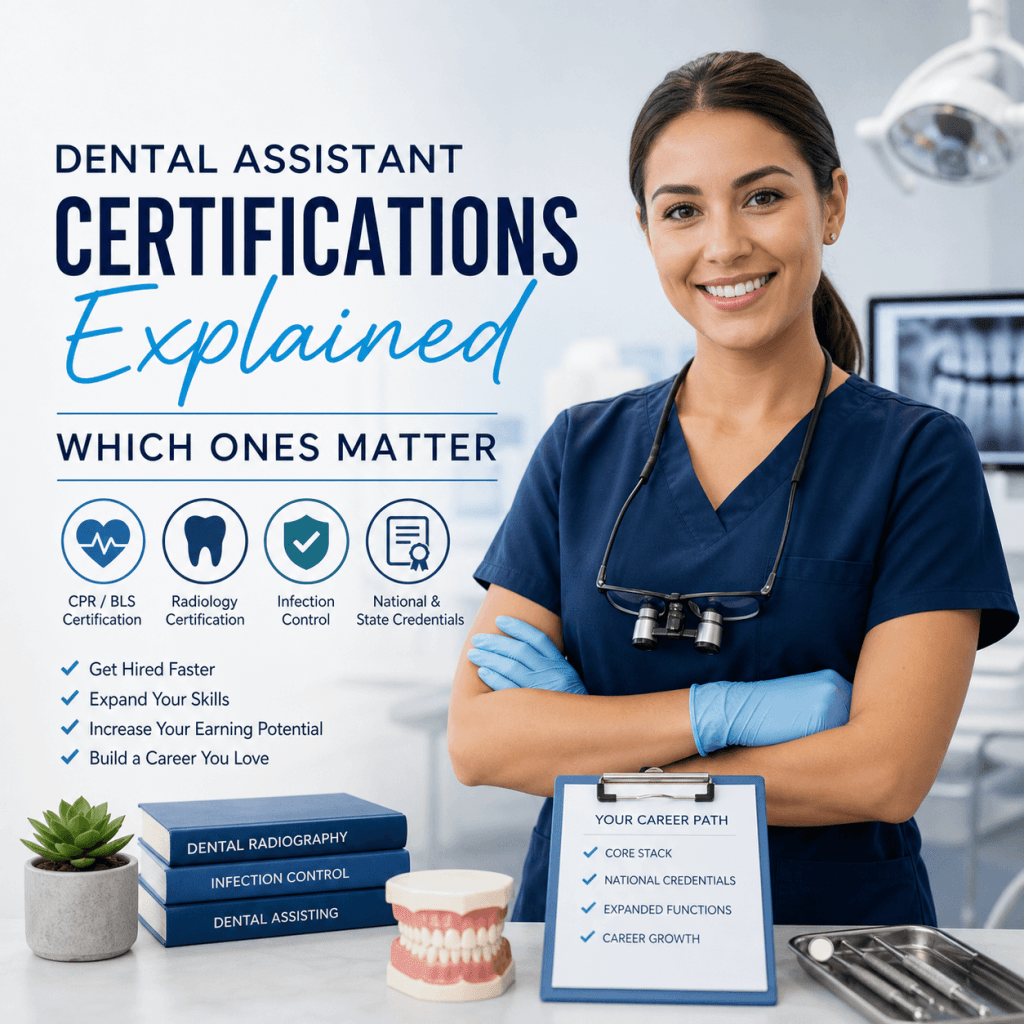
- Radiology training/credential (where applicable)
- CPR (BLS) for healthcare providers
- Infection control training
- A current clinical placement or employer verification (in some pathways)
Because requirements vary, the right approach is to treat prerequisites as a starting point and then confirm your state’s exact rules before enrolling.
When it may be smarter to wait
Consider pausing if:
- You are not currently in a clinical setting (or cannot access one for skills validation, if required)
- You are not ready for hands-on evaluation where technique is checked in real time
- You are unsure whether you meet state eligibility or whether your preferred program is accepted
When the timing is right, expanded functions can pair well with the broader benefits of dentistry: stable income potential, flexible schedules, long-term growth, and a respected role in healthcare. For those interested in pursuing such paths, it’s essential to have all your questions answered. You might find helpful insights in our frequently asked questions section. If you’re considering enrolling in a program, we have several locations available which you can explore here. Additionally, those looking to gain hands-on experience in dental assisting can explore our workforce training programs which offer practical exposure and skill development.
Expanded Functions vs Traditional Dental Assisting: What Changes Day-to-Day
Traditional dental assisting centers on chairside support and core clinical workflows such as room setup, instrument transfer, suctioning, patient prep, sterilization processes, documentation support, and procedure assistance within a basic scope. Expanded functions change the day-to-day by adding more technique-driven responsibilities that require:
- greater precision with dental materials and anatomy awareness
- stronger infection control discipline in procedure-specific steps
- tighter documentation and supervision compliance
- consistent outcomes under time pressure
In a modern, high-performance dental practice, expanded-function assistants are valuable because they show up ready to support procedures with repeatable technique, not just general assistance.
The “confidence + compliance” advantage
The real advantage is not only being able to do a task, but being able to:
- do it correctly and consistently
- document what matters
- follow the supervision rules that apply in your state and practice
That is also where patient safety and ethics come in. Expanded functions training should be more than test prep. Patients deserve clinical support that is careful, clean, and compliant every time.
What You’re Allowed to Do: Understanding Scope of Practice (Without Guessing)
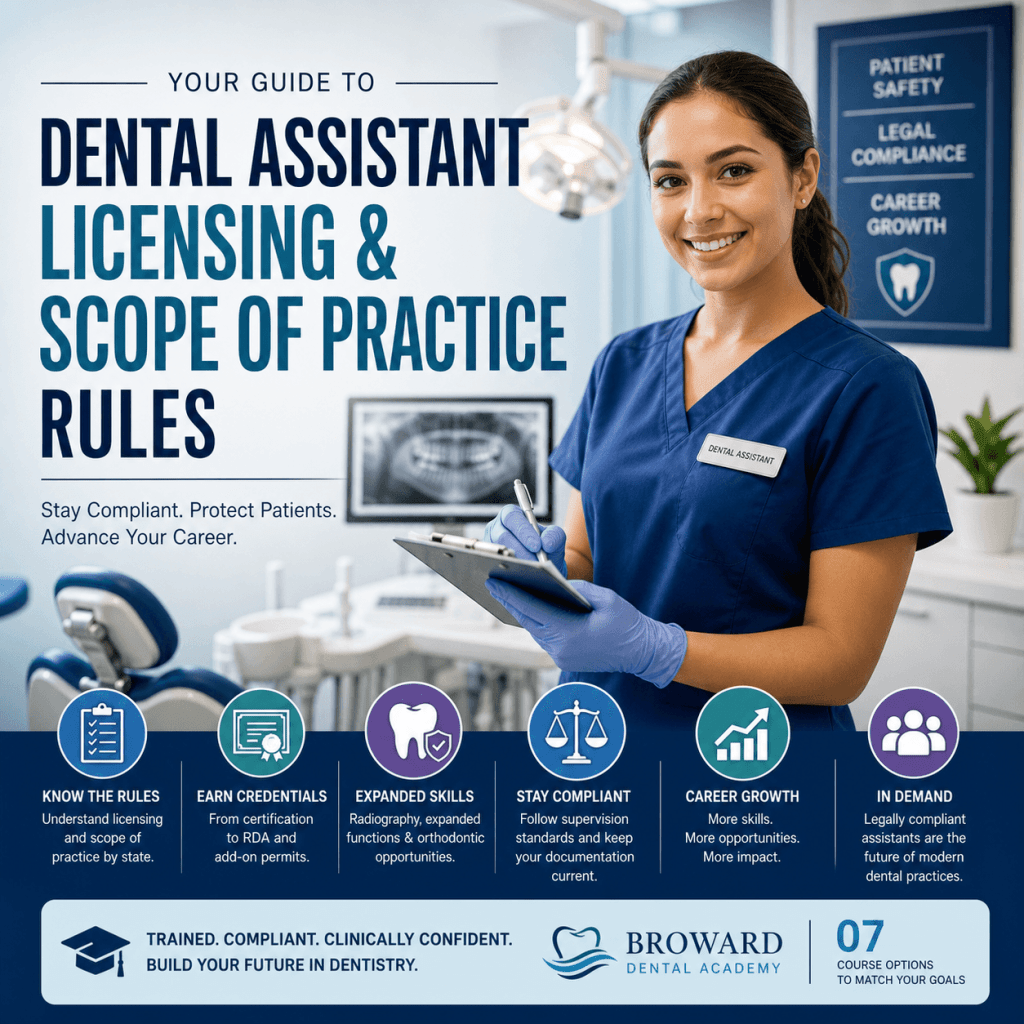
Scope of practice is determined by your state dental practice act and dental board rules. A certification course can be required, but it is only one piece of the legal puzzle. Before you invest time and money in a certification course like the one offered by Broward Dental Academy, verify your state’s requirements for:
- course hours and topics
- approved training providers
- exams (if required)
- permits, applications, or processing steps
- supervision levels required for each duty
For those considering a career in dental assisting, the Expanded Dental Functions Certification is a valuable asset.
How to confirm your state requirements (simple checklist)
- Locate your state dental board website
- Search the site for terms like expanded functions, EFDA, RFDA, dental assisting regulations, or restorative functions
- Confirm the approved training pathway (provider approval matters in many states)
- Confirm whether an exam is required and which exam is accepted
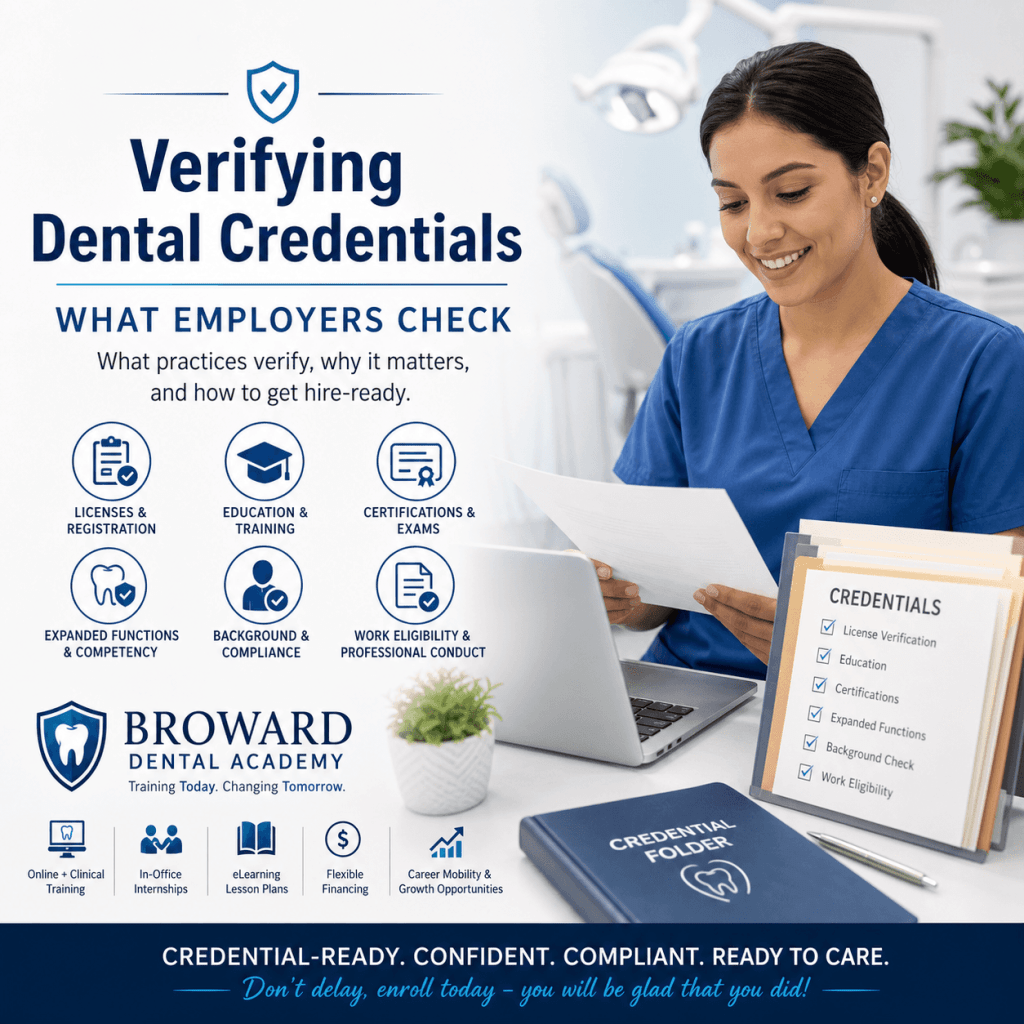
- Save or print the page and keep it in a personal compliance folder
- Keep copies of completion certificates, skills checklists, and any board forms
Common mistakes to avoid
- Taking a course that is not approved (when approval is required)
- Assuming another state’s rules apply to your state
- Performing expanded duties before you are authorized, documented, and supervised correctly
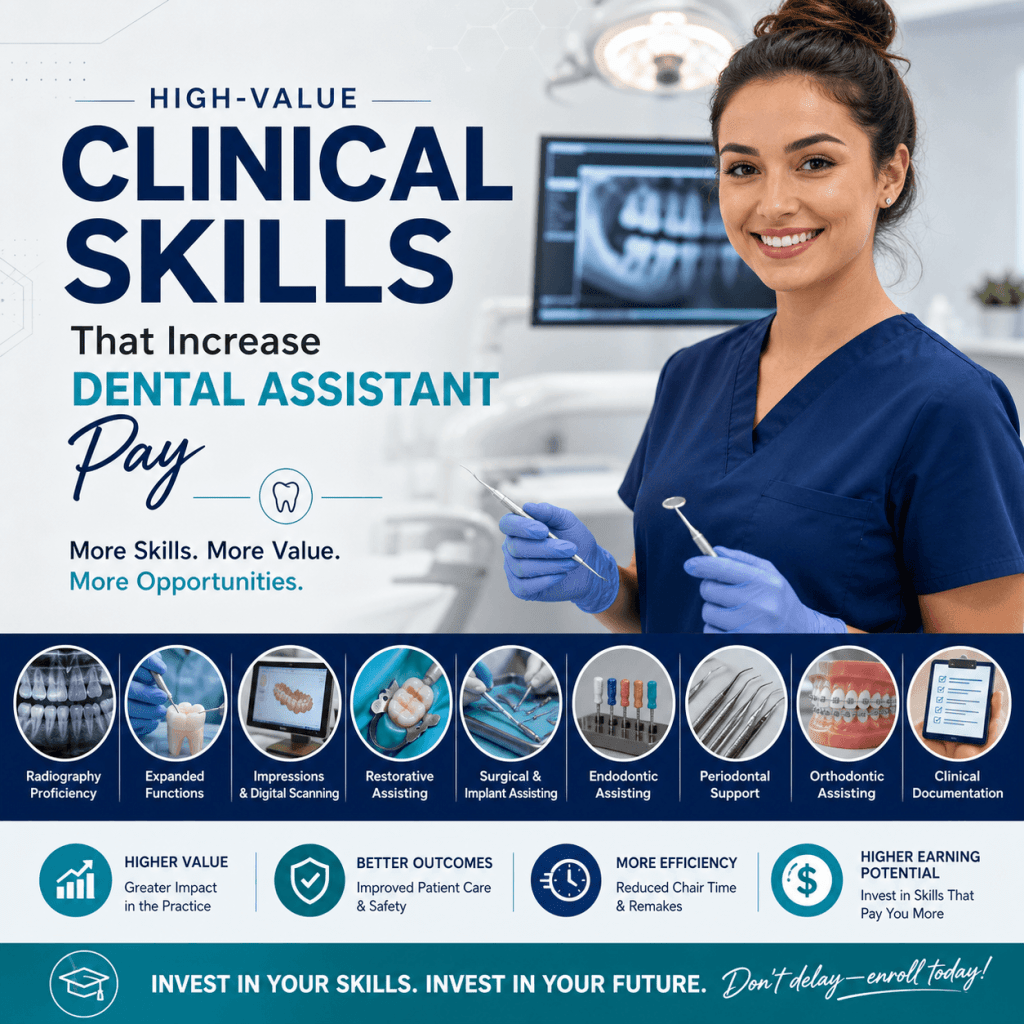
Common EFDA/RFDA Expanded Functions You May Train For
With the Expanded Dental Functions Certification, you can navigate your dental career with confidence.
Achieving the Expanded Dental Functions Certification differentiates you from peers in the job market.
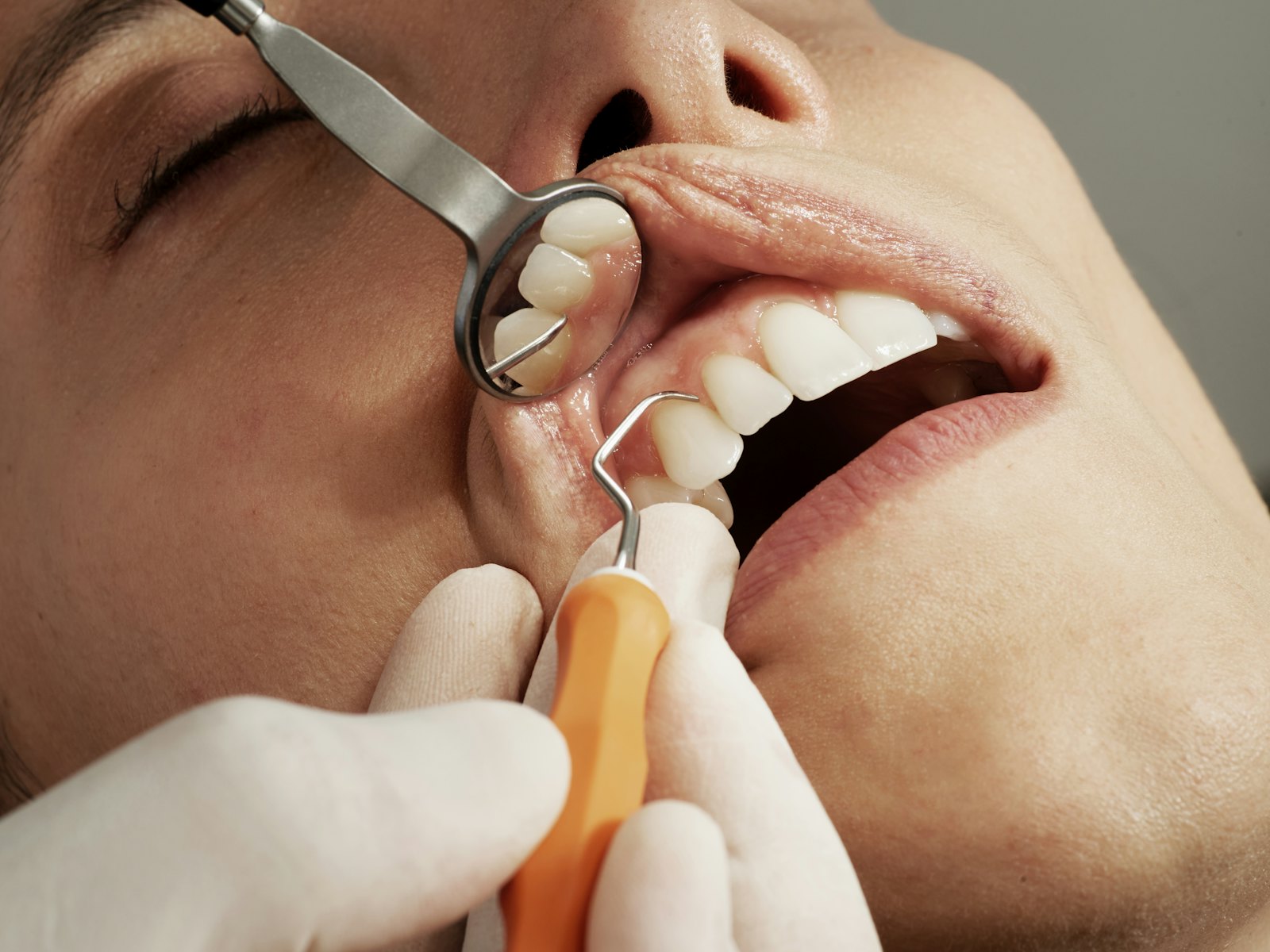
Expanded functions vary widely, but common categories that appear across many states include examples such as:
As you consider your future, remember the value of the Expanded Dental Functions Certification and its potential impact.
- Restorative assisting (state-dependent)
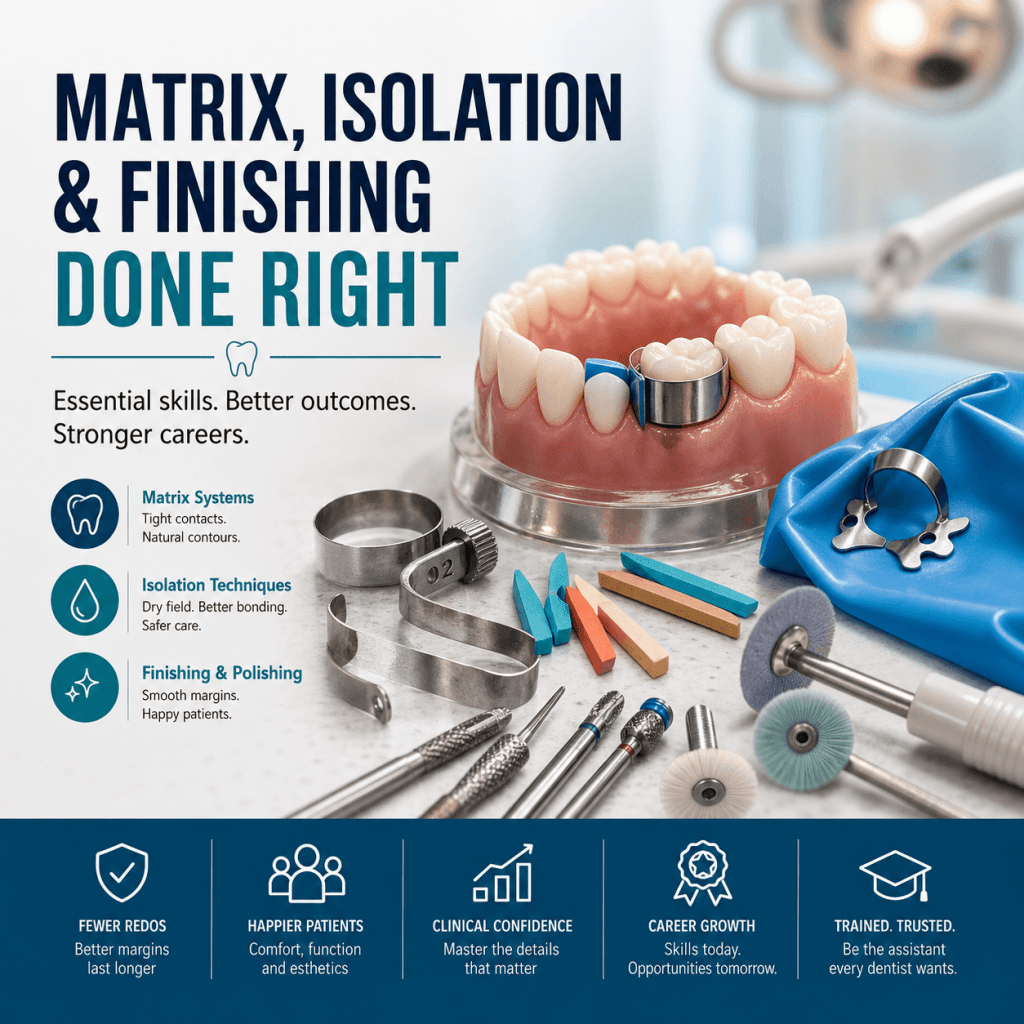
- Placing and removing matrices and wedges
- Finishing and polishing restorations (where allowed)
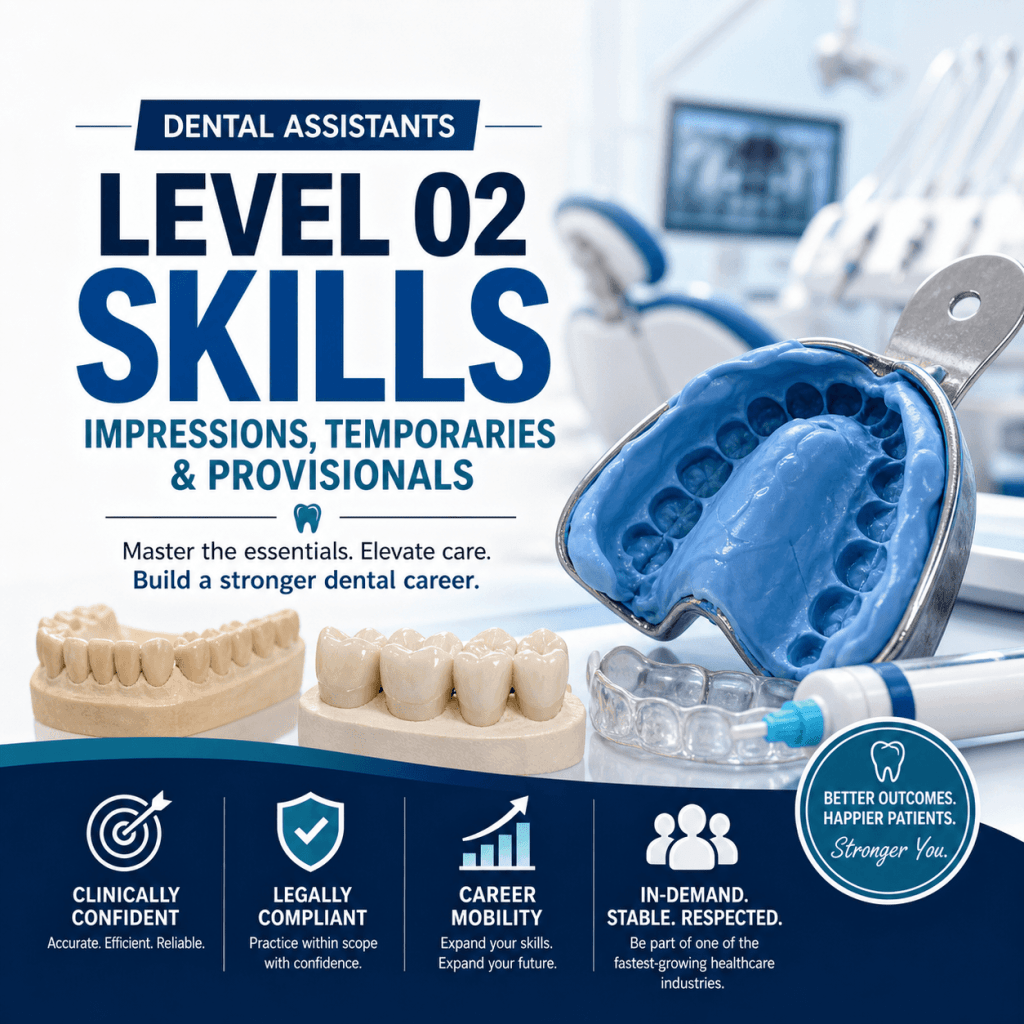
- Impressions (traditional or digital workflows, depending on setting and rules)
- Sealants
- Temporary restorations (temporaries)
- Orthodontic assisting elements in some jurisdictions
Training typically focuses on more than a checklist of steps. Quality programs emphasize:
- anatomy and tooth morphology basics tied to the procedure
- material handling and timing
- isolation and moisture control principles
- infection control at a procedure level
- chairside workflow and operatory efficiency
- documentation habits that support compliance
These are the outcomes practices want: predictable, efficient support that protects quality and reduces risk. Depending on jurisdiction, modules may be bundled into one pathway or offered as separate certifications such as those provided by Broward Dental Academy.
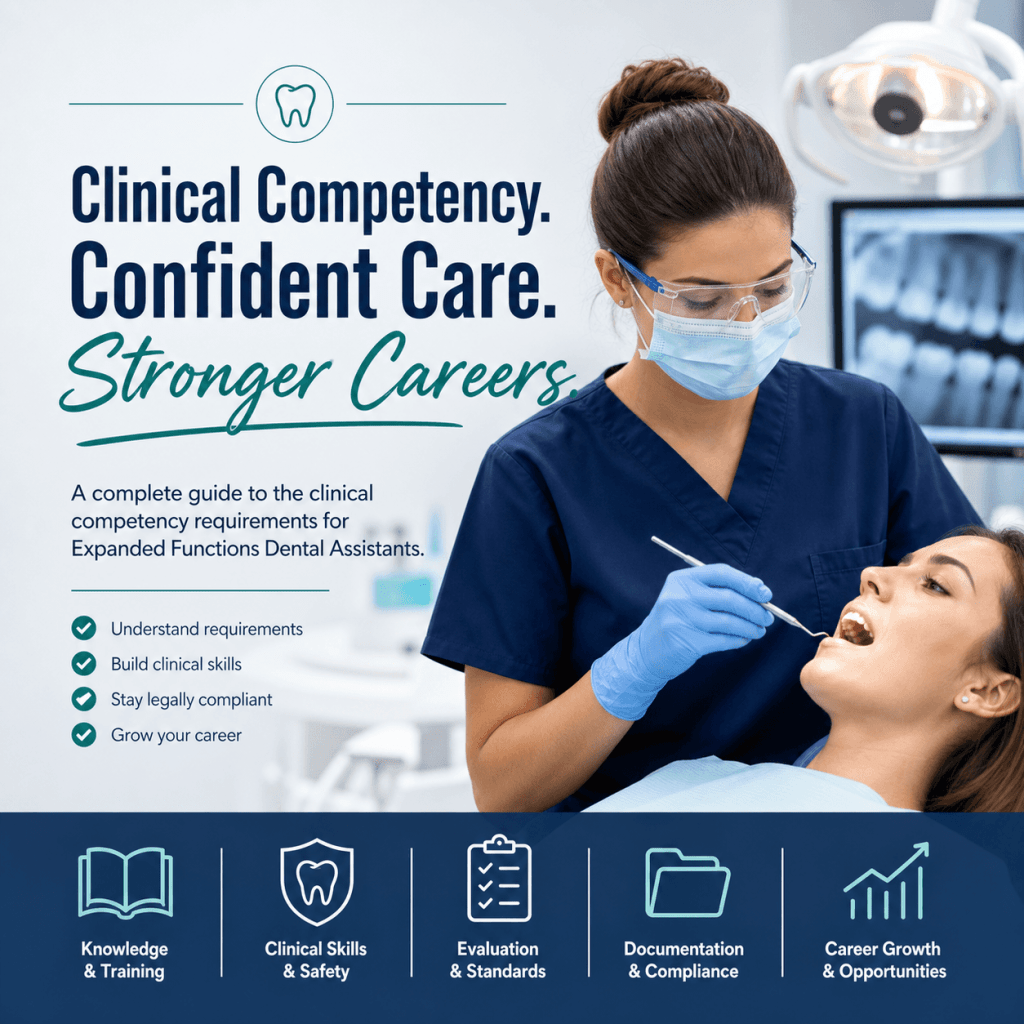
EFDA/RFDA Certification Requirements: The Building Blocks Most Programs Include
While every state is different, most reputable expanded functions programs include a structure like this:
- Eligibility and prerequisites
- Verification of basic requirements such as prior assisting education/experience, CPR, radiology, or infection control training where applicable.
- Didactic learning (theory)
- Coursework covering concepts behind the procedures, materials, safety, and legal boundaries.
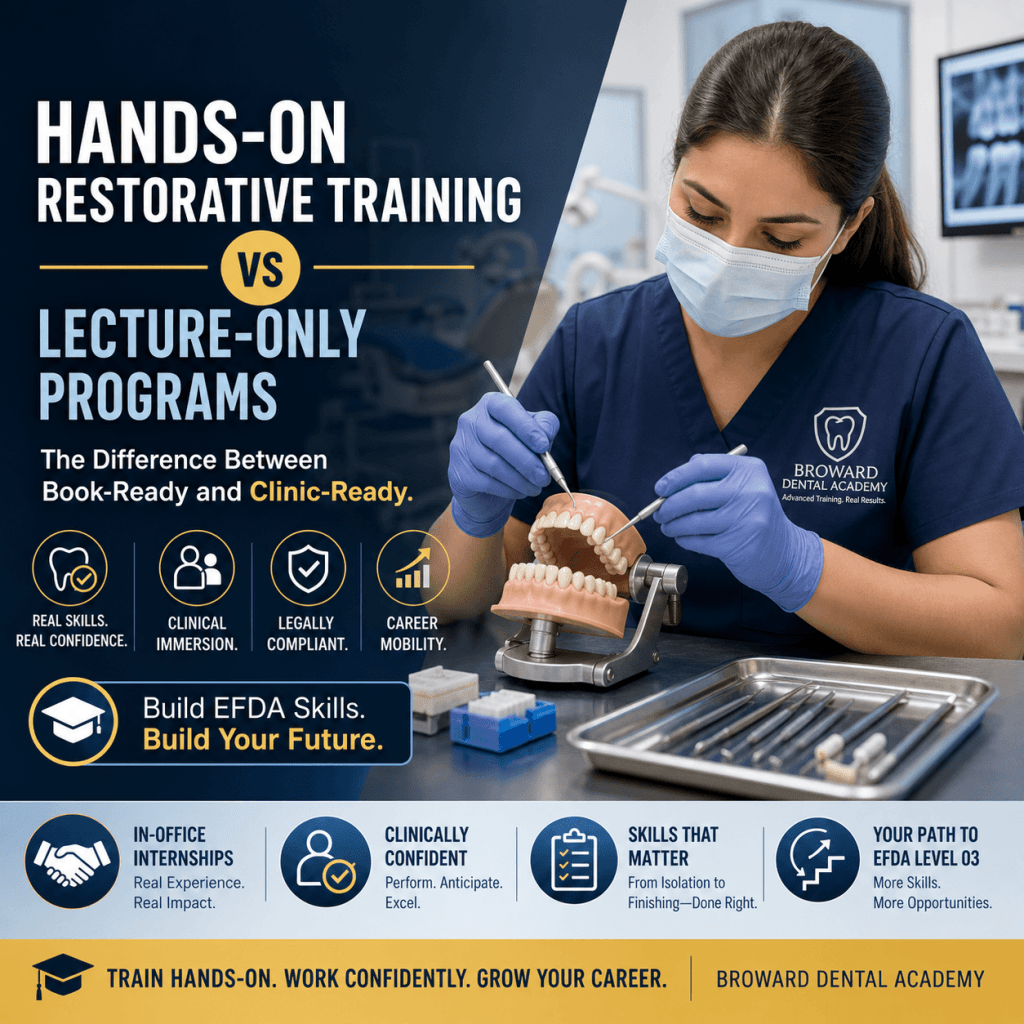
- Clinical skills lab
- Hands-on practice to develop technique in a controlled setting.
- Clinical competency evaluation
- Demonstration that you can perform tasks to a defined standard.
- Documentation and final verification
- Completion paperwork, skills checklists, and any required proof for employers or boards.
Immediate feedback is a major difference-maker. When an instructor corrects angulation, isolation, material timing, or finishing technique early, students build stronger habits before they ever bring those skills into a busy schedule. Some states also require approved exams, clinical hours, or employer verification. Timelines depend on your schedule, prior experience, and your state’s rules.
Choosing the Right Expanded Functions Dental Assistant Course: A Practical Checklist
Not all programs are equal. Use this checklist to choose a program that actually prepares you for real practice.
Investing time in achieving the Expanded Dental Functions Certification will pay dividends throughout your career.
1) State alignment and approval (where applicable)
- Is the program aligned to your state’s requirements?
- If your state requires approved providers, is the program recognized? It’s crucial to ensure the program meets the standards set by relevant authorities, as this can significantly impact your eligibility for certification and employment opportunities.
2) A strong clinical component
Expanded functions are hands-on. Look for:
- in-person labs or clinical validations
- defined competencies with clear performance standards
- enough repetition to build speed and consistency
Be cautious of programs that are “online-only” for skills that must be physically performed and evaluated.
3) Experienced instruction and clear outcomes
Ask who teaches the course, how competency is evaluated, and what documentation you receive when finished.
4) Practice readiness beyond passing
The best training includes:
- critical thinking in procedure flow
- ethical decision-making
- patient-centered communication
- documentation habits that support compliance
5) Support and logistics
Ask about:
- scheduling options and make-up policies
- what instruments/materials are provided vs required
- internship or externship opportunities (where applicable)
How Broward Dental Academy Prepares You for Expanded Functions (Beyond the Test)
Broward Dental Academy is built around a simple goal: preparing students to become thoroughly trained, legally compliant, clinically confident professionals. That means the focus is not just passing an assessment. It is building real operatory readiness for modern dentistry through a complex educational experience that includes immediate immersion in both online and clinical settings. Key elements students benefit from include:
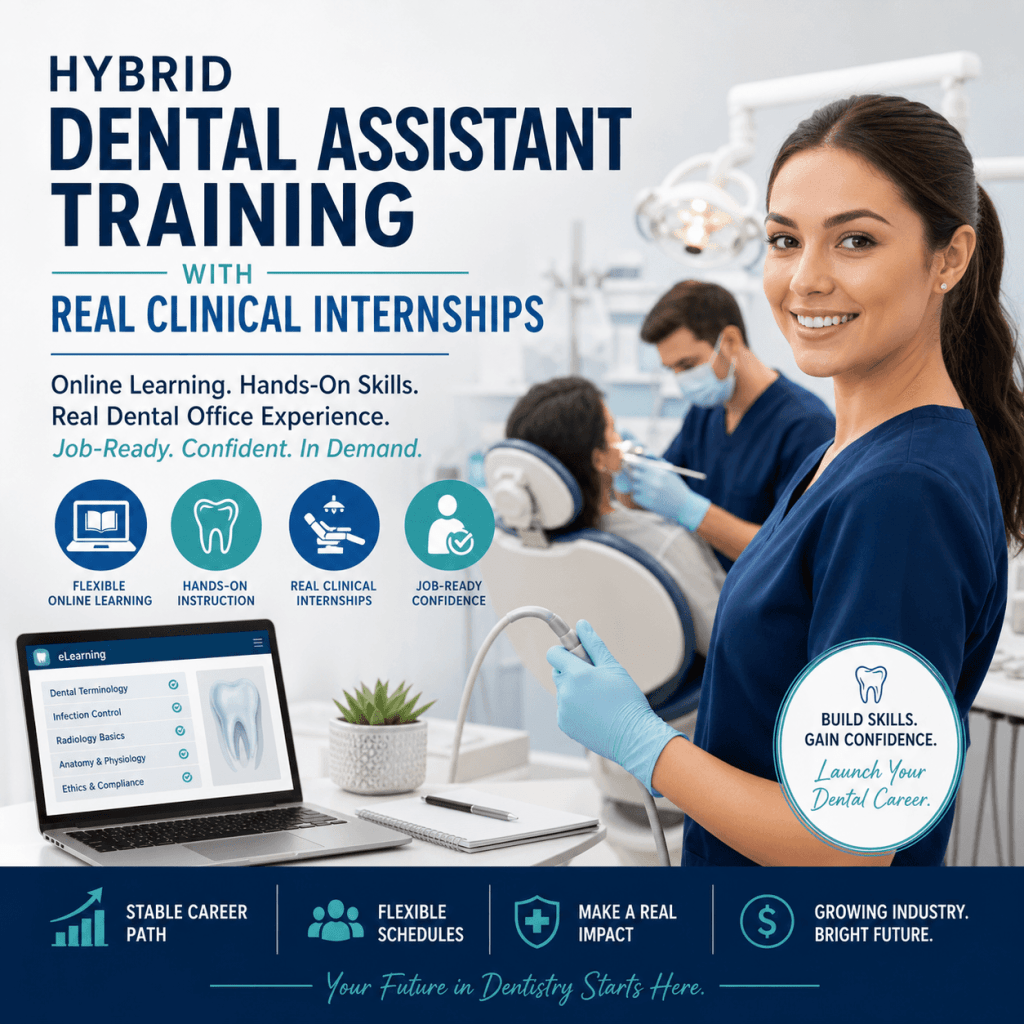
- Modern eLearning lesson plans incorporated for remote training
- Hands-on emphasis and coaching to build repeatable technique
- Training that reinforces students to think critically, act ethically, and perform confidently
- In-office internships (where applicable) that help connect training to real practice expectations
- A learning environment designed to develop accomplished, polished dental professionals
- A range of dental courses and advanced dental training options, such as those offered in our 07 courses, to support long-term career growth
What Training Feels Like: From Online Lessons to Clinical Skills Validation
Having the Expanded Dental Functions Certification allows you to perform an extended range of clinical tasks.
After completing your training, the Expanded Dental Functions Certification will prepare you for advanced responsibilities.
By achieving the Expanded Dental Functions Certification, you position yourself for success in the dental field.
While formats vary, a typical learner journey in expanded functions training looks like this:
- Onboarding You confirm prerequisites, course access, expectations, and documentation requirements.
- Online modules You learn the “why” behind techniques: anatomy basics, materials, infection control, supervision rules, and clinical sequencing.
- Skills demos Instructors show how to perform key steps correctly, including common failure points and how to avoid them.
- Guided practice You repeat techniques with coaching, refining isolation, handling materials, working efficiently, and maintaining quality.
- Competency checks You demonstrate skills to an objective standard, not just “good enough.”
- Documentation completion You finish the paperwork trail that proves training and competency, which matters for compliance and employability.
Repetition and feedback are what build speed without sacrificing quality. Clinical scenarios also help students get comfortable with:
- managing chairside time
- maintaining asepsis and clean transitions
- communicating clearly in the operatory
- staying calm when materials set quickly or conditions change
Professionalism is part of the training experience. Attendance, infection control standards, and patient-centered behavior are not “extras.” They are the foundation.
Timeline and Cost Planning: How to Budget for EFDA/RFDA the Smart Way
Costs and timelines vary, but most students should plan around these common cost buckets:
- Tuition
- Supplies/instruments (if not included)
- Exam or processing fees (if required by your state)
- CPR and ancillary requirements (if you need to update them)
Scheduling for working dental assistants
Many assistants pursue expanded functions while employed. Practical planning includes:
- choosing evening or weekend options when available
- pacing online modules consistently so you are ready for labs
- arranging clinical dates early so you do not lose momentum
Broward Dental Academy offers flexible financing, which can help students plan training without unnecessary delay.
Having the Expanded Dental Functions Certification can significantly boost your employability in various dental settings.
The ROI perspective
When aligned with your state rules and the needs of real practices, expanded functions can support:
- increased responsibility
- stronger employability
- long-term career mobility in dentistry
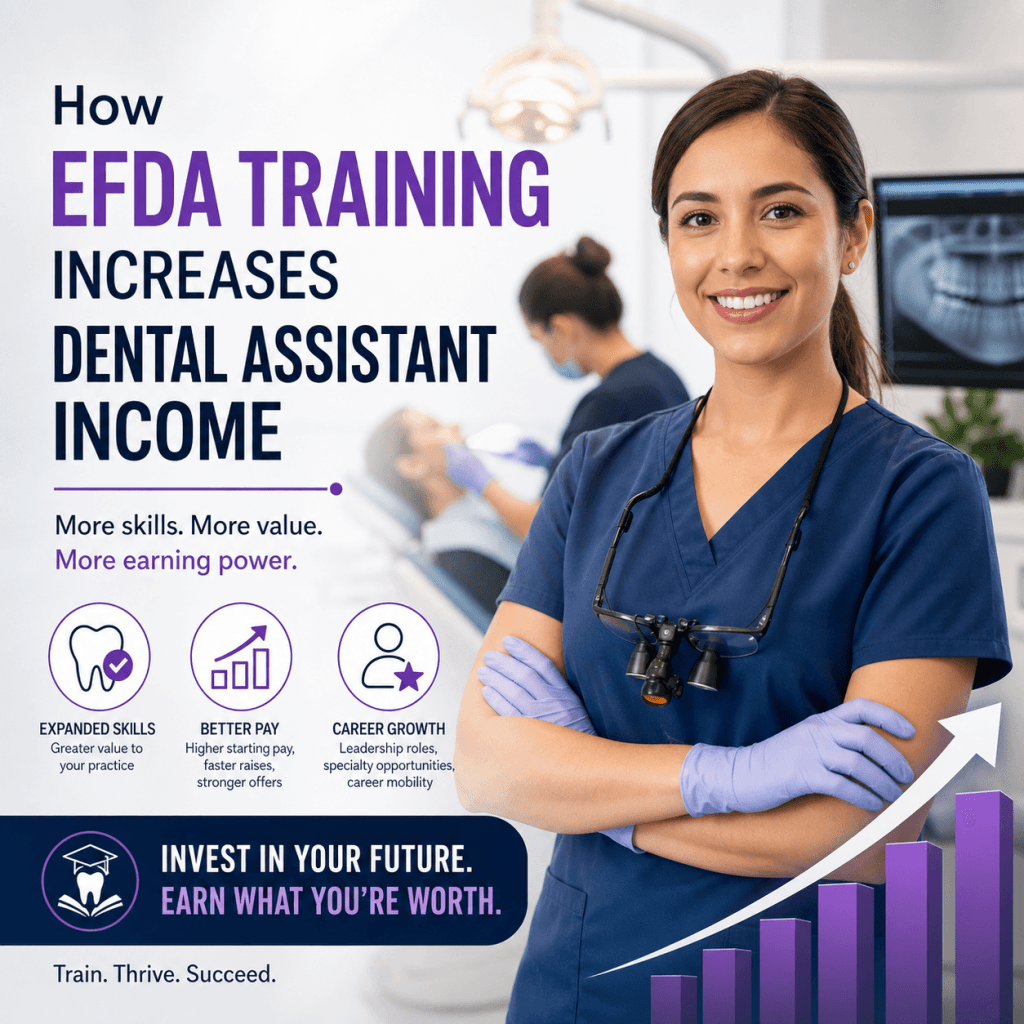
How EFDA/RFDA Helps Your Career: Pay, Mobility, and Practice Demand
Practices want team members who can contribute more while staying compliant and confident. Expanded functions can support that by helping you become:
- more useful chairside during procedure-heavy days
- more consistent with materials and clinical workflow
- more trusted to perform within a defined legal scope
Career mobility often shows up as:
- qualifying for more roles across more practices
- a stronger resume with verifiable competencies
- better scheduling leverage due to higher demand
- a clearer long-term growth path in one of the fastest-growing healthcare industries
Expanded functions also signal professionalism. It shows commitment to continuing education, quality, and patient safety.
Staying Compliant After You’re Certified: Documentation, Supervision, and Renewals
Expanded functions certification increases opportunity, but it also increases accountability. Even after certification:
- you must work under the required supervision level for each duty
- you must follow your state rules and your office’s protocols
- you should never assume a task is allowed without confirmation and authorization
Keep a personal compliance folder
Maintain a dedicated folder, digital and printed if possible, with:
- course completion certificates
- skills checklists and competencies
- permits (if your state issues them)
- continuing education records
- employer verification forms (if your pathway requires them)
As you progress in your career, the Expanded Dental Functions Certification will set you apart in the dental community.
Renewals and continuing education vary by state. Track dates early and communicate clearly with the dentist or office manager about what expanded duties are authorized in that practice and jurisdiction.
Every dental assistant should consider the value of the Expanded Dental Functions Certification in their career development.
Next Steps: Enroll, Train with Confidence, and Start Using Your Expanded Functions
Your best path forward is straightforward:
- Confirm your state requirements
- Choose an approved, hands-on program aligned with your goals
- Complete the training, labs, and competency evaluations
- Keep your documentation organized
- Apply your skills in practice under the correct supervision and protocols
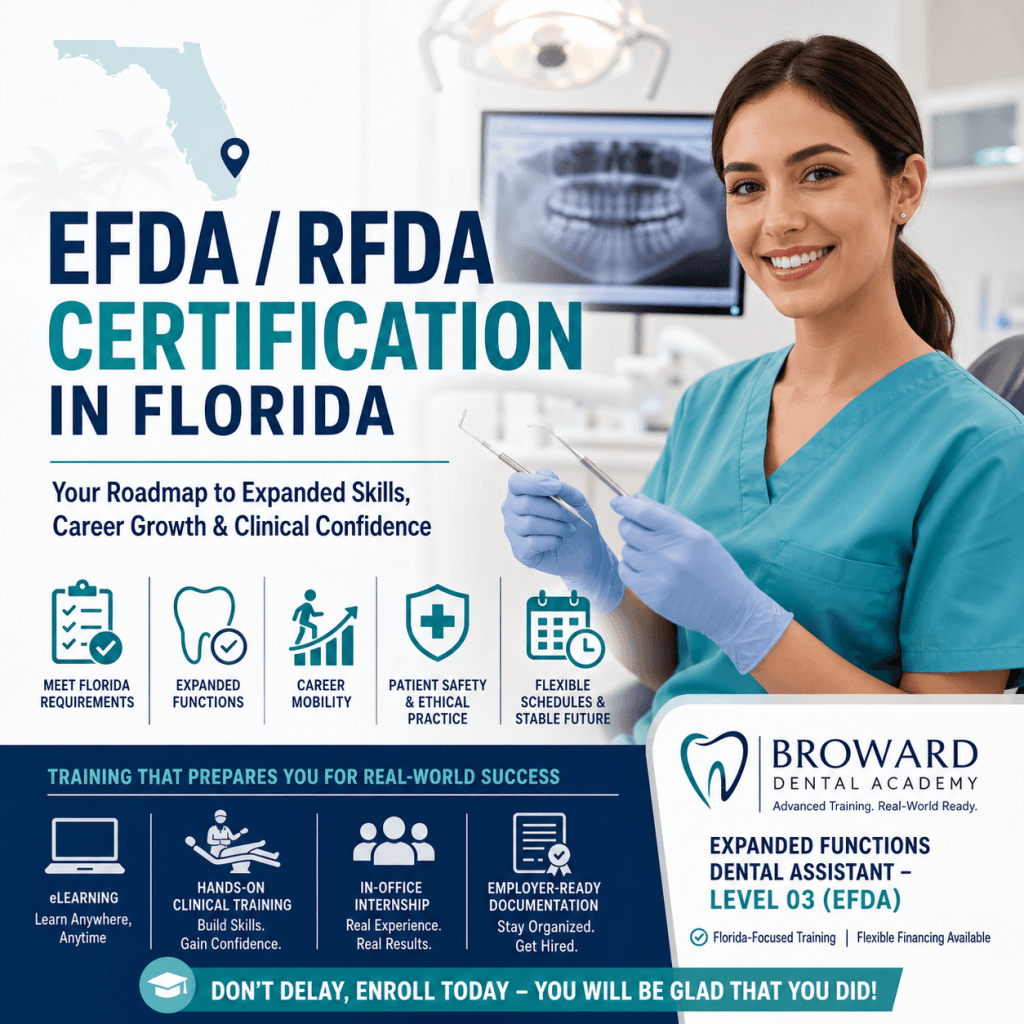
If you are ready to grow in dentistry with training designed for real practice, explore Broward Dental Academy’s expanded functions pathways or consider their Dental Assistant Level 01 or Level 02 courses for long-term career development. Broward Dental Academy prepares students for more than an exam. It prepares you to thrive in a modern, high-performance dental practice as a thoroughly trained, legally compliant, clinically confident professional. Don’t delay, enroll today – you will be glad that you did!
FAQs (Frequently Asked Questions)
What does EFDA/RFDA certification mean for dental assistants?
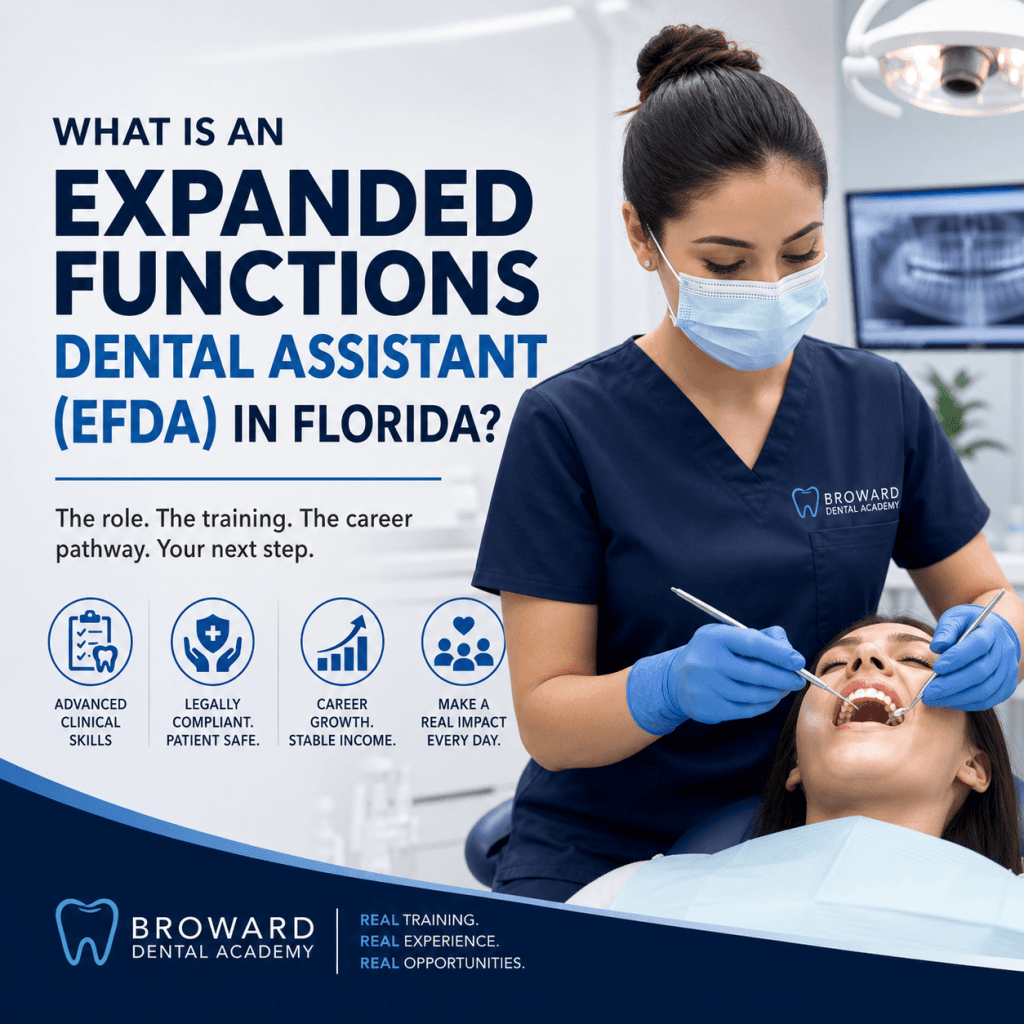
EFDA (Expanded Functions Dental Assistant) and RFDA (Registered/Restorative Functions Dental Assistant) certifications indicate that a dental assistant has completed additional education and clinical competency validation to perform expanded clinical tasks under a dentist’s supervision. However, the specific duties allowed vary by state dental board regulations and dental practice acts.
How can I confirm if my state allows certain expanded functions for dental assistants?
You should consult your state dental board and review your state’s dental practice act to understand what expanded functions are permitted, the required supervision levels, and accepted training programs. These resources provide the official guidelines tailored to your state’s regulations.
What kind of training is included in expanded functions certification programs like those at Broward Dental Academy?
Programs typically include comprehensive hands-on clinical skills practice across various specializations such as oral surgery, orthodontics, endodontics, and periodontics. Training also covers infection control, CPR (BLS), radiology where applicable, and ensures students are legally compliant and clinically confident.
Who is best suited to pursue expanded functions certification?
Expanded functions certification is ideal for dental assistants seeking career mobility, stronger clinical skills, and roles where performing expanded functions is expected. Candidates usually need prior dental assisting education or verified work experience and must meet specific prerequisites like CPR certification and infection control training.
When might it be better to delay pursuing an expanded functions certification?
Consider waiting if you are not currently working in a clinical setting or cannot access one for hands-on skills validation, are unprepared for real-time technique evaluations, or are uncertain about meeting your state’s eligibility requirements or program acceptance criteria.
For many, the Expanded Dental Functions Certification represents a commitment to lifelong learning and skill enhancement.
How do expanded functions change the daily role of a dental assistant compared to traditional duties?
While traditional dental assisting focuses on chairside support such as room setup, instrument transfer, suctioning, patient preparation, sterilization, documentation support, and assisting basic procedures, expanded functions allow assistants to perform additional clinical tasks under supervision, enhancing efficiency, consistency, standardization, and improving patient flow within the practice.
Many employers now prefer candidates with the Expanded Dental Functions Certification for specialized roles.
As you advance in your career, the Expanded Dental Functions Certification can help you stand out in a competitive job market.
Whether you are new to dental assisting or a seasoned professional, pursuing the Expanded Dental Functions Certification is a smart choice.
This certification reinforces your commitment to excellence in dental care, highlighting your Expanded Dental Functions Certification.
Your Expanded Dental Functions Certification can be a testament to your dedication and skill in dentistry.
Prepare for your future with the Expanded Dental Functions Certification and make your mark in the industry.
Embrace the opportunity to earn your Expanded Dental Functions Certification and grow in your career.
After your training, the Expanded Dental Functions Certification will empower you to excel in your profession.
The Expanded Dental Functions Certification is a critical step for those serious about their dental careers.
Ultimately, your Expanded Dental Functions Certification can lead to a rewarding and fulfilling career in dental assisting.
Your journey towards the Expanded Dental Functions Certification begins with understanding the requirements and commitment.
The opportunities afforded by the Expanded Dental Functions Certification are numerous and rewarding.
Invest in your future by pursuing the Expanded Dental Functions Certification today.
Your experience will be enriched by the knowledge gained through the Expanded Dental Functions Certification.
The commitment to obtaining the Expanded Dental Functions Certification is a commitment to enhancing patient care.
With the Expanded Dental Functions Certification, you enhance your qualifications significantly.
The Expanded Dental Functions Certification is a vital part of your professional growth strategy.
Achieving the Expanded Dental Functions Certification is an important milestone in your dental career.
The pathway through the Expanded Dental Functions Certification leads to enhanced job prospects.
As you pursue the Expanded Dental Functions Certification, consider the long-term benefits it brings.