If you’re reading this, you probably want the same thing most people want right now: a stable healthcare job, a clear path forward, and a timeline that does not drag on for months because you picked the wrong route.
Key takeaways
- What is the fastest route?
Structured training with supervised hands-on hours, followed by an in-office internship, rather than the shortest or cheapest course. - Where do people lose time?
Program length chosen badly, and classroom-only learning that leaves a graduate unready for operatory pace. - Does Florida require a credential?
Only for specific tasks such as radiography and expanded functions; general chairside duties do not carry a state credential. - How soon can you work?
Months, when hands-on practice and the internship stage run without gaps between them.
In South Florida, the fastest way to become a dental assistant is not just about finishing quickly. It is about getting trained in a way that makes a dentist confident enough to hire you. In a busy, modern dental office, speed only matters if you can walk in prepared, follow protocols, and keep up with the pace.
What “fast” realistically looks like depends on your starting point:
- No experience at all: you need structured training, hands-on practice, and real office exposure.
- Some healthcare background: you may pick up clinical routines faster, but you still need dental-specific skills and compliance habits.
- Your schedule: evenings, weekends, or hybrid programs can make the difference between moving now or waiting for the next semester cycle.
- The role you want: entry-level chairside assisting is different from expanded functions like oral surgery, orthodontics, or endodontics, and your training should match your goals.
In Florida, “dental assistant” can describe everything from entry-level chairside support to more advanced responsibilities as you build qualifications. In South Florida, employers tend to focus on three things: thorough training, legal compliance, and clinical confidence. The fastest path is the one that delivers all three.
This article will walk you through a practical roadmap: choose the right training model, build hands-on skills early, complete an internship or externship, then apply with confidence.
What is the fastest path, in one sentence?
The quickest route to becoming a successful dental assistant is usually a focused dental assistant program that blends efficient learning with immediate clinical skill-building and real dental office exposure.
This approach consistently beats trying to piece things together on your own or hoping a dental office will fully train you from scratch on the job. When you learn in a structured program, such as the ones offered for Dental Assistant Level 01, Dental Assistant Level 02, or Dental Assistant Hygienists Level 03, you build competency faster, avoid common mistakes, and show up to interviews with real confidence.
And that last part matters in South Florida. Dentists are not just looking for someone who “wants a chance.” They want someone who can:
- follow infection control protocols without being reminded
- set up, assist, and turn over rooms efficiently
- communicate professionally with patients and the team
- stay calm in a fast schedule and still do things correctly
Now let’s break it down step by step.
What do you actually need to become a dental assistant in Florida?
One of the most common questions is straightforward:
Do you need a degree to be a dental assistant?
For many entry-level dental assisting roles, a traditional degree is not the primary requirement. In real hiring situations, employers often care more about whether you are trained, dependable, and capable in a clinical setting.
That said, being “capable” is not vague. Dental offices want assistants who can show professionalism and follow protocols consistently. This includes understanding areas like periodontics which is crucial for effective patient care. Obtaining relevant certifications can also significantly enhance your employability.
Baseline qualities dental offices look for
- Professional communication (with patients and staff)
- Comfort working close to people and in a clinical setting
- Attention to detail, especially with infection control and sterilization
- Ability to stay organized during a fast schedule
- Willingness to learn and take coaching
Practical prerequisites you may need
Depending on the program or employer, you might also need items like:
- Background check or screening requirements
- Immunizations and basic health documentation
- CPR/BLS (varies by role and workplace expectations)
- Reliable transportation (South Florida commutes are real)
- Basic computer comfort for charting, scheduling, and digital forms
The key is to choose a training path that moves quickly but still covers what matters in a real dental office. For instance, Broward Dental Academy offers programs that do just that.
How do you choose the right program length?
People search for this every day: How long is a dental assistant program? and How long does it take to become a dental assistant?
The honest answer is that timelines vary, and the format you choose can either speed you up or slow you down.
How program format affects your timeline
- Accelerated programs: move faster, often with more concentrated training
- Traditional semester programs: can be solid, but may take longer due to academic scheduling
- Evening/weekend options: helpful if you are working, but make sure hands-on training is still strong
- Hybrid (online + in-person labs): can be ideal when online learning is paired with real skills practice
A common mistake is choosing something that looks fast on paper, but does not include the clinical practice you need to perform confidently. Then you finish “quickly” and still feel unprepared, which slows down your job search.
What “fast” should include (without cutting corners)
If your goal is speed and employability, look for training that covers essentials like:
- Infection control and safety protocols
- Chairside assisting fundamentals and four-handed flow
- Sterilization, room turnover, and operatory setup
- Dental instruments and tray setup
- Dental materials basics
- Impressions and patient prep (as appropriate to training scope)
- Charting and communication basics
- Radiography fundamentals (when applicable to your path and role)
Shortcuts that often slow you down later
- Programs with minimal clinical practice
- Limited instructor feedback or skills coaching
- No pathway into internships or externships
- Training that feels disconnected from real office workflow
Quick decision checklist
Before you enroll, ask yourself:
- Does the schedule realistically fit my life right now?
- How early do I get hands-on clinical practice?
- Is the clinical environment modern and structured?
- Is there internship/externship support built in?
- Are financing options available so I can start sooner?
Why is early hands-on clinical training the real accelerator?
If there is one thing that separates “finished a program” from “ready to work,” it is hands-on training.
You can read about instruments, procedures, and sterilization all day. But speed comes from repetition and routine:
- building muscle memory
- learning setup and breakdown without hesitation
- developing the rhythm of four-handed dentistry
- becoming comfortable speaking with patients while working
Skills employers notice quickly
In South Florida practices, dentists and lead assistants often notice these skills right away:
- Proper tray setup and instrument transfer basics
- Suction and retraction control
- Strong infection control habits
- Efficient room turnover and sterilization workflow
- Patient preparation and communication
- Comfort assisting during common restorative procedures (general)
- Taking vitals when appropriate to practice routine
“Legally compliant” in plain language
Being compliant is not about sounding technical in an interview. It is about consistently following safe, Florida-appropriate standards and clinical protocols in a way that protects patients, the team, and the practice.
In a hiring decision, compliance shows up as trust. Dentists want to know you will do things the right way, even when the day is busy.
The best training programs do not just explain what to do. They create enough real practice that you can do it confidently.
How does an in-office internship get you hired faster?
If you want to shorten the time between finishing training and getting paid, an internship or externship is one of the biggest accelerators.
Here is why it works: the dental office becomes your bridge from “student” to “assistant.” You gain real experience, real references, and a realistic view of daily workflow.
What to aim for in an internship
A strong in-office experience should expose you to:
- Scheduling flow and how the day is paced
- Sterilization systems and room turnover routines
- Professional communication with patients and the clinical team
- Assisting across a range of procedures (within your training scope)
- Punctuality, appearance, and workplace expectations
Why this matters in South Florida
South Florida offices can move fast. High patient volume practices value assistants who can adapt quickly and keep the day running smoothly. Internship experience helps you show that you are not starting from zero.
Even better, programs that include built-in in-office internships reduce the “now what?” gap that slows many graduates down.
Should you pursue certification, and when?
People often ask:
- How to become a certified dental assistant
- How to become a registered dental assistant
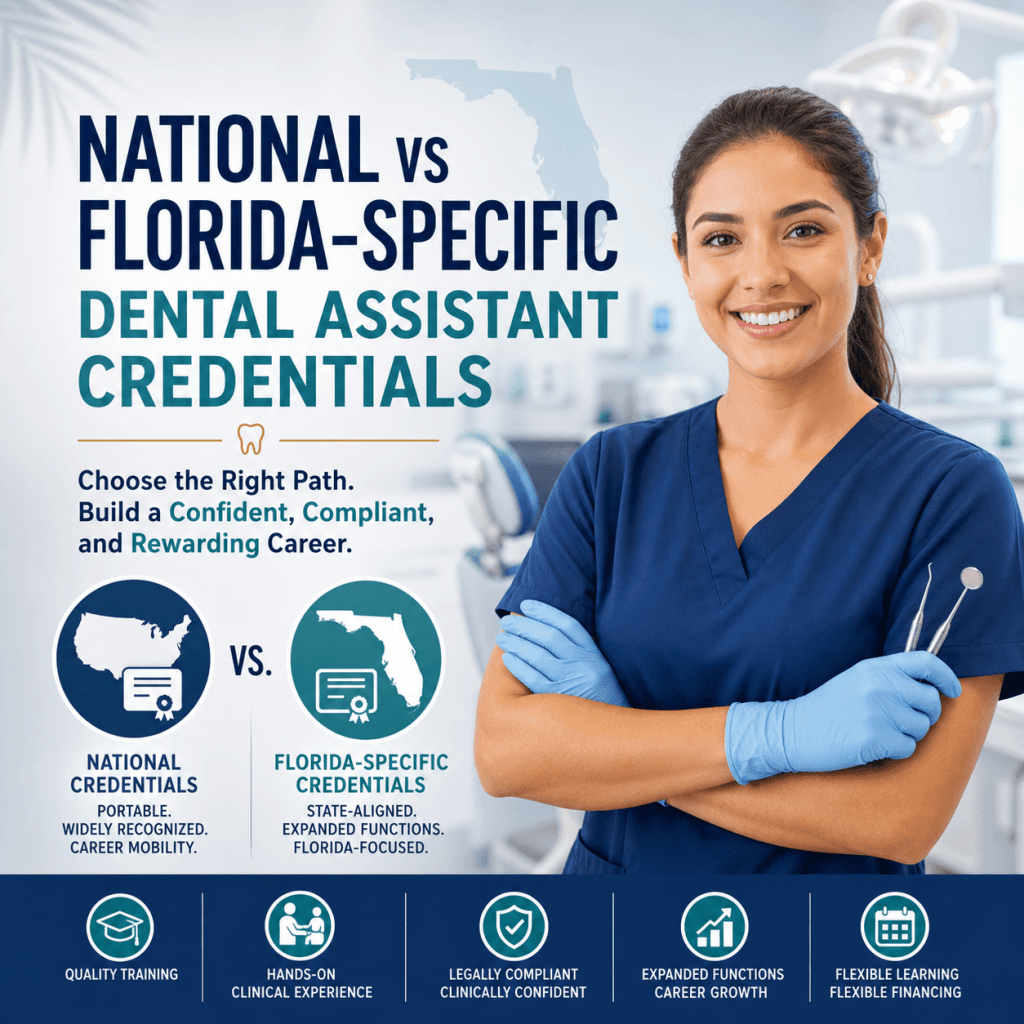
In plain terms, there is a difference between starting in entry-level assisting and pursuing additional credentials that may expand responsibilities and opportunities over time. The right approach depends on your goals and your timeline.
A practical strategy for speed
If your priority is working as soon as possible, a smart approach is:
- Get strong foundational training and hands-on skills
- Start working sooner in an entry-level role where appropriate
- Stack credentials later as you gain experience and clarity on your goals
Credentials can support long-term mobility and expanded opportunities, but you do not want to delay your start unnecessarily. Requirements vary, so confirm the pathway that matches your situation and the type of role you want.
What makes hiring in South Florida different?
South Florida is a unique market. Many practices are busy, modern, and fast-paced. You may see multi-provider offices, high demand for cosmetic dentistry, and diverse patient populations with different expectations and communication styles.
What practices want and why
Local dentists often prioritize assistants who bring:
- Reliability and strong attendance
- Infection control discipline that never slips
- Solid chairside assisting fundamentals
- Patient comfort skills and calm communication
- Confidence under pressure in a busy schedule
Demand for skilled dental professionals continues to rise, but hiring is not just about filling a seat. Training quality matters because it affects patient safety, team efficiency, and the overall experience in the practice.
If you want to get hired quickly and keep growing, choose training that prepares you to thrive in a modern dental office, not just finish a course.
Why is Broward Dental Academy built for the job-ready path?
Broward Dental Academy is designed for students who want speed without sacrificing real readiness.
The Academy offers a wide range of dental courses and advanced dental training, with a focus on developing well-rounded professionals. The goal is not just to help students pass an exam. It is to help them become the kind of assistants practices actually want: thoroughly trained, legally compliant, and clinically confident.
The learning model: immersion plus real training
Students benefit from:
- Immediate immersion in online and clinical settings
- Modern eLearning lesson plans for remote training
- Hands-on clinical training to build real confidence
- In-office internships that connect training to real practice workflow
That mix matters because it supports fast progress while still building the habits that protect patients and support the dental team.
Outcomes that match employer needs
Broward Dental Academy emphasizes:
- critical thinking in clinical situations
- ethical practice and professionalism
- confident performance in a high-expectation environment
Broward Dental Academy also offers flexible schedules and flexible financing options, making it easier for students to start sooner instead of waiting for the “perfect time.” The Academy offers 07 courses, giving students options based on their goals and where they want to grow next.
If you have any questions about the programs, you can find answers in the frequently asked questions section.
If you are ready to move from interest to enrollment quickly, the next section will help you visualize the timeline.
What is a realistic timeline from interested to working?
The fastest path is usually the one with fewer gaps. Here is a simple, realistic progression many students can follow when they choose a program that is structured, hands-on, and connected to real offices.
Phase 1: Research and enrollment (days to a couple of weeks)
What speeds it up:
- You choose a program with clear start dates and a defined process
- You ask direct questions about hands-on training and internship placement
- You complete paperwork quickly
Phase 2: Online learning and foundational knowledge (varies by schedule)
What speeds it up:
- You set consistent weekly study blocks
- You treat online modules like appointments, not “free time”
- You take notes with the goal of using the info in clinic, not memorizing it
Phase 3: Clinical labs and hands-on skill-building (where confidence is built)
What speeds it up:
- You show up consistently and take coaching seriously
- You practice core routines until they are automatic
- You focus on accuracy first, then efficiency
Phase 4: Internship/externship (the bridge to employment)
What speeds it up:
- You approach it like a working interview
- You ask for feedback and correct issues quickly
- You build relationships and a strong reference
Phase 5: Job applications and interviews (often faster with real experience)
What speeds it up:
- You apply strategically to offices that match your skill level
- You prepare to speak clearly about what you can do
- You show professionalism in communication, appearance, and punctuality
Mini checklist: prepare upfront
- Your weekly schedule availability
- Transportation plan
- Childcare plan (if relevant)
- A simple financial plan and questions about financing
- Any basic documents a program may request
The goal is not just finishing quickly. It is being ready to perform confidently in a real dental practice.
Which mistakes slow people down?
Mistake 1: Choosing the cheapest or shortest option with little hands-on training
What happens: you finish, but you are not confident. Interviews feel stressful, and hiring takes longer.
Fix: choose immersive training with real clinical practice and instructor feedback.
Mistake 2: Delaying internship or real office exposure
What happens: you have no references and no proof you can handle workflow.
Fix: prioritize programs with built-in in-office experience.
Mistake 3: Not understanding what dentists want in South Florida
What happens: your resume looks fine, but your interview reveals you are not ready for a fast-paced office.
Fix: train for real chairside flow, communication, and professionalism.
Mistake 4: Focusing only on “passing” instead of becoming clinically confident
What happens: early job burnout, mistakes under pressure, and a harder first few months.
Fix: practice the routines, ask for feedback, and build a professional daily standard.
Why is this career worth entering quickly?
Dental assisting is one of the most practical ways to enter healthcare quickly with a role that is respected and skill-based.
The dental industry is one of the fastest-growing healthcare industries, and it offers real advantages:
- stable income potential
- flexible schedules in many practice settings
- strong career mobility as you gain experience
- opportunities to move into expanded functions or specialized interests over time
If you start with quality training from an institution like Broward Dental Academy, you can enter the field quickly and keep leveling up without feeling stuck.
What are the next steps toward your first job?
Here is a simple action plan:
- Pick a realistic start date based on your schedule
- Confirm schedule and financing so you can commit without delays
- Begin online learning modules and stay consistent
- Show up for clinical training ready to practice and improve
- Complete your internship/externship with professionalism
- Apply strategically and interview with confidence
For a broader statewide overview, visit the hub page: How to Become a Dental Assistant in Florida.
If your goal is the fastest route, remember this: the quickest path is the one that makes you job-ready, not just “done.” Trained, compliant, and confident is what gets you hired in South Florida.
Don’t delay, enroll today, you will be glad that you did!
FAQs (Frequently Asked Questions)
What is the fastest way to become a dental assistant in South Florida?
The fastest way to become a dental assistant in South Florida is to enroll in a focused dental assistant program that combines efficient learning with immediate clinical skill-building and real dental office exposure. This approach ensures you are job-ready by training smart, getting hands-on experience, and proving your competency to employers.
Do I need a degree to become a dental assistant in Florida?
For many entry-level dental assisting roles in Florida, a traditional degree is not required. Employers prioritize candidates who are trained, dependable, and capable in clinical settings. However, obtaining relevant certifications and completing structured training programs can significantly enhance your employability.
What qualities do dental offices in South Florida look for in dental assistants?
Dental offices seek dental assistants who demonstrate professional communication with patients and staff, comfort working closely in clinical environments, attention to detail especially regarding infection control and sterilization, ability to stay organized during fast-paced schedules, and willingness to learn and take coaching.
How does my background affect the time it takes to become a dental assistant?
Your starting point influences your timeline: if you have no experience, you will need structured training with hands-on practice and office exposure; if you have some healthcare background, you may learn clinical routines faster but still require dental-specific skills training. Choosing programs with flexible schedules like evenings or weekends can also accelerate your path.
What are the practical prerequisites for enrolling in a dental assistant program?
Depending on the program or employer, prerequisites may include background checks or screenings, immunizations and health documentation, CPR/BLS certification (varies by role), reliable transportation especially for South Florida commutes, and basic computer skills for charting and scheduling.
How long does it take to complete a dental assistant program?
Program lengths vary depending on format: accelerated programs offer concentrated training that moves faster, while traditional semester-based programs may take longer. Selecting an accelerated or hybrid program that fits your schedule can help you complete training more quickly while still covering essential skills for employment.