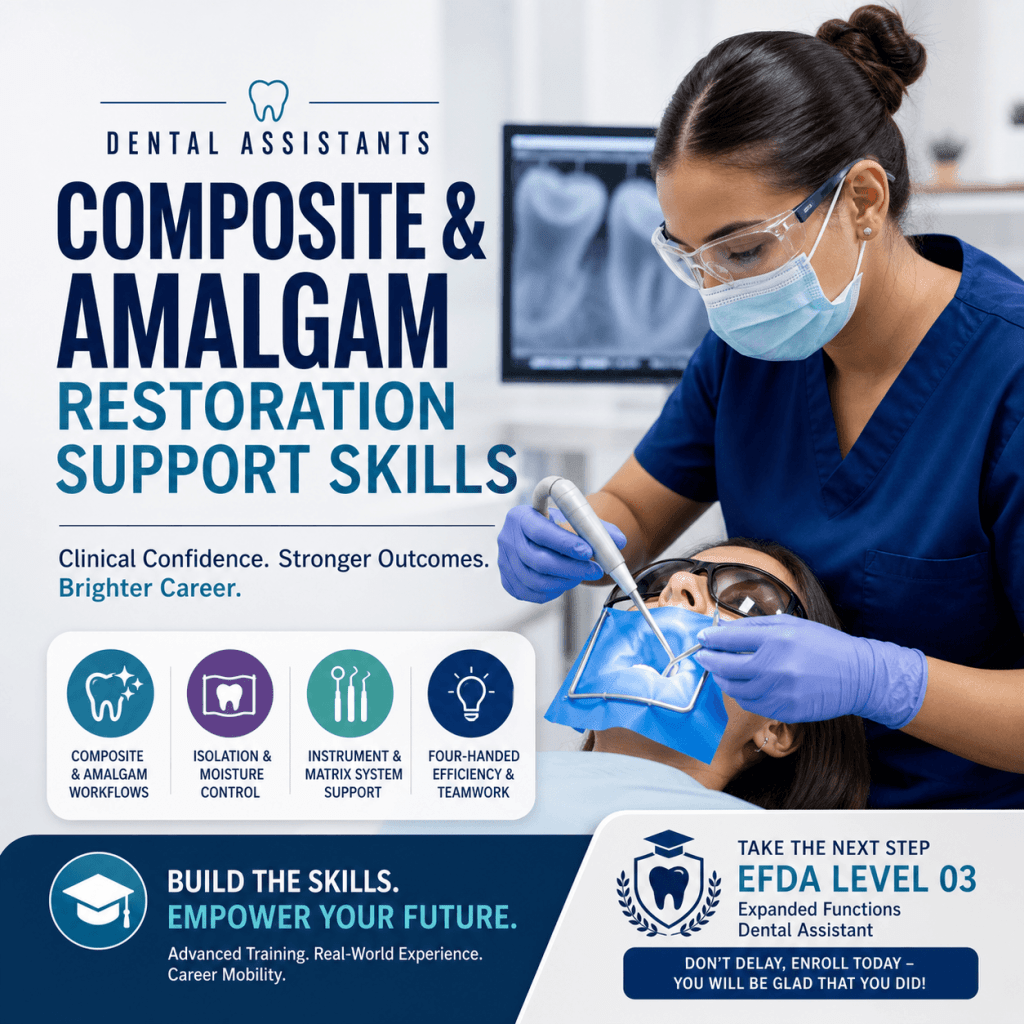
When a schedule is full of fillings, dentists rely on assistants to keep appointments efficient, safe, and predictable. That means the right setup, clean isolation, confident suction and retraction, and perfect timing with materials and instruments.
It also connects directly to patient outcomes. Isolation, moisture control, and accurate matrix placement are not just “helpful.” They can influence bond strength, margin integrity, postoperative sensitivity, and the long-term success of the restoration.
Just as important, it helps to be clear on scope. These are support skills, not expanded functions performed independently. Dental assistants support under dentist supervision and must follow state rules, office protocols, and training requirements. For a detailed understanding of these regulations, you may refer to this comprehensive guide.
If you want career growth, restorative proficiency is one of the fastest ways to build confidence and become more employable. It also sets a strong foundation for an Expanded Functions Dental Assistant (EFDA) pathway when you are ready.
Why composite and amalgam support skills matter for today’s dental assistants
Restorative appointments can look routine on the schedule, but they are detail-heavy in the operatory. When assistants know the sequence and can anticipate needs, the dentist stays focused on the tooth, not on logistics.
Here is what strong support skills change in real time:
- More predictable appointments: less fumbling for wedges, bands, curing light, or cotton rolls mid-procedure.
- Better clinical outcomes: dryness for composite bonding, stable matrices for tight contacts, clean field control for both materials.
- Safer dentistry: reliable infection control, safer handling of materials, and consistent operatory cleanup.
- Better patient experience: calm explanations, smoother flow, shorter chair time, and fewer “pause moments.”
Over time, those same skills often lead to greater responsibility, stronger references, and access to expanded functions training when appropriate.
But remember that restorative dentistry is just one aspect of a dental assistant’s role. There are other areas such as oral surgery, orthodontics, endodontics, each requiring a unique set of skills. If you’re looking to broaden your expertise beyond restorative dentistry or if you’re interested in exploring various specialties within dentistry such as oral surgery, orthodontics, or endodontics, consider enrolling in some of these specialized courses offered by institutions like Broward Dental Academy. They provide comprehensive training across various fields including restorative dentistry and beyond.
Composite vs. amalgam restorations: what’s different (and what support looks like)
Composite and amalgam restorations are both common, but they demand different support habits.
Composite is a tooth-colored resin material often used for small to moderate restorations, especially in visible areas. It is technique sensitive, meaning moisture or contamination can compromise the bond and reduce longevity. Support revolves around isolation, step-by-step bonding, and controlled light-curing.
Amalgam is a silver-colored alloy used primarily for posterior restorations in certain clinical situations. It involves trituration, delivery, condensation, carving, and burnishing, along with strict mercury hygiene and office-specific waste protocols. Support focuses on timing, field management, and compliant cleanup.
A simple workflow comparison:
- Composite: isolate → etch/prime/bond (or universal adhesive steps) → place in increments → light-cure → finish/polish → occlusion check
- Amalgam: isolate/manage field → triturate capsule → deliver → condense → carve/burnish → check occlusion → cleanup/waste handling
Many practices still need both skill sets depending on patient needs, insurance coverage, existing restorations, caries risk, and clinical conditions. A restorative-ready assistant can pivot smoothly without slowing the provider down.
Pre-op readiness: operatory setup and infection control for restorative procedures
Efficient restorative care starts before the patient sits down. Great assistants build a consistent system for turnover, setup, and checks. To achieve optimal results in restorative procedures such as periodontics, it’s essential to ensure that the operatory setup is meticulously planned. This includes maintaining stringent infection control measures to safeguard both patient and staff health. Moreover, having a well-trained staff who hold relevant certifications can significantly enhance the quality of care provided during these procedures. It’s also beneficial for dental practitioners to address any frequently asked questions related to these procedures to better prepare their patients. In terms of logistics, offering services at multiple locations can improve accessibility for patients seeking restorative care.
Room turnover essentials
- Place barriers and perform surface disinfection per office protocol.
- Confirm sterilization indicators and instrument packaging integrity.
- Follow hand hygiene and PPE standards for restorative procedures (including eye protection and masks appropriate to aerosol risk).
Tray setup fundamentals
While setups vary by dentist, most restorative trays include:
- Basic exam instruments: mirror, explorer, cotton pliers
- Anesthetic setup per provider preference
- Isolation items: cotton rolls, dry angles, gauze, bite blocks, rubber dam materials if used
- Suction tips: HVE and saliva ejector
- Matrix systems and wedges (stock options ready)
- Articulating paper and holder
Material readiness
- Check expiration dates on bonding agents, etchants, liners, and composite.
- Store composite away from heat and operatory light exposure.
- Organize amalgam capsules by type and size, if used in the practice.
Equipment checks
- Confirm curing light tip cleanliness and output readiness (per office testing routine).
- Confirm suction performance, especially HVE flow.
- Check handpieces and any mixing devices or triturator readiness.
Documentation basics
Before starting, verify:
- Medical history updates
- Allergies (including latex sensitivity)
- Any material sensitivities or prior reactions
Patient prep and communication that keeps the appointment smooth
Restorative visits go better when patients know what to expect and feel guided.
- Confirm the procedure: tooth number, side, and planned restoration type per dentist direction.
- Support consent workflow: ensure the practice process is followed.
- Watch for medical flags: anticoagulants, pregnancy, latex sensitivity, and anything the provider needs to know before anesthesia or isolation.
- Assist with local anesthesia setup: topical, syringe components, and suction positioning.
- Positioning matters: support patient comfort while keeping ergonomic access for the provider and assistant.
A simple phrase that often reduces anxiety is:
“You’ll feel water and suction, and some pressure, but if you need a break just raise your left hand.”
Good positioning also protects your body. When assistant posture is consistent, visibility improves and fatigue drops, especially during long Class II restorations.
Isolation and moisture control: the make-or-break support skill for composites
Composite bonding depends on a clean, dry field. Saliva, blood, and moisture contamination can weaken bond strength and increase the risk of staining, marginal leakage, and sensitivity.
Rubber dam support (when used)
Dental assistants commonly support by:
- Preparing the dam, frame, punch, and clamp options
- Passing the clamp and forceps safely
- Helping with placement flow (frame positioning, dam stabilization) as directed by the dentist
Four-handed suction techniques
Strong moisture control often comes down to:
- Keeping HVE close enough to capture aerosol and water without blocking the dentist’s view
- Using saliva ejector strategically when needed
- Anticipating rinse steps during etch and bonding
Retraction and mirror skills
During etch, bonding, placement, and curing, assistants help maintain access by:
- Retracting cheek and tongue safely
- Using mirror retraction to improve visibility and reduce fogging
- Stabilizing tissue so the dentist can focus on margins
Common issues and quick fixes
- Fogging: warm the mirror, reposition airflow, or adjust suction placement.
- Pooling water: move HVE closer, change angle, add gauze or cotton rolls quickly.
- Tongue interference: use a bite block, gentle retraction, and clear communication with the patient.
Matrix systems and wedge support for Class II and beyond
Matrices are not just “bands.” They help recreate proper contour and contact, prevent overhangs, and support anatomical form.
Common matrix systems you will see
- Tofflemire (universal matrix): common for posterior restorations and many amalgam cases.
- Sectional matrices: often preferred for composite Class II to achieve tight contacts and natural contours.
- Clear matrices: used in certain composite cases to allow light transmission and contour control.
Why wedges matter
Wedges help:
- Seal the gingival margin to reduce flash and overhangs
- Slightly separate teeth to improve contact
- Stabilize the band and protect gingival tissue
Assistant’s role during matrix placement
- Select components quickly based on the dentist’s preference
- Anticipate the moment wedges are needed and have sizes ready
- Pass/receive instruments cleanly and maintain stable suction and retraction
- Watch for band stability and tissue blanching that may signal excessive pressure
Helpful checkpoints to keep in mind:
- Does the band look stable and properly adapted at the gingival margin?
- Is the wedge seated and not traumatizing tissue?
- Does anything look loose before the dentist begins placement?
Composite workflow support: bonding, placement, and curing
Composite appointments run best when the assistant controls the “micro-sequence” so the dentist never has to pause.
Etch and bond sequence support
- Stage materials in the order used.
- Dispense etch and bonding agents per protocol without cross-contamination.
- Keep caps closed and bottles protected from operatory light.
Composite handling basics
Assistants should be comfortable with:
- Shade selection support (as directed by the dentist)
- Managing composite compules and tips
- Minimizing light exposure to prevent premature curing
- Knowing that incremental placement often improves cure quality and reduces shrinkage stress
Light-curing support
Curing is a clinical step where assistants often add real value:
- Maintain correct angulation and close distance without touching the material
- Cure for the correct time per material and light protocol
- Cure through a matrix when appropriate and directed
- Follow safety glasses protocol for blue light protection
Troubleshooting moments
If something goes off track, calm support helps the dentist recover quickly:
- Tacky surface: confirm curing cycle completion and tip cleanliness; be ready to cure again as directed.
- Slumping: adjust suction and retraction, pass appropriate instrument quickly, reduce operatory light exposure.
- Premature curing: keep compules covered and stage only what is needed.
- Contamination: be ready with rinse, suction, and isolation reinforcement to restore a clean field.
Amalgam workflow support: trituration, delivery, condensation, and carving assistance
Amalgam requires different timing and safety habits, especially around capsule handling and waste.
Safety and handling basics
- Select the correct capsule type and size.
- Use a closed system for trituration.
- Follow office mercury hygiene policies and spill protocols.
Timing matters
Amalgam has a working time window. Assistants support by:
- Triturating only when the dentist is ready for placement
- Having carrier and condensers ready
- Keeping the field controlled so condensation is uninterrupted
Field management during condensation and carving
- Strong HVE positioning reduces debris and improves visibility.
- Retraction must be steady without impeding the dentist’s hand position.
- Anticipate instrument changes as carving progresses.
Waste management and cleanup
- Use the designated amalgam waste container (not regular trash).
- Follow evacuation and separator protocols used by the office.
- Complete operatory cleanup steps consistently and compliantly.
Patient messaging
Some patients notice taste or strong pressure sensations. A calm explanation helps: “You may feel pressure as the material is packed. That part is normal. If anything feels sharp, let us know.”
Finishing, polishing, and occlusion checks: supporting the final details
The last five minutes can determine whether a patient leaves comfortable.
Occlusion support
- Place articulating paper and guide the patient through bite checks.
- Help the dentist interpret marks by keeping the field clean and visible.
- Expect multiple rounds of check and adjust.
Finishing and polishing armamentarium
Have organized and ready:
- Finishing burs
- Discs, strips, and finishing points
- Polishing cups and points appropriate to material
Soft tissue protection
During finishing, support with:
- Suction and retraction to reduce aerosol exposure
- Tissue shielding to prevent trauma from burs or discs
Quality cues assistants can notice
Assistants often spot issues first. If you notice something, flag it respectfully:
- Rough margins
- Possible overhang risk
- High spots
- Open contact concerns
Finish with a final rinse, and provide fluoride or varnish only if prescribed by the practice protocol. Then reset the operatory efficiently for the next patient.
Charting, documentation, and team handoffs during restorative appointments
Restorative charting should be accurate, complete, and consistent with office protocol.
Common documentation elements include:
- Tooth number and surfaces restored
- Material type (composite or amalgam)
- Composite shade (if used)
- Liners or bases placed (if applicable)
- Anesthetic type, amount, and notes as required by the practice
- Patient tolerance and any notable events
Imaging support
When indicated, support pre-op or post-op bitewings and ensure images are properly saved and labeled.
Clear handoffs
At the end, the team should be aligned on:
- What was completed today
- Post-op instructions and what symptoms are normal vs. not normal
- Any future treatment steps and scheduling notes
Thorough charting protects patients, providers, and the practice. It also helps future clinical decisions make sense.
What practices look for: the support skills that make you “restorative-ready”
Dentists and office managers tend to notice the same high-value behaviors again and again.
- Speed with accuracy: quick setup and transfer without skipping safety or contamination control.
- Consistency: repeatable isolation, reliable suction, and predictable staging of steps.
- Professionalism: calm chairside communication and ethical behavior within scope.
- Adaptability: switching smoothly between composite and amalgam workflows as needed.
- Confidence: steady support that reduces stress for the entire team and keeps patients comfortable.
When assistants deliver these consistently, restorative appointments feel controlled instead of chaotic.
Build these skills with expanded functions training at Broward Dental Academy
If you want to move beyond basic assisting and become truly restorative-ready, these support skills are the bridge to an Expanded Functions Dental Assistant (EFDA) pathway.
Broward Dental Academy offers a wide range of dental courses and advanced dental training designed to help students become thoroughly trained, legally compliant, and clinically confident professionals. The goal is not just passing an exam. It is learning to thrive in a modern, high-performance dental practice with critical thinking, ethical standards, and confident execution.
Students train through a blended experience that includes online learning with updated eLearning lesson plans, clinical immersion, and in-office internships. Broward Dental Academy is committed to serving the Dental Community by developing well-rounded professionals through its training programs, with flexible financing available.
The dental industry continues to grow, offering stable income potential, flexible schedules, career mobility, and respected opportunities in healthcare. Practices are actively looking for assistants who can support restorative dentistry at a high level.
If you are ready to take the next step towards becoming an Expanded Functions Dental Assistant, explore the Expanded Functions Dental Assistant Level 03 (EFDA) program here: EFDA Program.
Additionally, Broward Dental Academy also offers various levels of dental assistant training that can further enhance your skills:
Don’t delay, enroll today – you will be glad that you did!
FAQs (Frequently Asked Questions)
What role do dental assistants play in restorative dentistry procedures?
Dental assistants are crucial in restorative dentistry by ensuring appointments run efficiently, safely, and predictably. They manage the right setup, maintain clean isolation, provide confident suction and retraction, and time materials and instruments perfectly. Their support directly influences patient outcomes such as bond strength, margin integrity, postoperative sensitivity, and the long-term success of restorations.
Why are composite and amalgam support skills important for dental assistants today?
Composite and amalgam restorations require detailed support skills that impact appointment flow and clinical outcomes. Skilled assistants help create more predictable appointments with less fumbling for materials, improve clinical results through effective moisture control and matrix placement, enhance safety via reliable infection control and material handling, and contribute to a better patient experience with smoother procedures and shorter chair time.
How do composite and amalgam restorations differ in terms of dental assistant support?
Composite restorations are technique-sensitive tooth-colored resins requiring strict isolation, step-by-step bonding, controlled light-curing, and moisture control. Amalgam restorations involve handling a silver-colored alloy with steps like trituration, delivery, condensation, carving, burnishing, mercury hygiene, and waste protocols. Dental assistant support varies accordingly to ensure proper field management, timing, and compliance during each procedure.
What pre-operative preparations should dental assistants focus on for restorative procedures?
Effective pre-op readiness involves meticulous operatory setup including instrument organization and infection control measures to safeguard patient and staff health. Dental assistants should establish consistent systems for turnover and checks before procedures begin. Additionally, having well-trained staff with relevant certifications enhances care quality during restorative treatments such as periodontics.
How does mastering restorative dentistry skills benefit dental assistants’ career growth?
Developing proficiency in restorative dentistry builds confidence and increases employability for dental assistants. These support skills often lead to greater responsibilities, strong professional references, and opportunities to pursue expanded functions training like the Expanded Functions Dental Assistant (EFDA) pathway when ready.
Are restorative dentistry skills the only specialty dental assistants should consider?
No. While restorative dentistry is vital, dental assistants can broaden their expertise by exploring other specialties such as oral surgery, orthodontics, endodontics, and periodontics. Enrolling in specialized courses offered by institutions like Broward Dental Academy can provide comprehensive training across various fields to enhance skills beyond restorative dentistry.