Key takeaways
- What is day one like?
Faster than most expect: you join a booked schedule, so the practice needs you dependable at sterilization and setup immediately. - What gets you shortlisted?
Documented hands-on training, radiology support where trained, a clean infection-control answer, and an internship reference. - What do interviews test?
Often a practical component: instrument identification, setup, and how you talk to a patient who is anxious. - How do you grow from there?
Add expanded functions or specialty training once you are reliable at the fundamentals, usually within the first year or two.
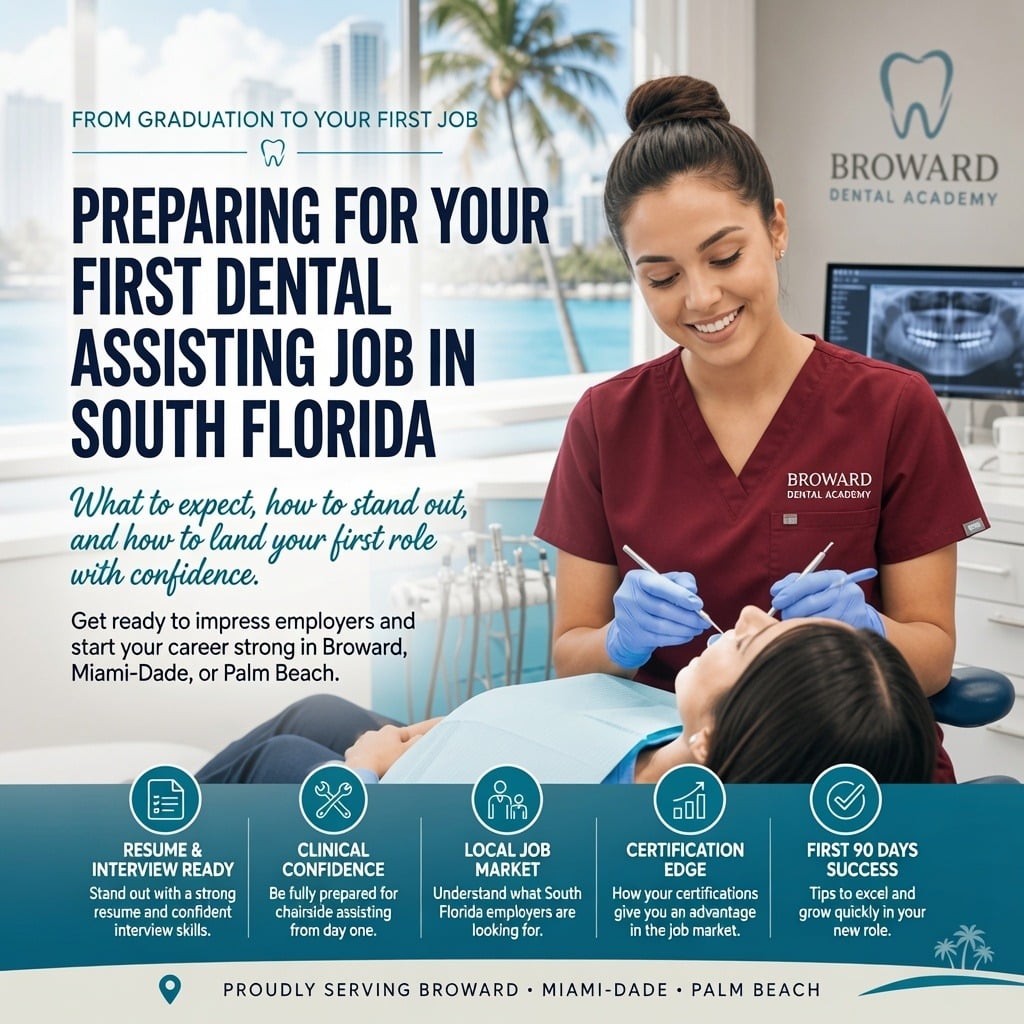
Starting your First Dental Assistant Job in South Florida is exciting, but it is also a real shift into a fast, people-focused healthcare environment. One day you are practicing set-ups and radiographs in training, and the next you are supporting multiple providers, turning rooms quickly, and helping patients who are nervous, late, or in pain.
This guide is not just about getting certified. It is about walking into your first day ready to contribute, learn fast, and build a reputation as the assistant people can count on.
What will your first dental assisting job really look like?
Most new assistants imagine day one as slow training with lots of supervision. In some offices, you will get that. However, in many South Florida practices, including those specializing in areas like endodontics, you will feel the pace immediately.
Here is what “day 1” often looks like:
- High patient volume and tight scheduling. Same-day emergencies, add-ons, and last-minute cancellations are normal.
- Multiple providers and moving parts. You might support a dentist plus a hygienist or float between rooms depending on the practice’s needs.
- Teamwork over solo work. Sterilization, room turnover, lab cases, and patient flow depend on everyone staying in sync.
- Efficiency with a strong patient experience. South Florida offices compete heavily, so patient comfort, speed, and professionalism matter.
The variety of locations across South Florida also means you’ll have the opportunity to work in diverse settings. Whether it’s a bustling practice in Fort Lauderdale or a quieter office in Boca Raton, each experience will contribute to your growth as a dental assistant.
Common practice types in South Florida (and how your role shifts)
Not all dental assistant jobs feel the same. Your day changes depending on the specialty.
- General dentistry: A wide mix of procedures. You will support fillings, crowns, bridges, endo, extractions, impressions, same-day emergencies, and sometimes implants depending on the dentist.
- Pediatric dentistry: Behavior management and communication are huge. You will move fast, keep rooms kid-friendly, and help parents understand aftercare.
- Orthodontics: More repetitive workflows (bonding, wire changes, scans, impressions), but speed, organization, and patient communication are critical.
- Oral surgery: Strong focus on set-ups, sterile fields, patient monitoring, post-op instructions, and staying calm when procedures get intense.
- Periodontics: You may assist with surgical procedures, grafts, and implants, with high standards for sterile technique and documentation.
Why South Florida is unique
South Florida dental offices often share a few realities:
- Diverse patients and cultural expectations. Communication style matters. Courtesy and clarity go a long way.
- Bilingual communication is a real advantage. Spanish is common, and Haitian Creole can be a major plus depending on the area.
- Competitive hiring. There are many offices and many applicants. Practices tend to choose candidates who look ready to contribute quickly.
- High emphasis on efficiency and hospitality. Think clinical precision plus customer service.
In such a diverse environment where cultural competence is essential in healthcare settings like dental offices, understanding these dynamics can significantly enhance your effectiveness as a dental assistant.
What should you clarify about Florida requirements before applying?
One of the biggest stress points for new assistants is job postings that seem contradictory. For instance, an “Entry-level dental assistant” job might list tasks that sound like expanded functions. That is why it’s crucial to understand the difference before you apply.
Entry-level vs expanded functions (why job posts get confusing)
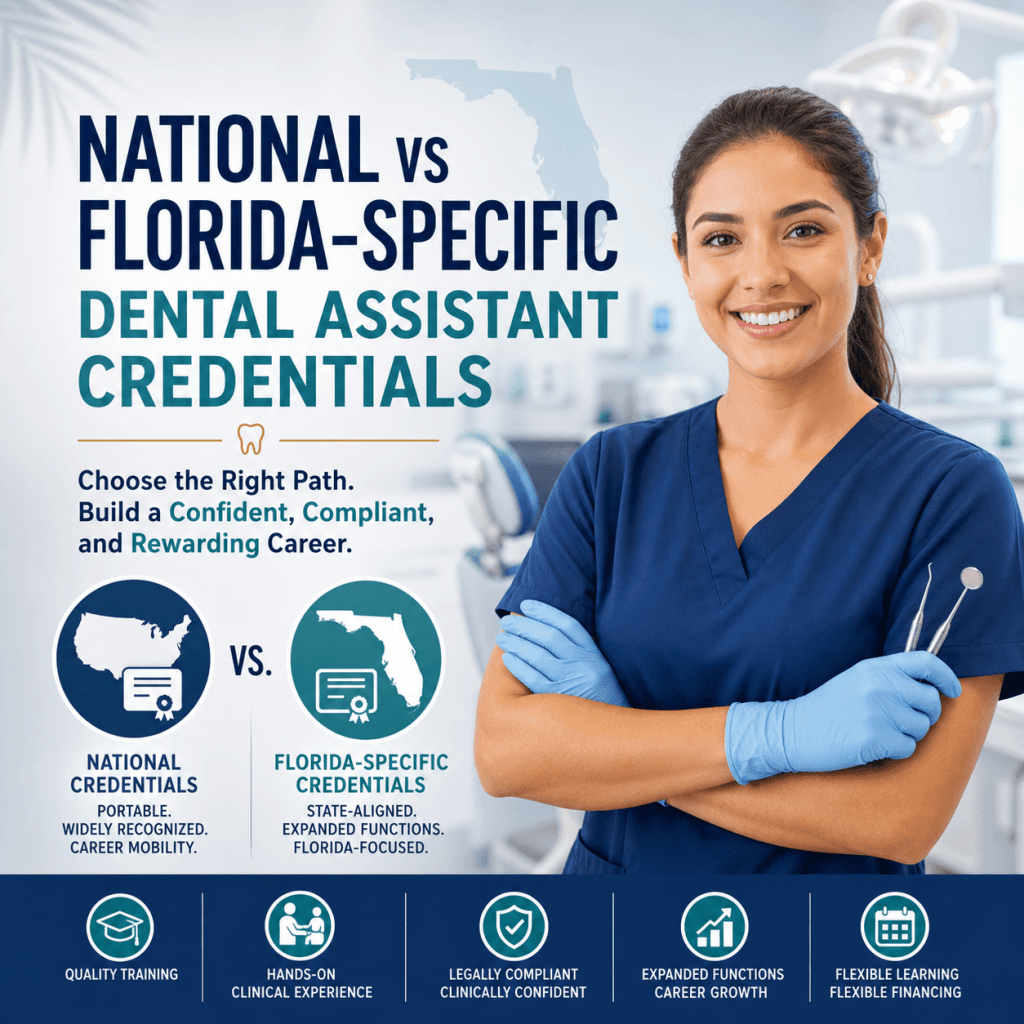
- Entry-level dental assistants typically support chairside procedures, sterilization, room turnover, charting support, supply stocking, and patient flow. You can acquire these skills through programs like Dental Assistant Level 01.
- Expanded functions can include additional clinical duties depending on Florida rules, training, and supervision requirements. These are often covered in advanced courses such as Dental Assistant Level 02, or even Dental Assistant Level 03 for more specialized roles.
Florida has specific regulations around what a dental assistant can and cannot do, and offices care about this more than people realize. Practices want assistants who understand boundaries, ask questions when unsure, and do not “guess” their way into a compliance issue.
What employers screen for right away
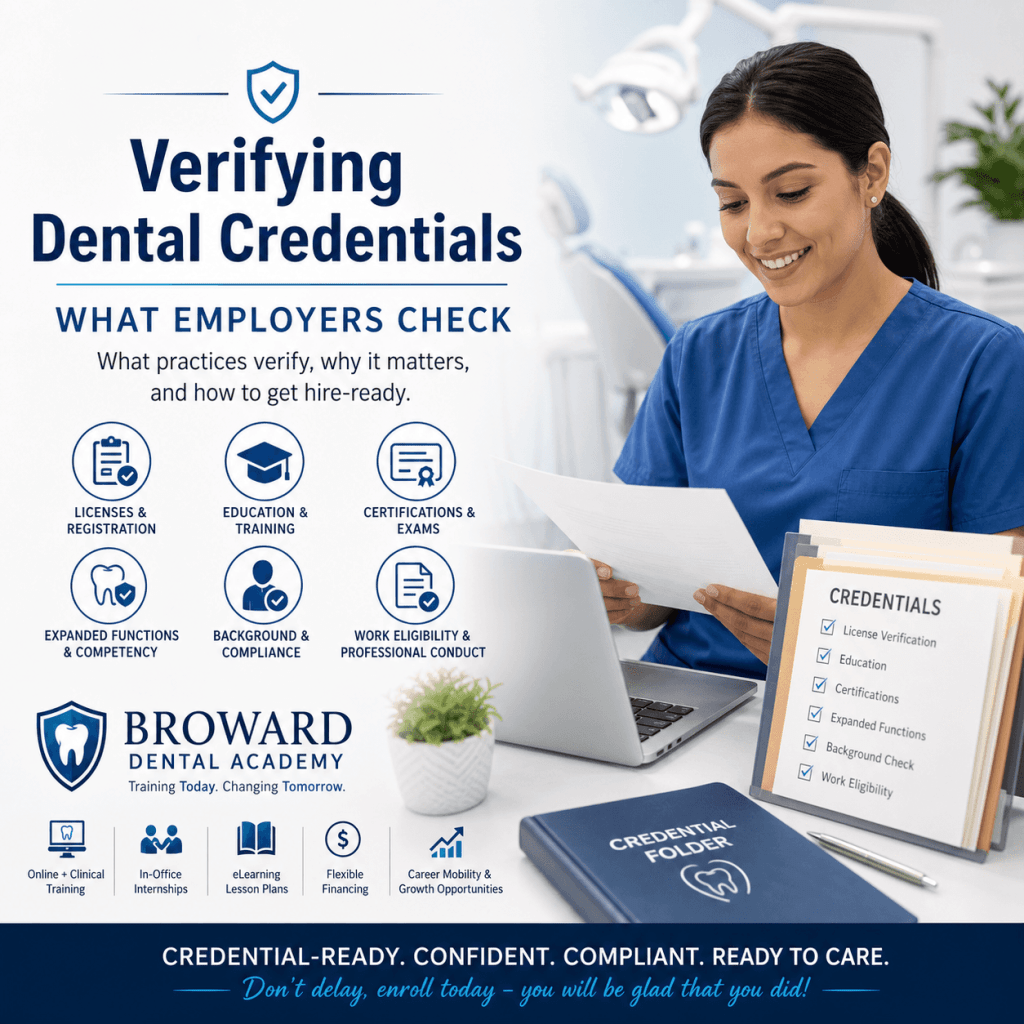
Even for entry-level roles, many South Florida offices look for baseline readiness in:
- Infection control fundamentals and operatory turnover
- Familiarity with radiology concepts and safe positioning
- Chairside flow, suction, isolation, and instrument transfer basics
- Charting comfort and a willingness to document accurately
- A mindset of speed without shortcuts
Modern practices run like high-performance environments. If the schedule is stacked, the assistant who stays calm, stays clean, and stays organized becomes valuable quickly.
Which skills should you sharpen before your first day?
If you want to feel confident in your first 30 days, sharpen the skills that show up every single hour.
Chairside assisting essentials
These are the fundamentals that make dentists trust you fast:
- Tray set-ups and knowing what goes where
- Instrument transfer and passing with minimal disruption
- High-volume suction, saliva ejector placement, and patient comfort
- Isolation and retraction with good visibility for the provider
- Adjusting light, chair position, and patient head position quickly
- Anticipating the next step (materials, burs, cotton, hemostatic agents)
Anticipation is what separates “new” from “ready.” You do not need to know everything. You do need to watch patterns and think one step ahead.
Understanding the expectations for your First Dental Assistant Job will prepare you for a successful start.
Sterilization and operatory turnover
South Florida offices move fast, but infection control is never optional. A strong assistant understands:
- Clean-to-dirty workflow and instrument processing sequence
- Cassettes, pouching, labeling, and storage systems
- Why biological indicators matter and how tracking works
- Surface disinfection, barriers, and contact time
- Turning rooms quickly without cutting corners
Speed comes from repetition and a system, not from skipping steps.

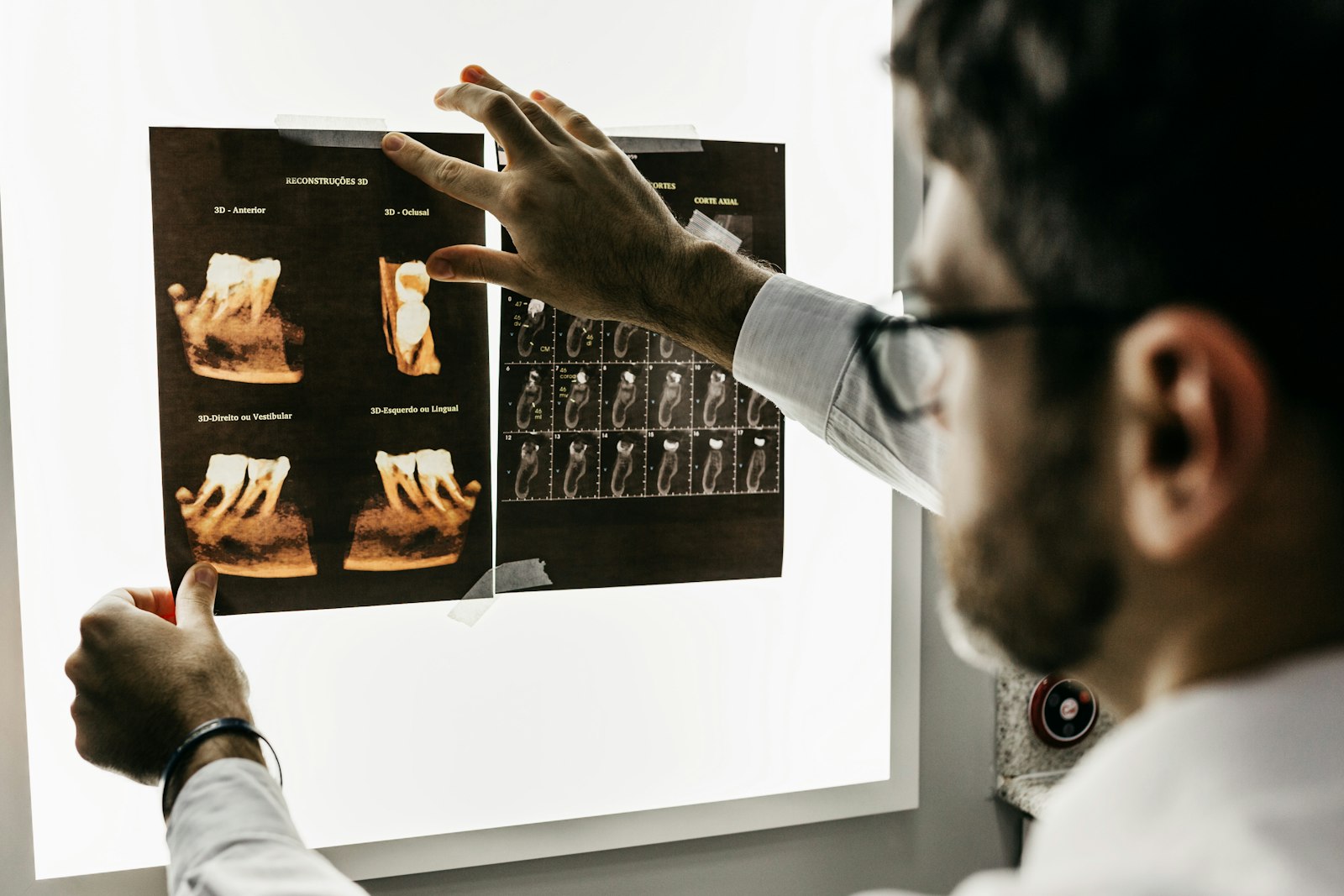
Dental radiography confidence
Radiographs are one of the fastest ways new assistants get tested. Work toward confidence in:
- Positioning basics and patient comfort
- Reducing retakes by controlling angulation and receptor placement
- Understanding why image quality matters for diagnosis and treatment planning
- Staying calm with gaggers, kids, and anxious patients
Even if a practice has digital sensors and modern systems, the basics still win.
Charting and documentation
Documentation protects the patient, the provider, and you. Be ready for:
- Common abbreviations and tooth numbering systems used in the office
- Updating medical history and noting changes properly
- Flagging allergies and key risk factors clearly
- Understanding informed consent awareness, especially when procedures change
Soft skills that matter as much as clinical skill
In many South Florida offices, soft skills are the difference between keeping the job and growing in it:
- Clear, respectful communication under pressure
- Coachability and a willingness to be corrected
- Reliability and punctuality
- Ethical judgment, especially around scope and safety
- A calm tone with patients, even when the schedule is behind
What makes a candidate stand out in South Florida hiring?
When practice owners and office managers hire, they look for “safe hands” and “good energy.” In real terms, that usually means:
- Professional appearance and communication
- On-time habits and dependable transportation
- A patient-first attitude
- Consistent clinical fundamentals, not overconfidence
The bilingual advantage (and cultural competence)
If you speak Spanish or Haitian Creole, mention it clearly on your resume and in interviews. If you are not fluent, you can still stand out by showing cultural competence:
- Speak clearly and avoid slang with patients who might not be fluent in English
- Use interpreter resources appropriately
- Confirm understanding with simple questions
- Show patience when patients need things repeated
How to get “experience” without experience
Internships, externships, and hands-on training are what make you job-ready. Hiring managers understand that a new graduate will not be perfect, but they want proof you have:
- Worked in real operatories
- Turned rooms under time pressure
- Assisted in procedures, even if supervised
- Followed infection control systems in a live environment
Showing you can thrive in a modern practice
Offices want assistants who can function in a high-performance schedule. Examples you can share:
- “I pre-stage rooms so we are not opening materials mid-procedure.”
- “I keep a restock list so we do not run out during peak hours.”
- “I confirm provider preferences and write them down so I apply them consistently.”
How do you write a resume dental offices actually read?
Dental offices are busy. Your resume needs to be clear in 10 seconds.
Keep it simple and dental-specific
A clean resume structure usually wins:
- A strong headline (Dental Assistant, Entry-Level)
- Certifications and training
- Clinical skills (chairside, radiography familiarity, sterilization)
- Software exposure (if applicable)
- Externship or internship details
Turn training into proof
Do not just write “trained in dental assisting.” List the competencies:
- Tray set-ups for restorative procedures
- Operatory turnover and surface disinfection
- Sterilization workflow (pouching, cassettes, autoclave process)
- Radiograph positioning basics
- Impression assistance or scanning exposure (if applicable)
If you completed internship or externship hours, include them prominently.
Add measurable details without fluff
You do not need to exaggerate. You do need specifics.
Examples:
- “Assisted with restorative procedures under supervision during clinical training.”
- “Performed operatory turnover between patients while maintaining infection control standards.”
- “Supported instrument processing and maintained clean-to-dirty sterilization flow.”
References and professionalism
Your best references are usually:
- Instructors
- Internship or externship supervisors
- Dentists or lead assistants you trained under
Ask early, ask politely, and make it easy by sharing the job type you are applying for.
Application checklist
Before you hit submit, make sure you are ready to provide:
- Any required documentation tied to Florida roles
- CPR/BLS (if you have it)
- Clear availability (days, evenings, weekends)
- Proof you can reliably commute (South Florida traffic is real)
How do you prepare for the interview and skills test?
Dental offices often move quickly in hiring, but they also want to reduce risk. Expect one or more of these:
- Phone screen
- In-person interview
- Working interview or shadowing
- Skills check

How to answer the big questions
“Tell me about yourself.”
Keep it professional: your training, what you are strong at, and what kind of office you want.
“Why dental assisting?”
Focus on patient care, teamwork, and the pace of dentistry, not just “I like teeth.”
“How do you handle a difficult patient?”
Talk about staying calm, listening, confirming concerns, and asking for help when needed.
“How do you prioritize?”
Mention safety first (infection control, patient medical history), then procedure flow, then efficiency tasks like restocking.
Likely skills they will test
Even entry-level candidates may be asked to demonstrate:
- Instrument identification
- Tray set-up logic
- Sterilization steps and why they matter
- Suction and isolation basics
- Basic radiography knowledge (positioning and retakes)
For a comprehensive understanding of these skills, consider taking a look at the dental assistant test which often includes these areas.
Smart questions to ask the office
You are interviewing them too. Ask:
- “What does training look like in the first two weeks?”
- “How many patients do you typically see per day?”
- “How many assistants per provider?”
- “Which software do you use for charting and scheduling?”
- “What is your sterilization system and who runs it?”
- “How do you handle same-day emergencies?”
Red flags for new assistants
Be cautious if you notice:
- No training plan and no one assigned to support you
- Unsafe shortcuts with infection control or radiography
- Chronic understaffing with constant blame
- Unclear boundaries about what assistants are expected to do
If something feels unsafe, it usually is.
How do you ramp up in your first 30 days?
Your goal in the first month is simple: become dependable. Speed comes after accuracy.
Week 1 focus: learn the system
- Learn office flow and daily rhythm
- Understand room stocking and where everything lives
- Learn provider preferences and write them down
- Lock in sterilization non-negotiables
If you master where things are and how the office runs, you reduce stress fast. To prepare yourself for these challenges, consider reviewing some frequently asked questions that can provide valuable insights into common scenarios faced by dental assistants.
Weeks 2 to 4: speed plus accuracy
- Anticipate steps in common procedures
- Reduce turnover time safely through better staging
- Improve radiographs by correcting the same mistakes
- Strengthen charting habits and documentation consistency
Taking feedback like a pro
The fastest-growing assistants do three things:
- Write down preferences and corrections
- Repeat back to confirm
- Apply the feedback the next time
Time management habits that help immediately
- Pre-stage rooms before peak hours
- Use checklists for room reset and restocking
- Do an end-of-day reset so mornings are smoother
- Minimize rework by doing it right once
Common new-assistant mistakes to avoid
- Guessing instead of asking
- Skipping documentation
- Forgetting medical history updates
- Rushing sterilization steps
Which professionalism basics protect your career?
Dental assisting is built on trust. Professionalism is not a bonus, it is protection.
Patient privacy and trust
- Keep a HIPAA mindset everywhere, including hallways and break rooms
- Avoid patient discussions at the front desk where others can hear
- Be careful with photos and social media boundaries
Infection control and safety culture
Shortcuts can end careers. If you see something unsafe, speak up respectfully. A good office will value your concern.
Ethics and scope awareness
Stay within duties. Ask questions when unsure. Document properly. Practices want assistants who are compliant and careful.
Team communication
In a busy South Florida schedule, miscommunication causes chaos. Confirm instructions, give clean handoffs, and stay calm when the pace spikes.
How do you move from entry level to expanded functions?
Dental is one of the fastest-growing areas in healthcare, and demand for skilled dental professionals continues to rise. For you, that can translate into long-term opportunity.
People choose dental assisting because it offers:
- Stable income potential
- Flexible schedules in many practices
- A respected role in healthcare
- Career mobility and specialization options
Growth paths to consider
As you gain experience, you can grow into:
- Specialty offices (ortho, peds, oral surgery, perio)
- Lead assistant roles
- Strong radiography proficiency and advanced clinical confidence
- Expanded functions through additional training
- Administrative and management tracks over time
The assistants who earn more responsibility usually keep learning consistently.
How does Broward Dental Academy get you ready for day one?
Broward Dental Academy is built around preparing students to thrive in a modern, high-performance dental practice, not just pass an exam.
That preparation includes:
- A training culture that supports critical thinking, ethics, and real-world clinical confidence
- Immediate immersion in online and clinical settings, so students learn how dentistry actually moves
- Latest eLearning lesson plans incorporated for remote training
- In-office internships designed to translate into job-ready confidence and smoother first-day performance
- A wide range of options including 07 courses and advanced dental training to support long-term growth
- Flexible financing options to help students move forward without unnecessary delays
Practices are looking for professionals who are thoroughly trained, legally compliant, and clinically confident. That is the training target.
What is a simple plan to prepare, apply and get hired?
If you want a clear plan, use this:
- Confirm your readiness checklist (chairside fundamentals, sterilization workflow, radiography basics, charting comfort).
- Tighten your resume so it is dental-specific and proof-based.
- Practice interview answers and be ready for a working interview or skills check.
- Target offices that match your goals (general vs specialty, single provider vs multi-provider).
- Follow up professionally within 24 to 48 hours after applying or interviewing.
If you are earlier in your journey and want the full step-by-step path, start here: How to Become a Dental Assistant in Florida.
Preparation turns nervousness into confidence on day one. Do not delay. Enroll today at Broward Dental Academy. You will be glad that you did.
FAQs (Frequently Asked Questions)
What does a typical first day look like for a dental assistant in South Florida?
On your first day, expect a fast-paced environment with high patient volume, supporting multiple providers, quick room turnovers, and managing patients who may be nervous or in pain. You’ll need to contribute immediately, work efficiently, and provide excellent patient care.
How do dental assisting roles vary across different specialties in South Florida?
Roles shift based on specialty: general dentistry involves diverse procedures like fillings and crowns; pediatric dentistry focuses on behavior management and kid-friendly communication; orthodontics requires repetitive workflows with emphasis on speed and organization; oral surgery demands sterile technique and patient monitoring; periodontics involves assisting with surgical procedures and strict documentation.
Why is bilingual communication important for dental assistants in South Florida?
South Florida’s diverse population often speaks Spanish or Haitian Creole. Being bilingual enhances communication, builds rapport with patients, and improves overall patient experience, making it a valuable skill for dental assistants in the region.
What are the differences between entry-level dental assistant roles and expanded functions in Florida?
Entry-level assistants typically perform chairside support, sterilization, room turnover, charting, and supply stocking. Expanded functions include additional clinical duties allowed under Florida regulations after advanced training. Understanding these distinctions helps candidates meet job expectations and comply with legal boundaries.
What do South Florida dental offices prioritize when hiring new dental assistants?
Employers look for candidates who demonstrate readiness to contribute quickly, understand their scope of practice, communicate effectively (including cultural competence), maintain efficiency while ensuring patient comfort, and adhere strictly to compliance and safety standards.
How can new dental assistants prepare before applying for jobs in South Florida?
It’s important to understand Florida’s certification requirements and job expectations clearly. Gaining relevant training through programs like Dental Assistant Level 01 or higher levels for expanded functions helps. Also, developing cultural competence and language skills can improve your competitiveness in this diverse market.