Key takeaways: dental terminology for beginners
- Why does dental terminology for beginners come first?
Chart notes, tray setups and doctor instructions all run on shorthand, so terminology is what lets a new assistant follow the appointment instead of guessing at the next instrument. - Why learn the words first?
Chart notes, tray setups and doctor instructions all run on shorthand, so terminology is what lets a new assistant follow the appointment. - What is the fastest way?
Study in buckets: anatomy, surfaces and directions, conditions, restorative, specialties, radiology, instruments and charting. - Which terms come up hourly?
Tooth numbers and surfaces, caries and restoration terms, prophy and perio basics, and the common radiograph nicknames. - Where does it become real?
At the chair, where terminology turns into the right instrument at the right moment rather than a definition on a page.
Dental terminology can feel like a different language at first. The good news is you do not need to learn everything at once. You just need the daily essentials that show up in conversations, chart notes, treatment plans, X-rays, instrument setups, and insurance paperwork.
This beginner-friendly glossary is for:
- Patients who want to understand “dentist terms for teeth” in plain English.
- New team members and interns.
- Anyone exploring dental assistant terminology and trying to feel more confident in a busy practice.
If you are brand new, learning a core set of terms will help you communicate clearly, avoid mix-ups, and pick things up faster chairside.

Why does dental terminology matter, even if you are brand new?
Dental “jargon” is everywhere, including:
- Chart notes: brief shorthand like “MOD comp #14.”
- Treatment plans: sequences like “RCT then crown.”
- Radiology: “BWX” or “PA” images.
- Instrument setup: passing the correct hand instrument quickly.
- Insurance and coding: procedure names tied to CDT codes.
- Patient conversations: explaining what you see and what comes next.
Knowing the basics does not just make you sound professional. It helps prevent misunderstandings that can lead to real clinical mistakes, especially when the schedule is full and the pace is fast.
Exploring Further into Dental Specialties
As you familiarize yourself with dental terminology, you might find it beneficial to delve deeper into specific areas such as periodontics. Understanding this specialty could enhance your communication with patients regarding gum-related issues.
Enhancing Your Qualifications
For those aiming to further their career in dentistry, obtaining relevant certifications can be immensely helpful. These credentials not only bolster your knowledge but also increase your employability in a competitive field.
Common Queries Addressed
Navigating the dental field can often lead to a myriad of questions. To assist with this, we’ve compiled a list of frequently asked questions that cover various aspects of dental practices and terminologies.
Educational Opportunities Available
If you’re interested in formal education or training within this field, there are several courses offered that provide comprehensive knowledge about dental practices including hands-on experience which is crucial for mastering dental assistant terminology.
How should you use this glossary to learn faster?
A simple way to learn is to study in “buckets”:
- Anatomy (teeth and oral structures)
- Surfaces and directions
- Conditions and diagnoses
- Prevention and hygiene
- Restorative
- Endo, perio, prosth, ortho, surgery
- Radiology
- Instruments, materials
- Charting and abbreviations
Try this routine:
- Learn 10 terms per day.
- Say them out loud (pronunciation matters chairside).
- Match terms to real tools, photos, or diagrams.
- Use them in a mock chart note.
Common confusion pairs to watch:
- Prophylaxis vs scaling and root planing (SRP) (routine cleaning vs deep cleaning for gum disease)
- Cusp vs cingulum (point on a chewing surface vs ridge on the back of an anterior tooth)
- Composite vs amalgam (tooth-colored resin vs silver filling)
If you are shadowing or in internship, keep a small “clinic notebook” and write down new terms you hear in real time. Those are the words you will actually use daily.
Which tooth anatomy terms will you hear every day?
These are the structures you will hear constantly in exams, restorations, and endodontic conversations.
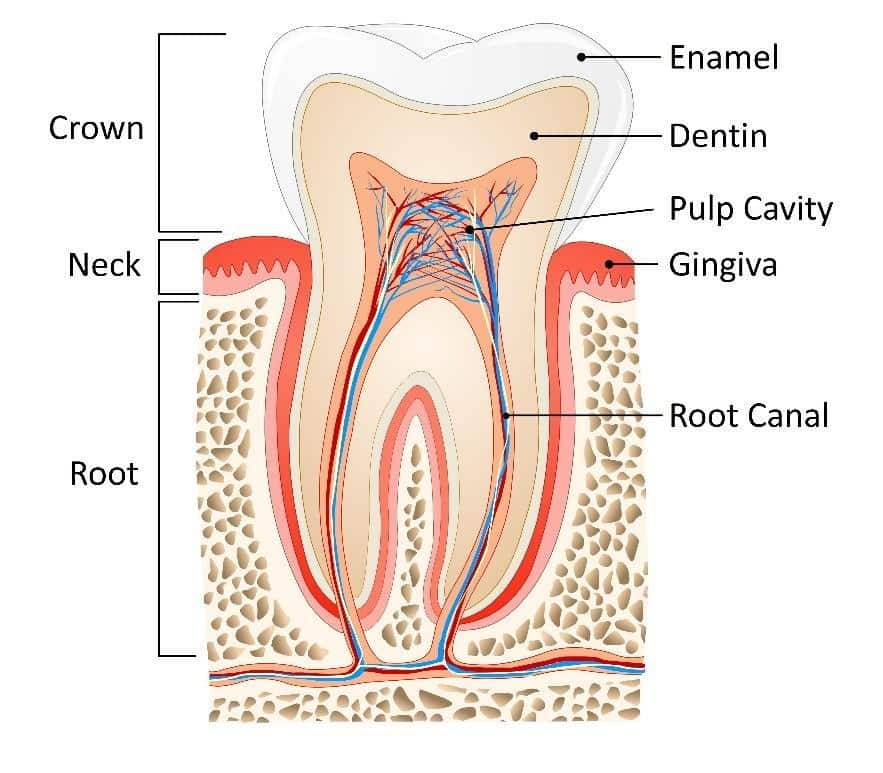
Tooth structures
- Enamel: The hard outer layer of the crown. Strong but can demineralize and decay.
- Dentin: The layer under enamel and cementum. More sensitive than enamel.
- Cementum: Outer covering of the root. Helps attach the tooth to the ligament.
- Pulp: The “nerve” tissue inside the tooth containing nerves and blood vessels.
- Pulp chamber: The space in the crown where pulp tissue sits.
- Root canal (anatomy): The natural canal space inside the root that contains pulp tissue.
- Apex: The tip of the root where nerves and blood vessels enter.
- Periodontal ligament (PDL): Fibers that connect the root to surrounding bone and absorb chewing forces.
For those interested in expanding their knowledge beyond just dental terms, understanding oral surgery could be beneficial as it involves various aspects of dental procedures that may not be covered in this glossary. Additionally, if you’re seeking educational resources or training facilities for dental education, exploring options at different locations could provide valuable insights and opportunities.
Parts of the tooth
- Crown: Visible part above the gums.
- Root: Part anchored in bone below the gums.
- Neck / CEJ (cementoenamel junction): Where crown enamel meets root cementum. A key area for recession and sensitivity.
Common descriptors (you will hear these in charting)
- Cusp: A pointed chewing surface “hill” (common on premolars and molars).
- Fissure: A deep groove, often where decay starts.
- Groove: A natural line or depression on the tooth surface.
- Pit: Small pinpoint depression, often on molars.
- Contact area: Where two neighboring teeth touch.
- Marginal ridge: Elevated enamel border on the chewing surface (important in Class II restorations).
Why it matters clinically: these terms connect directly to sensitivity, decay patterns, how restorations are shaped, and why a tooth might need a root canal.

How do tooth numbering and naming systems work?
If you can find a tooth quickly from charting, you are already ahead.
Universal Numbering System (permanent teeth 1-32)
- Upper right third molar = #1
- Upper left third molar = #16
- Lower left third molar = #17
- Lower right third molar = #32
Think in quadrants and count across. With practice, you will “see” the chart in your head.
Primary teeth (A-T)
Primary teeth are labeled with letters:
- Upper right second molar = A
- Upper left second molar = J
- Lower left second molar = K
- Lower right second molar = T
FDI (two-digit) quick intro
FDI is common internationally and in many educational settings.
- First digit = quadrant (1-4 permanent, 5-8 primary)
- Second digit = tooth position (1-8)
Example: 11 is permanent upper right central incisor.
Tooth types
- Incisors: Front cutting teeth (central and lateral).
- Canines: “Corner” teeth, pointed for tearing.
- Premolars (bicuspids): Between canines and molars.
- Molars: Large chewing teeth in the back.
- Primary vs permanent: “Baby” teeth vs adult teeth.
Practical example: “MOD on #14”
- #14 (Universal) is the upper left first molar.
- MOD means the restoration involves the Mesial, Occlusal, and Distal surfaces. Plain English: a filling that spans the chewing surface and both side surfaces between neighboring teeth.
Which terms describe dental surfaces and directions?
These terms tell you exactly where a cavity, filling, or crown margin is located.
Surfaces
- Mesial (M): Toward the midline of the face.
- Distal (D): Away from the midline.
- Facial (F): Toward the cheeks or lips (general term).
- Buccal (B): Toward the cheek (posterior teeth).
- Labial: Toward the lip (anterior teeth).
- Lingual (L): Toward the tongue.
- Palatal: Toward the palate (upper lingual).
- Occlusal (O): Chewing surface of posterior teeth.
- Incisal (I): Biting edge of anterior teeth.
Directional terms
- Anterior: Front.
- Posterior: Back.
- Superior: Up (maxilla).
- Inferior: Down (mandible).
- Coronal: Toward the crown.
- Apical: Toward the root tip.
Mini-scenarios
- “Caries on #30 MO” means decay on the lower right first molar, mesial + chewing surface.
- “Composite on #8 F” means a tooth-colored filling on the front surface of the upper right central incisor.
Which oral anatomy terms go beyond the teeth?
- Gingiva: Gum tissue around teeth.
- Mucosa: Softer tissue lining the mouth (cheeks, lips, floor of mouth).
- Attached gingiva: Firm gum tissue bound to underlying bone.
- Alveolar bone: Bone that holds the tooth roots.
- Frenulum (frenum): Tissue band connecting lips/cheeks/tongue (like the labial frenum).
- Vestibule: Space between cheeks/lips and teeth.
Other essentials:
- Hard palate / soft palate: Roof of mouth (front bony vs back soft).
- Floor of mouth: Tissue under the tongue, important for exams and oral cancer screening.
- Salivary glands: Parotid, submandibular, sublingual. Saliva protects teeth and helps digestion.
- TMJ (temporomandibular joint): Jaw joint. Comes up with pain, popping, locking, headaches, and bite issues.
The Periodontium, which is the support system of the tooth consisting of gingiva, cementum, PDL, and alveolar bone, plays a crucial role in understanding everything related to periodontal charting.
Which conditions and diagnoses come up most?
Caries-related
- Caries: Tooth decay.
- Demineralization: Early mineral loss in enamel, can look like a white spot.
- Lesion: General term for an area of disease or damage.
- Recurrent caries: New decay around an existing restoration.
Pulp and infection
- Pulpitis: Inflammation of the pulp.
- Reversible pulpitis: Irritation that can resolve once the cause is treated.
- Irreversible pulpitis: Pain and inflammation that typically requires root canal therapy.
- Necrosis: Dead pulp tissue.
- Abscess: Collection of infection or pus, often resulting from a necrotic tooth.
- Fistula: A drainage pathway from an abscess, sometimes visible as a small “pimple” on the gums.
Wear and damage
- Abrasion: Mechanical wear, often from aggressive brushing.
- Attrition: Tooth-to-tooth wear caused by grinding.
- Erosion: Chemical wear caused by acid.
- Fracture / crack: Breaks in tooth structure, ranging from minor to severe.
Occlusion and alignment
- Malocclusion: Misalignment of the bite.
- Overbite: Vertical overlap of the front teeth.
- Overjet: Horizontal projection of the upper front teeth.
- Crowding / spacing: Teeth positioned too close together or too far apart.
Inflammation vocabulary
- Edema: Swelling.
- Erythema: Redness.
- Localized vs. generalized: Limited to a specific area versus widespread throughout the mouth.
Which prevention and hygiene terms anchor most appointments?
- Prophylaxis (prophy): Routine preventive cleaning for a generally healthy mouth.
- Periodontal maintenance: Ongoing maintenance after periodontal treatment, typically at shorter intervals.
- Scaling and root planing (SRP): “Deep cleaning” for gum disease, removing calculus and biofilm above and below the gumline.
Fluoride and sealants:
- Fluoride varnish: Painted-on fluoride for enamel strengthening.
- Fluoride gel/foam: Often used in trays.
- Sealants: Protective coating on grooves of molars to prevent decay.
Home care terms:
- Interdental cleaning: Cleaning between teeth (floss, brushes, water flosser).
- Antimicrobial rinse: Mouth rinse designed to reduce bacterial load.
- Xerostomia: Dry mouth, increases caries risk.
How assistants support prevention: reinforcing instructions, documenting education, and helping patients choose products based on the dentist or hygienist’s recommendations.
Which restorative terms cover fillings and rebuilding teeth?
Restoration basics
- Restoration: Any material placed to repair a tooth.
- Filling: Direct restoration placed in the mouth.
- Inlay / onlay: Indirect restoration made outside the mouth, then cemented.
- Crown: Covers the entire tooth.
- Temporary vs permanent: Short-term material vs final restoration.
Materials
- Composite resin: Tooth-colored filling material.
- Amalgam: Silver-colored filling material.
- Glass ionomer (GI): Bonds chemically, releases fluoride, used in specific situations.
- Resin-modified glass ionomer (RMGI): GI with added resin properties.
Cavity preparation and bonding terms
- Outline form: Shape/extent of the preparation.
- Retention: Features that help hold a restoration in place.
- Bonding: Adhesive process for composite.
- Etch: Acid etch that prepares enamel/dentin.
- Primer: Helps adhesive penetrate.
- Adhesive: Bonding resin layer.
Surfaces and classes (intro-level)
- MO / DO / MOD: Mesial-occlusal, distal-occlusal, mesial-occlusal-distal.
Class I-V (basic idea)
- Class I: Pits/fissures (occlusal).
- Class II: Proximal surfaces of posterior teeth.
- Class III: Proximal surfaces of anterior teeth (no incisal edge).
- Class IV: Proximal of anterior teeth including the incisal edge.
- Class V: Near the gumline on facial/lingual surfaces.
Matrix systems and isolation
- Tofflemire: Common matrix band system for Class II.
- Sectional matrix: Often used for tight contacts in composite Class II.
- Wedge: Helps seal the matrix at the gingival margin and separate teeth slightly.
- Rubber dam: Isolation sheet for moisture control and safety.
- Cotton rolls: Basic isolation.
- Isolation techniques: Methods to keep the area dry and visible.
Which endodontic terms should you know?
The field of Endodontics, a specialty focused on the pulp and root canals, involves several key terms:
- RCT (root canal therapy): Treatment to remove infected pulp, disinfect canals, and seal them.
- Canal: Space inside the root.
- Working length: Measurement to determine how far instruments go in the canal.
- Obturation: Filling/sealing the cleaned canal.
- Gutta-percha: Rubber-like material used to fill canals.
- Sealer: Paste used with gutta-percha to seal tiny spaces.
Symptoms and diagnosis terms
Some common diagnostic terms include:
- Percussion: Tapping on a tooth to check inflammation around the root.
- Palpation: Pressing on tissues to locate tenderness/swelling.
- Thermal testing: Cold or heat tests for pulp response.
- Radiolucency: Dark area on X-ray that can suggest infection/bone loss.
Common steps (plain English)
The typical steps involved in an endodontic procedure are:
- Access: Opening into the tooth.
- Cleaning and shaping: Removing tissue and shaping canals.
- Irrigation: Rinsing canals to disinfect.
- Obturation: Sealing canals.
- Temporary restoration: Sealing the access until
Which periodontal terms cover gums, bone and charting?
- Probing depth: Depth of the gum pocket measured in millimeters.
- Bleeding on probing (BOP): Bleeding when the probe is used, a sign of inflammation.
- Clinical attachment loss (CAL): Measure of support loss around a tooth.
- Furcation: Area where molar roots split. Furcation involvement can complicate cleaning and prognosis.
- Mobility: Tooth looseness.
Treatment terms:
- SRP: Scaling and root planing.
- Debridement: Removal of heavy deposits and inflamed tissue.
- Perio tray: Specialized tray setup for periodontal treatment.
- Localized vs generalized periodontitis: Limited vs widespread gum disease.
Patient-facing language you will hear:
- “Deep cleaning”
- “Inflammation”
- “Bone loss”
Assistant tie-in: periodontal charting must be recorded accurately because treatment decisions, referrals, and follow-ups depend on those numbers.
Which prosthodontic terms cover crowns, bridges and implants?
Fixed prosthetics
- Crown: Full-coverage restoration.
- Bridge: Replaces missing tooth/teeth using adjacent teeth or implants for support.
- Pontic: The replacement tooth in a bridge.
- Abutment: The tooth or implant supporting a prosthesis.
- Margin: Edge where crown meets tooth. Fit here matters for long-term health.
- Impression: Mold used to create restorations.
- Bite registration: Material/record used to capture how teeth come together.
Removable prosthetics
- Complete denture: Replaces all teeth in an arch.
- Partial denture (RPD): Replaces some teeth, removable.
- Clasp: Metal component that helps retain an RPD.
- Reline: Resurfacing the tissue side to improve fit.
- Rebase: Replacing the base material while keeping the teeth.
Implant vocabulary
- Implant fixture: The titanium post placed in bone.
- Healing cap: Temporary component during healing.
- Osseointegration: Bone fusing to the implant surface.
- Implant abutment: Connector between fixture and crown.
- Implant crown: Final crown attached to implant components.
Assistant basics: tray selection, impression materials, temporary crowns, and cementation vocabulary.
Which orthodontic terms describe braces and aligners?
The field of orthodontics, a specialty focused on tooth alignment and bite correction, includes several key terms:
- Brackets: Attachments bonded to teeth.
- Archwire: Wire that connects brackets and moves teeth.
- Ligature: Tie that holds wire into bracket (elastic or metal).
- Elastics: Rubber bands to adjust bite relationships.
- Bands: Metal rings often used on molars.
Clear aligners:
- Attachments: Tooth-colored bumps that help aligners grip and move teeth.
- IPR (interproximal reduction): Small amount of enamel reduction between teeth to create space.
- Refinements: Additional aligners after the initial series.
- Retention: Phase after movement to keep teeth in place.
Retainers:
- Hawley: Acrylic and wire retainer.
- Essix: Clear plastic retainer.
- Relapse: Teeth shifting back without retention.
Beginner takeaway: soreness after adjustments is common because orthodontic forces create controlled inflammation that allows movement.
Which oral surgery terms cover extractions and minor procedures?
- Extraction (EXT): Removal of a tooth.
- Simple extraction: Tooth removed without cutting flap or removing bone.
- Surgical extraction: May involve a flap, bone removal, or sectioning the tooth.
- Elevation: Using an elevator instrument to loosen a tooth.
- Forceps: Instrument used to remove a loosened tooth.
- Socket: The hole in bone where the tooth root sat.
- Sutures: Stitches.
Impactions and surgical terms:
- Impacted tooth: Tooth stuck and unable to erupt fully (often wisdom teeth).
- Partially erupted: Part of the tooth is visible but not fully erupted.
- Flap: Gum tissue lifted to access bone/tooth.
- Bone removal: Sometimes needed to access an impacted tooth.
Post-op vocabulary:
- Dry socket (alveolar osteitis): Painful complication after extraction when clot is lost.
- Hemostasis: Stopping bleeding.
- Gauze pressure: Standard instruction to help clot formation.
Assistant perspective: suction selection, sterile field basics where required, documentation, and reinforcing post-op instructions.
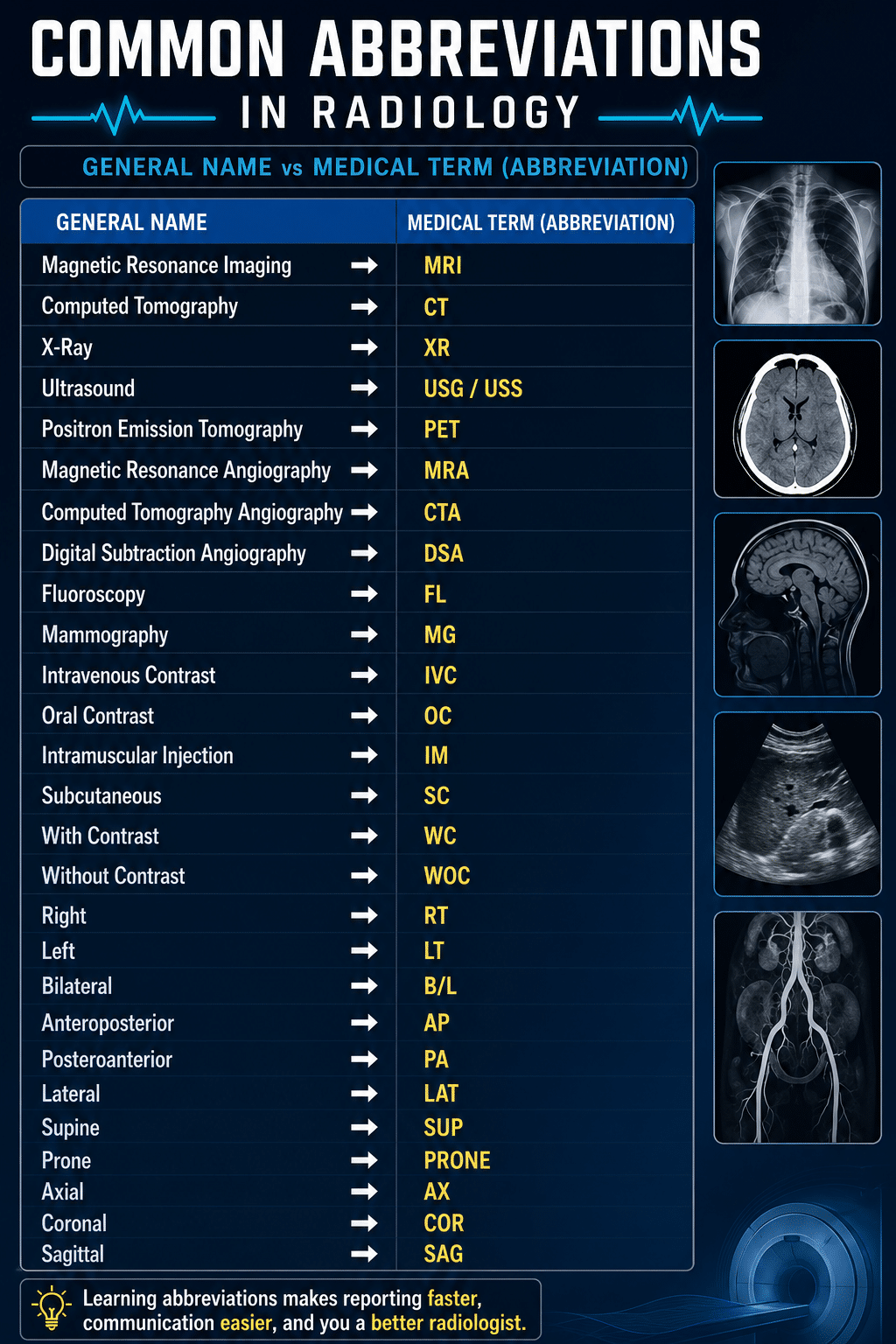
Which radiology terms and nicknames will you hear?
Common images:
- Bitewing (BWX): Shows crowns of upper and lower posterior teeth and bone levels. Great for interproximal caries.
- Periapical (PA): Shows the entire tooth from crown to root tip. Great for endo and abscess evaluation.
- Panoramic (pano): Wide view of jaws, teeth, TMJ area, sinuses.
- Cephalometric (ceph): Side skull image used in orthodontics.
Radiographic terms:
- Radiolucent: Dark on X-ray (often decay, infection, or spaces).
- Radiopaque: Light on X-ray (bone, enamel, metal restorations).
Safety vocabulary:
- ALARA: As Low As Reasonably Achievable (radiation exposure principle).
- Lead apron and thyroid collar: Protective equipment (usage depends on office protocol and current guidelines).
- Digital sensor vs film: Modern sensors reduce processing time and often reduce retakes.
Why it matters: the right image answers the clinical question. Good positioning and correct angulation reduce retakes and save time.
Which instrument terms cover what you pass and why?
Basic exam set:
- Mouth mirror: Retracts, reflects, improves visibility.
- Explorer: Detects calculus and evaluates surfaces (used carefully).
- Periodontal probe: Measures pocket depths.
- Cotton pliers (college pliers): Grabs cotton, gauze, small items.
Handpieces and burs:
- High-speed: For cutting tooth structure quickly.
- Low-speed: For caries removal, polishing, and certain procedures.
- Friction grip: Bur type typically used in high-speed.
- Latch: Bur type typically used in low-speed.
- Round bur: Often for caries removal or access.
- Fissure bur: Often for shaping and cutting.
Suction and isolation:
- Saliva ejector: Low-volume suction.
- HVE (high-volume evacuator): Strong suction for aerosols and water.
- Air-water syringe: Delivers air, water, or mist.
- Cheek retractor: Improves access and visibility.
Scaling overview:
- Scaler: Removes calculus primarily above the gumline.
- Curette: Designed for subgingival scaling and root surfaces.
- Ultrasonic scaler: Uses vibration and water to disrupt calculus and biofilm.
Sterilization area language:
- Ultrasonic cleaner: Removes debris before sterilization.
- Autoclave: Steam sterilization unit.
- Pouching: Sealing instruments in sterilization pouches.
- Indicators: Color-change markers to verify exposure conditions.
- Spore test: Confirms sterilizer effectiveness (office schedule varies by protocol).
For a comprehensive understanding of these instruments and equipment terms, you might want to consider taking a test that covers these topics.
Which material terms describe what is in the tray?
Impression materials:
- Alginate: Common, fast, cost-effective impression material.
- PVS (polyvinyl siloxane): Very accurate impression material used for crowns/bridges.
- Bite registration material: Captures bite relationship.
Cements and liners:
- Glass ionomer cement: Can chemically bond and release fluoride.
- Resin cement: Strong cement used for many indirect restorations.
- Temporary cement: Holds temporaries for short-term use.
- Liner/base: Protective material placed under restorations in certain situations.
Anesthetics (intro-level):
- Topical: Surface numbing gel/spray.
- Local anesthetic: Numbs a targeted area.
- Infiltration: Injection near the tooth area.
- Nerve block: Injection near a nerve trunk for a wider area.
- Carpule: Anesthetic cartridge.
- Aspirating syringe: Syringe designed to aspirate and reduce intravascular injection risk.
Disposables:
- Gauze, cotton rolls, saliva ejector, microbrushes, mixing tips.
Which charting abbreviations appear in notes and the schedule?
Common shorthand:
- Tx: Treatment
- Dx: Diagnosis
- Hx: History
- CC: Chief complaint
- RCT: Root canal therapy
- EXT: Extraction
- BWX / PA: Bitewings / periapical radiographs
Procedure coding awareness:
- CDT codes: Standardized codes used for dental procedures (accuracy matters for communication, billing, and compliance).
Consent and records:
- Informed consent: Patient understands and agrees to the procedure, risks, benefits, and alternatives.
- HIPAA: Patient privacy and protection of health information.
- Medical history review: Confirming conditions, medications, allergies, and changes at each visit.
How assistants use terminology daily: updating notes, relaying messages, confirming the planned procedure, and ensuring the clinical team is aligned.
How does the jargon translate in real chart notes?
Example 1
“BWX shows interproximal caries on #19 D.”
Translation: Bitewing X-rays show a cavity between teeth near the back lower left first molar, on the side facing away from the midline (distal surface).
Example 2
“SRP UR and UL, 4-6mm pockets with BOP.”
Translation: Deep cleaning is planned for the upper right and upper left areas. Gum pockets measure 4 to 6 mm and bleed when probed, which suggests inflammation and periodontal disease.
Example 3
“Composite MOD on #14 with rubber dam isolation.”
Translation: A tooth-colored filling will be placed on the upper left first molar covering the mesial, chewing, and distal surfaces, and the tooth will be isolated with a rubber dam to keep it dry and safe.
Example 4
“RCT #8 then crown.”
Translation: The upper right central front tooth needs a root canal first to treat the nerve space, then a crown afterward to protect and strengthen the tooth long-term.
What is the practical next step for a dental assisting career?
Dental practices are looking for professionals who are thoroughly trained, legally compliant, and clinically confident. Terminology is a major part of that confidence because it affects how you set up, assist, chart, and communicate with patients and the clinical team.
The dental industry is also one of the fastest-growing healthcare fields, offering:
- Stable income potential
- Flexible schedules
- Career mobility
- Opportunities to move into expanded functions over time
- A respected role in healthcare with rising demand for skilled professionals
If you want structured training that goes beyond memorization, Broward Dental Academy prepares students to thrive in a modern, high-performance dental practice through immediate immersion in online and clinical settings, updated eLearning lesson plans, and in-office internships. Broward Dental Academy offers various courses such as Dental Assistant Level 01 Training, Dental Assistant Level 02 Training, and Dental Assistant Hygienists Level 03 Training along with flexible financing options.
Ready to take the next step?
Enroll in one of our comprehensive courses today! Don’t delay, enroll today, you will be glad that you did!
FAQs (Frequently Asked Questions)
Why is learning dental terminology important for new dental team members and patients?
Learning dental terminology is crucial because it helps new team members, interns, and patients communicate clearly, avoid misunderstandings, and understand chart notes, treatment plans, X-rays, instrument setups, and insurance paperwork. This knowledge prevents clinical mistakes in a fast-paced environment and improves overall confidence.
What are some common areas where dental jargon is used in daily practice?
Dental jargon appears frequently in chart notes (e.g., ‘MOD comp #14’), treatment plans (like ‘RCT then crown’), radiology terms (‘BWX’, ‘PA’), instrument setups, insurance coding with CDT codes, and patient conversations explaining diagnoses and procedures.
How can beginners effectively learn dental terminology?
Beginners can learn dental terms faster by studying them in categories such as anatomy, surfaces and directions, conditions and diagnoses, prevention and hygiene, restorative procedures, specialties like endodontics or periodontics, radiology, instruments/materials, and charting abbreviations. A recommended routine is learning 10 terms per day aloud, associating them with real tools or diagrams, practicing mock chart notes, and keeping a clinic notebook to record new terms heard during internships or shadowing.
What are some commonly confused dental terms that beginners should be aware of?
Commonly confused pairs include: Prophylaxis (routine cleaning) vs Scaling and Root Planing (SRP) which is deep cleaning for gum disease; Cusp (a point on a chewing surface) vs Cingulum (a ridge on the back of an anterior tooth); Composite (tooth-colored resin filling) vs Amalgam (silver filling). Understanding these differences is essential for accurate communication.
What are the core tooth anatomy terms every dental assistant or patient should know?
Key tooth anatomy terms include: Enamel (hard outer layer of the crown), Dentin (layer beneath enamel), Cementum (outer covering of the root), Pulp (nerve tissue inside the tooth), Pulp chamber (space housing pulp tissue), Root canal (canal inside the root with pulp), Apex (tip of the root), Periodontal Ligament (connects root to bone). Also important are parts like Crown (visible part above gums), Root (anchored below gums), and Neck/CEJ where enamel meets cementum.
Where can someone find further educational resources or certifications related to dental terminology and practices?
Individuals interested in advancing their dental knowledge can explore specialized areas such as periodontics or oral surgery through dedicated courses. Obtaining relevant certifications enhances qualifications and employability. Various comprehensive courses offering hands-on experience are available at institutions like Broward Dental Academy. Additionally, FAQs and location details can be found on their website to assist learners.