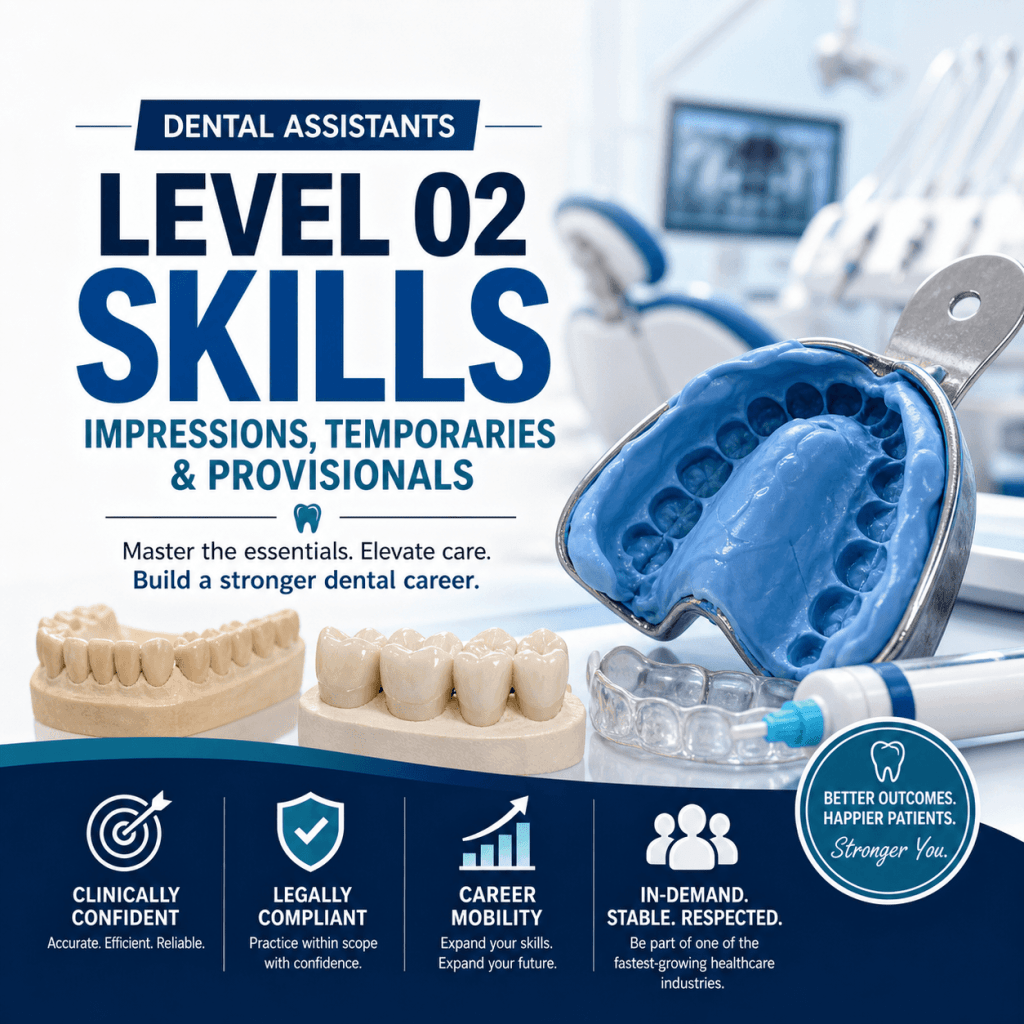
Why do these Level 02 skills matter in a real office?
In a busy restorative practice, acquiring “Dental Assistants Level 02 Skills” typically signals something employers care about immediately: you can do more at chairside, you work with less hand-holding. You help the team avoid costly remakes.
Key takeaways: Dental Assistant Level 02 Skills
- What are the Dental Assistant Level 02 Skills?
Impressions, temporaries and provisionals — the advanced chairside work that decides whether a crown, bridge or implant restoration fits the first time instead of returning from the lab as a remake. - What are the three skills?
Impressions, temporaries and provisionals: the work that decides whether a crown, bridge or implant restoration fits. - Why do impressions matter?
An inaccurate impression travels through the lab and comes back as a remake, costing chair time the practice cannot recover. - What does a temporary do?
Protects the prep, holds the space and keeps the patient comfortable between appointments, so the final restoration seats cleanly. - Why does it pay?
Assistants who handle these tasks reliably remove remakes and rescheduling from the practice’s week, which is measurable value.
Impressions, temporaries, and provisionals show up in everyday workflows, not just “advanced” cases. Think crowns and bridges, removable appliances, night guards, aligners, diagnostic models, and follow-up seating appointments. When these steps are done well, the entire day runs smoother. When they are done poorly, the schedule gets backed up quickly.
Dental practices want professionals who are thoroughly trained, legally compliant, and clinically confident. Level 02 training is designed to build those outcomes by giving you repeatable systems, hands-on practice, and the judgment to know when something is not acceptable and needs to be corrected before it leaves the operatory.
In this guide, you will learn what these skills include, what accuracy looks like, where assistants add the most value in various areas such as [oral surgery](Oral Surgery training program), orthodontics, or endodontics, and what to practice so you become the person a dentist trusts on restorative days. You will also see how building Level 02 skills can support career mobility and stable income in one of healthcare’s fastest-growing industries.
What do impressions, temporaries and provisionals include?
Before getting into technique, it helps to define the terms in plain language:
- Impressions are records of teeth and tissues, captured with impression material or digital systems. So a lab or in-office workflow can fabricate an accurate restoration or appliance.
- Temporaries (temporary restorations) are short-term covers placed after a tooth is prepared, primarily to protect the tooth and keep the patient comfortable until the final restoration is delivered.
- Provisionals (provisional restorations) are interim restorations that often carry more functional and esthetic demands than a basic temporary. They are frequently used as a “test drive” for the final outcome.
Accuracy matters because these steps affect:
- Fit and retention
- Margin quality and tissue health
- Occlusion and comfort
- Lab communication and remake risk
- Overall restorative success and patient confidence
At Level 02, assistants are trained to support the dentist through setup, tray selection, material handling, timing, moisture control support, provisional fabrication and finishing, and patient instructions. Duties and supervision requirements can vary by state and by office protocol. So reputable training emphasizes safe, ethical performance within your permitted scope.
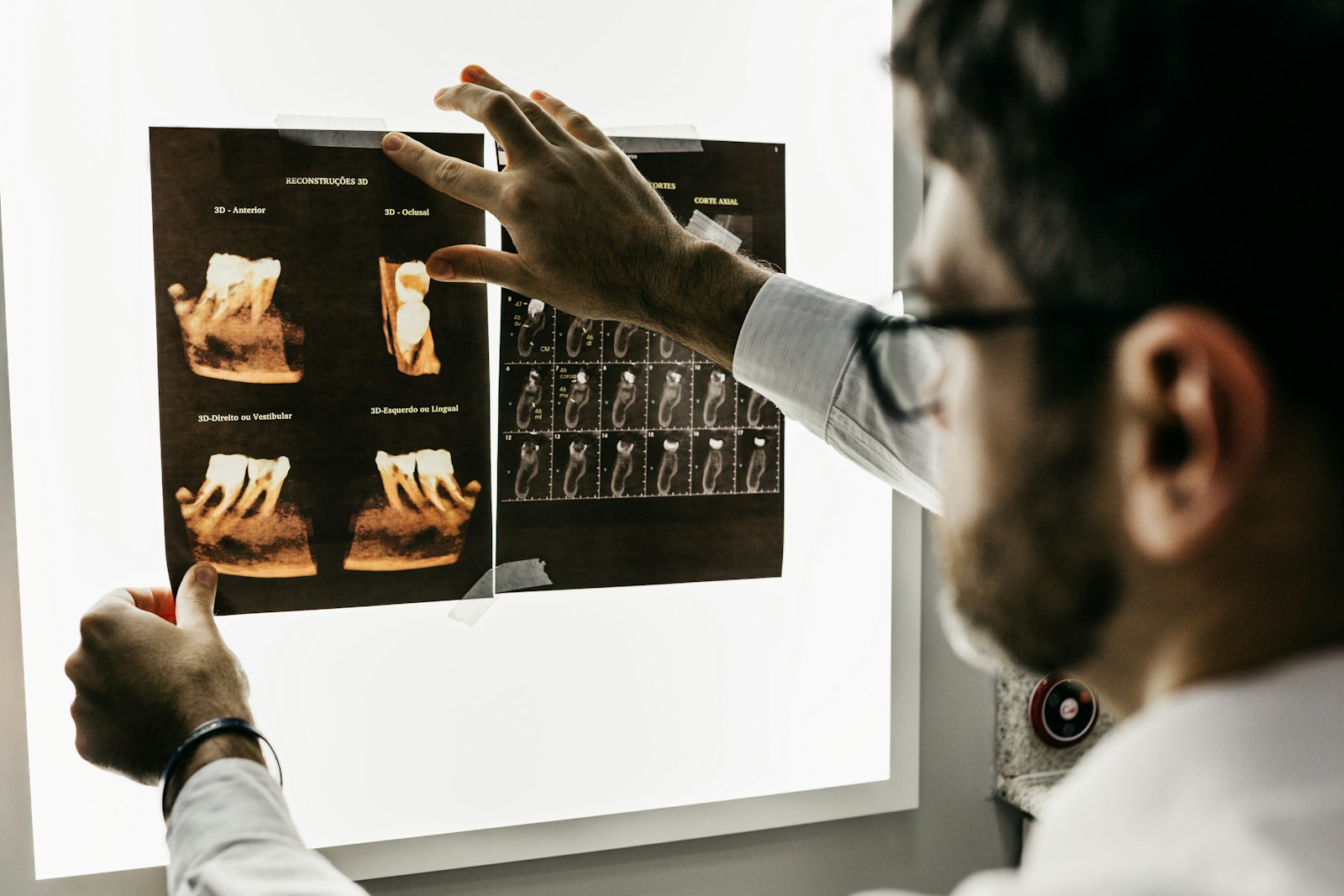
Why are impressions the foundation for accurate restorations?
Impressions impact far more than crowns. They influence:
- Crowns, bridges, and implant restorations (case-dependent)
- Partials and other removable appliances
- Aligners and retainers (case-dependent)
- Night guards and occlusal guards
- Diagnostic models and wax-ups
- Bite registrations for mounting and occlusion
A good impression captures full anatomical detail and the information the dentist and lab need to succeed. In practical terms, that means:
- Clear detail of teeth and soft tissue where needed
- Clean, readable margins when a crown prep is involved
- Minimal voids, pulls, bubbles, and drag lines
- A stable set with no distortion
- Correct bite registration when needed
The assistant’s role
Chairside, the assistant often becomes the “systems manager” for impressions. That includes anticipating the material and setup, managing timing, supporting moisture control, coaching the patient to reduce movement, and documenting what the lab needs to know.
A strong assistant also knows how to quickly evaluate an impression and speak up immediately if a retake is the best decision. Redoing it now is almost always faster than trying to “make it work” later.
Impression materials you’ll handle (and what can go wrong)
Alginate (irreversible hydrocolloid)
Alginate is commonly used for study models, preliminary impressions, bleaching trays, and some guards.
Common failures include:
- Tears at the margin or interproximal areas from thin material or early removal
- Bubbles and voids from poor loading or trapped air
- Distortion from tray movement, improper removal, or material thickness issues
- Delayed pour problems because alginate loses accuracy if it sits too long
PVS/VPS (polyvinyl siloxane) and polyether
These materials are typically used when higher accuracy is needed, such as crowns, bridges, and many final restorative impressions.
What can go wrong:
- Moisture contamination (saliva and blood) that interferes with detail, especially near margins
- Tray adhesion issues if adhesive is missed, rushed, or incompatible
- Timing errors that lead to premature removal or incomplete set
- Pulls and drag lines from movement during setting
For more specialized procedures like periodontics, understanding these materials becomes even more crucial.
Putty/wash and dual-arch impressions
Putty/wash techniques and dual-arch trays can be efficient in the right situations. They can also create remakes if basics are missed.
Frequent mistakes include:
- Inadequate wash flow around margins
- Tray flex or improper seating
- Not capturing enough adjacent anatomy
- Bite errors that throw off occlusion
Temperature, set time, and mixing method
Room temperature and how you mix or dispense matters. Faster set can reduce working time and increase stress, while slow set can tempt movement. With automix systems, common issues include:
- Not bleeding the cartridge before placing a tip
- Using a partially clogged tip, creating inconsistent mix
- Waiting too long after dispensing before seating
If you’re looking to broaden your skills in
Tray selection, try-in, and patient prep
Impression success begins before material is ever mixed.
Selecting the correct tray size and extension
- Verify coverage of vestibules and key posterior anatomy (including tuberosities and retromolar pad areas)
- Avoid trays that are too small, which leads to incomplete capture
- Avoid trays that are too large and unstable, which increases movement
Stock vs custom trays
- Stock trays can work well when rigid and properly sized
- Custom trays can improve uniform thickness and accuracy when showed
- Rigidity matters because flex can distort the set impression
Try-in steps
- Seat the tray and check border clearance and comfort
- Confirm frenal areas are not pinched
- Watch for gag reflex triggers and adjust approach
- Ensure the patient can keep position without strain
Patient coaching Small coaching details reduce movement, which reduces remakes:
- Explain the sensation and how long it will take
- Encourage nasal breathing
- Position the head appropriately
- Give clear bite instructions for dual-arch trays and bite registrations
Moisture control and soft-tissue management support
Even the best impression material cannot capture detail through saliva, bleeding, or tissue collapse.
Assistant-driven support often includes:
- Efficient suction strategy and isolation
- Keeping the field dry without traumatizing tissue
- Retraction assistance and visibility support
- Preparing what the dentist needs so retraction steps are not rushed
Why tissue management matters For crown impressions, margin capture is everything. If tissue collapses over the margin or bleeding contaminates the area, the impression can look “fine” at a glance but fail at the most important location.
Supporting retraction cord placement Where permitted and as directed, assistants may support the process by ensuring:
- The area remains visible and dry
- Cord stays clean and appropriately managed during the sequence
- Materials and timing are ready so the dentist can work efficiently
Common errors that ruin detail
- Saliva contamination right before seating the tray
- Tissue rebound that covers margins
- Minor bleeding that smears or creates voids at the margin
Impression evaluation, disinfection, and lab-ready documentation
A fast evaluation checklist can save hours later.
Quick evaluation checklist
- Margins captured and readable (where applicable)
- No significant bubbles at critical areas
- No pulls, tears, or drag lines
- No tray show-through in critical zones
- No missing anatomy or incomplete vestibules when needed
- Bite registration accurate and stable (when taken)
Disinfection and handling Follow infection control standards and manufacturer instructions so the impression is disinfected without distortion. Improper handling can warp an otherwise perfect impression.
Packaging and lab communication Even a great impression can fail if the lab is missing information. Depending on the case, documentation may include:
- Patient identifiers and complete lab slip/Rx
- Shade and stump shade notes when requested
- Notes about margins, tissues, or timing concerns
- Photos that clarify shade, characterization, and adjacent teeth
When to speak up If the impression is not acceptable, a confident assistant helps the team by calling it early. A same-visit retake is usually the most efficient choice for the schedule and the patient.
How do temporaries protect the prep and the patient?
A temporary is not just a cover. It protects the prep and helps the patient function normally between appointments.
Core goals of temporaries
- Protect dentin and reduce sensitivity
- Keep tooth position, contacts, and occlusal stability
- Support gingival health and tissue position
- Give basic function and esthetics
Why temporaries fail
- Open or overextended margins that irritate tissue
- High occlusion leading to pain, dislodgement, or fracture
- Poor proximal contacts that cause food traps and shifting
- Weak material from poor technique or timing
- Cement cleanup problems that inflame gingiva and create discomfort
A Level 02-trained assistant improves outcomes by controlling the sequence, timing, and finishing, so the temporary is comfortable, cleansable, and stable.
Temporary materials and techniques assistants commonly use
Common materials
- Bis-acryl materials are popular for many temporaries due to handling and esthetics.
- Acrylic (in certain workflows) can be strong, but technique-sensitive due to heat and shrinkage during setting.
Matrix methods
- Pre-op impression or putty matrix made before preparation
- Vacuform shells for certain cases
- Preformed crowns in specific scenarios and where appropriate
Mixing and dispensing tips
- Load the matrix evenly to reduce voids
- Avoid trapping air at line angles and cusp tips
- Follow working and set times closely so the temporary is not distorted during removal
Heat and shrinkage considerations Some materials generate heat or shrink as they set. Knowing when to remove and reseat (per material protocol and dentist preference) helps reduce lock-in and distortion.
Trimming, contouring, contacts, and occlusion (where most problems happen)
Finishing is where a temporary goes from “good enough” to clinically helpful.
A simple finishing sequence
- Gross trim and remove flash
- Refine margins
- Shape embrasures and contours for cleansability
- Smooth and polish for comfort
Contacts and emergence profile
- Verify proximal contacts so the tooth does not drift and food does not pack
- Create an emergence profile that supports tissue health, especially near the margin
Occlusion checks High occlusion is a top reason temporaries hurt or come off. The goal is to adjust high spots without flattening all anatomy. Stable contacts in functional movements matter.
Cement cleanup Leftover cement is a common cause of gingival inflammation and soreness. Thorough cleanup supports tissue healing and improves the patient’s experience.
Temporary cementation support and patient instructions
Cement selection basics Temporary cement should be retentive enough to stay on but retrievable at the next appointment. The assistant supports correct handling, timing, and isolation.
Isolation and bite pressure
- Keep the prep dry as directed
- Coach the patient on bite pressure during set so the temporary seats fully
Post-op instructions Patients do better when expectations are clear:
- Avoid sticky or very hard foods on the temporary
- Call promptly if it comes off
- Mild sensitivity can occur, but persistent pain should be reported
Documentation Note anything that will help the next visit go faster, such as:
- Contact or occlusion adjustments made
- Any sensitivity complaints
- Temporary material used and any complications
Why are provisionals a practice run for the final restoration?
Provisionals are interim restorations, but they often function as a diagnostic tool. Compared to a basic temporary, provisionals typically involve:
- Higher esthetic demands
- Better function and occlusal stability
- Longer wear time
- More detailed evaluation before the final is made or delivered
They matter because they help verify:
- Occlusion and chewing comfort
- Contacts and floss feel
- Phonetics and speaking comfort
- Smile line, length, and overall esthetics
- Tissue response and gingival health
Level 02 assistants add value by fabricating provisionals consistently, finishing them to a high standard, and communicating feedback clearly to the dentist and lab.
Provisionals in common cases (single unit to multiple units)
Single crown provisionals Margin quality and occlusion stability are key. A clean, smooth margin supports tissue health and patient comfort.
Bridge provisionals
- Pontic contour matters for tissue health and hygiene access.
- The provisional must allow cleaning while supporting the tissue profile.
Anterior provisionals Anterior provisionals often need more time and detail:
- Shape, length, symmetry, and midline considerations.
- Phonetics, especially “F” and “V” sounds.
- Clear expectation-setting with the patient.
Longer-term provisionals Durability matters more when the provisional will be worn longer. Adjustments are common as tissue and bite settle, so documentation and follow-up communication become even more important.
Finishing and polishing for comfort, hygiene, and esthetics
Small rough spots become big complaints quickly. Finishing is not cosmetic only; it is clinical. Key goals include:
- Smooth margins and contours to reduce plaque retention.
- Proper embrasures for flossing and hygiene.
- No sharp edges or overhangs.
- A polished surface for natural luster and stain resistance.
For bridges and tissue conditioning, contour and pontic shaping can influence inflammation, comfort, and appearance. When the provisional supports the tissue correctly, the final restoration is easier to deliver and more predictable.
Communicating provisional feedback to improve the final restoration
Provisionals create valuable information, but only if the team captures it.
What to record
- Patient comfort during chewing.
- Any bite “hit first” areas or soreness.
- Esthetic preferences (length, shape, squareness, embrasures).
- Phonetic issues and where they occur.
- Tissue irritation points and suspected causes.
How photos and notes help Clear photos and concise notes help the lab replicate what worked and avoid what did not. Shade and characterization details can also be coordinated when applicable.
When teams use provisional feedback well, they reduce remakes and increase patient satisfaction because the final restoration is built on a proven blueprint.
This guide gives further insights into managing provisionals effectively in various dental scenarios.
Also, understanding the biological implications of provisional restorations can significantly enhance patient outcomes. For a deeper dive into this aspect, refer to this comprehensive study.
Which quality and safety standards tie the three together?
Impressions, temporaries, and provisionals look like separate tasks, but they share the same professional foundation.
Infection control and material handling A clean workflow matters from tray setup through disinfection and delivery. Consistent aseptic technique protects patients and the team, and it supports reliable outcomes.
Risk reduction Know when to stop and alert the dentist, especially with:
- Bleeding that prevents margin capture
- Incomplete impressions or obvious distortion
- Poor marginal adaptation on a temporary or provisional
- Patient discomfort that suggests occlusal issues or soft-tissue trauma
Ethical practice and compliance Stay within permitted duties and follow office and state protocols. Level 02 training supports the clinical confidence to do the work correctly and the professional judgment to escalate concerns promptly.
Consistency mindset The assistants who stand out are usually not “naturals.” They are consistent. Checklists, time management, and repeatable steps make your results dependable.
How does Broward Dental Academy train these Level 02 skills?
Broward Dental Academy focuses on real-world performance, not just passing an exam. The goal is to help you thrive in a modern, high-performance dental practice where restorative efficiency and accuracy matter every day.
Here is what students can expect in Level 02 training:
- Immediate immersion in online and clinical settings, so concepts connect quickly to what you will do in an operatory.
- Up-to-date eLearning lesson plans incorporated for remote training, supporting structured learning and consistent review.
- Hands-on guided clinical practice designed to build muscle memory for impression workflows and provisional techniques.
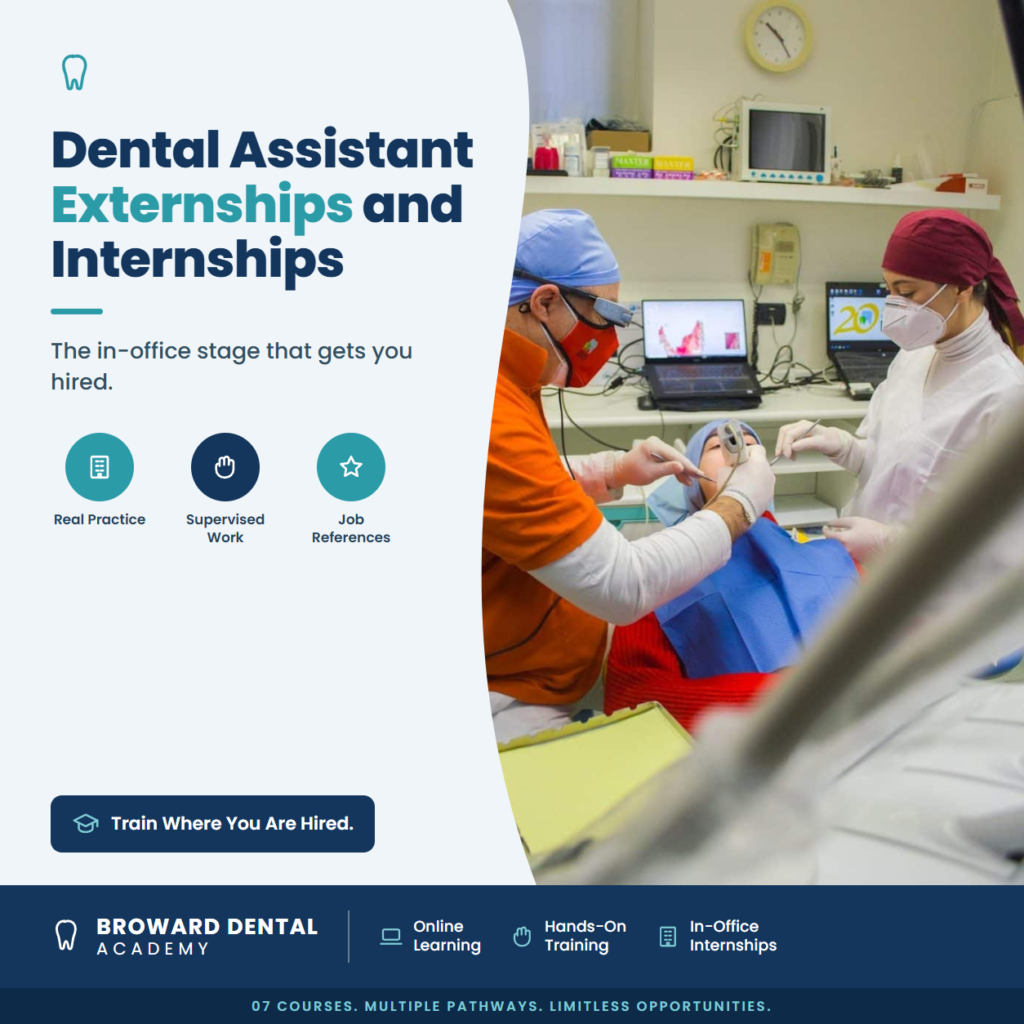
- In-office internships, where supervised exposure helps students become accomplished, polished dental professionals.
Throughout training, students are taught to think critically, act ethically, and perform confidently. That combination is exactly what employers mean when they say they want professionals who are thoroughly trained, legally compliant, and clinically confident.
Why does mastering these skills raise your value fast?
When you can support impressions and fabricate or help with temporaries and provisionals correctly, you become a restorative-day multiplier for the entire practice.
That competency signals:
- Fewer remakes and fewer delays
- Smoother appointments and better time control
- Better patient experience and fewer post-op complaints
- Stronger communication between doctor, assistant, and lab
Zooming out, the dental industry continues to grow and offers benefits many people are actively seeking: stable income potential, flexible schedules, a respected role in healthcare, and opportunities for expanded functions with proper training.
Level 02 skill-building is also a practical step toward career mobility. Many assistants start in entry-level roles, then advance into expanded responsibilities by stacking training, experience, and confidence.
How do you enroll in Level 02 advanced training?
If you want to be thoroughly trained, legally compliant, and clinically confident in impressions, temporaries, and provisionals, Level 02 is the next move.
Explore the program here: Advanced Dental Assistant Training: Level 02.
Broward Dental Academy offers 07 courses and flexible financing to make training accessible. Whether you are leveling up for a better role now or building long-term momentum in the dental community with Dental Assistant Hygienists: Level 03, or starting from Dental Assistant Level 01, we have got you covered.
Don’t delay, enroll today, you will be glad that you did!
FAQs (Frequently Asked Questions)
Why are Level 02 Dental Assistant skills important in a real dental office?
Level 02 Dental Assistant skills matter because they enable assistants to perform more tasks chairside with less supervision, helping the dental team avoid costly remakes. These skills include handling impressions, temporaries, and provisionals, which are common in everyday workflows such as crowns, bridges, removable appliances, night guards, and aligners. Accurate execution of these tasks ensures smoother daily operations and higher patient confidence.
What do ‘Impressions,’ ‘Temporaries,’ and ‘Provisionals’ mean at Level 02 training?
‘Impressions’ are detailed records of teeth and tissues used to fabricate restorations or appliances. ‘Temporaries’ are short-term protective covers placed after tooth preparation to ensure comfort until the final restoration arrives. ‘Provisionals’ are interim restorations with greater functional and esthetic demands, often serving as a test drive for the final outcome. Mastery of these ensures fit, margin quality, occlusion, lab communication, and overall restorative success.
What role does a Level 02 Dental Assistant play in taking dental impressions?
At Level 02, the assistant acts as a systems manager for impressions by anticipating materials and setup, managing timing, supporting moisture control, coaching patients to reduce movement, and documenting lab requirements. They must evaluate impressions quickly and recommend retakes if necessary to prevent delays or remakes later.
What impression materials do Level 02 Dental Assistants commonly handle and what issues can occur?
Assistants commonly handle alginate (irreversible hydrocolloid) for study models and preliminary impressions, which can suffer from tears at margins, bubbles, distortion from tray movement, or delayed pouring issues. They also use PVS/VPS (polyvinyl siloxane) and polyether for high-accuracy needs like crowns and bridges. Problems include moisture contamination affecting detail, tray adhesion failures due to missed adhesives, and timing errors during setting.
How does mastering Level 02 skills support career mobility and income stability in dentistry?
Building Level 02 skills equips assistants with repeatable systems, hands-on practice, and clinical judgment that make them valuable team members trusted by dentists on restorative days. This expertise enhances employability across specialties like oral surgery, orthodontics, and endodontics within one of healthcare’s fastest-growing industries, leading to better job stability and income potential.
Why is accuracy critical when performing impressions, temporaries, and provisionals at Level 02?
Accuracy affects fit and retention of restorations, margin quality impacting tissue health, occlusion ensuring patient comfort, effective lab communication reducing remake risks, and overall restorative success boosting patient confidence. Errors can back up schedules quickly in busy practices; so precise execution is essential for smooth daily workflow.