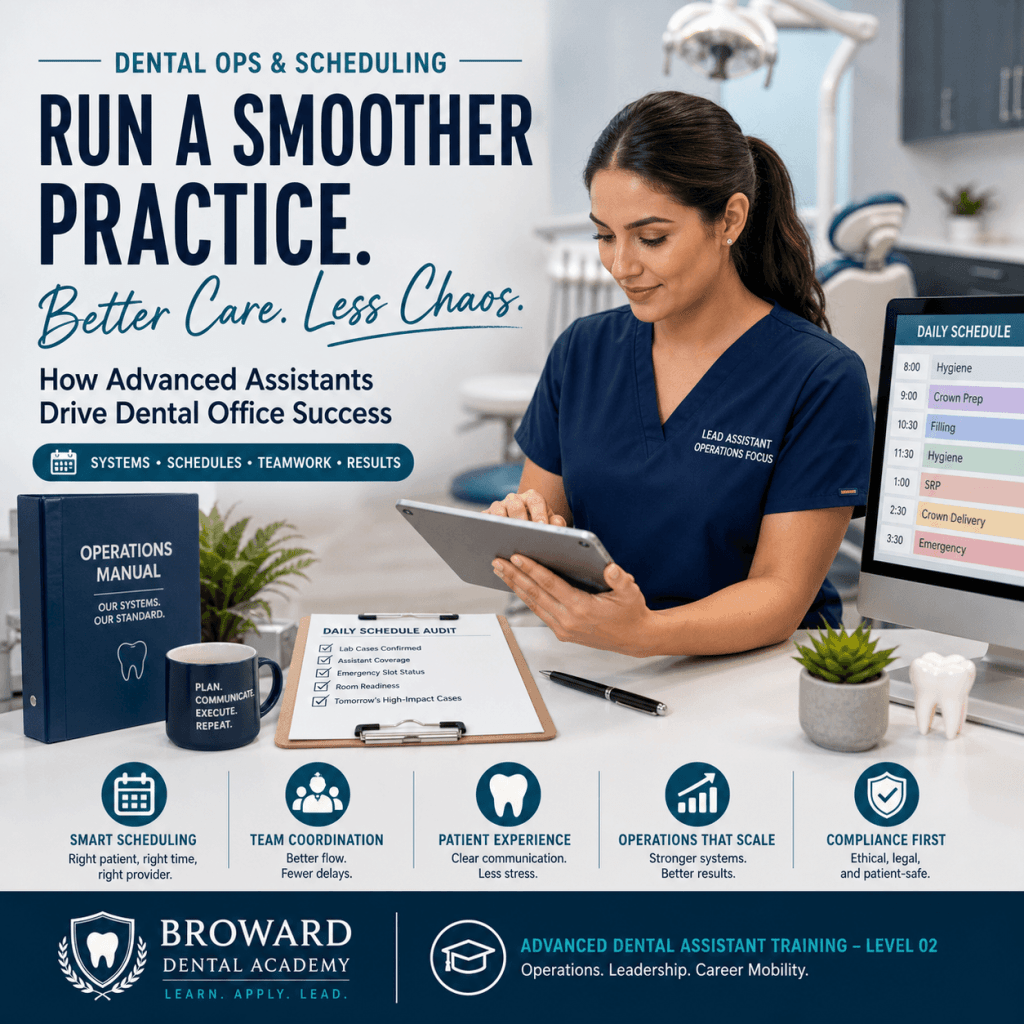
Key takeaways: dental office operations
- What do dental office operations actually cover?
Scheduling and block design, room turnover, instrument readiness and the coordination between hygiene exams and the doctor’s chair — the work that decides whether a full book actually runs on time. - Why does scheduling decide the day?
A full book is not the same as a workable one: block design, room turnover and assistant coverage decide whether it runs on time. - What should an assistant own?
Setup and turnover timing, instrument readiness, and the coordination between hygiene exams and the doctor’s chair. - How are emergencies absorbed?
By designing the day with deliberate space rather than pretending emergencies will not happen. - What should be measured?
Start-time accuracy, turnover time, unfilled gaps and same-day completion, so improvement is visible rather than felt.
That is exactly why dental operations and scheduling matter more than ever. And it is also why advanced dental assistants are increasingly driving the systems that keep the day running on time.
When you can connect clinical flow, front desk communication, and provider productivity, you become the operational bridge that holds the practice together.
This guide covers practical dental office operations, dental appointment scheduling, scheduling guidelines, and real systems that reduce daily chaos. It also connects these skills to career mobility. Assistants who master operations become indispensable and, where legally allowed, are often the first considered for expanded responsibilities and leadership pathways.
Why do operations and scheduling matter so much?
A schedule can look “full” and still fail. A day can be booked solid and still run late, frustrate patients, burn out the team, and leave production below goal.
Practices feel pressure from multiple directions:
- Higher patient expectations for on-time visits and clear communication
- Tighter margins and higher supply and lab costs
- More same-day decision making, especially with digital workflows
- Heavier demand for skilled dental professionals as the industry continues to grow
This is where advanced assistants stand out. You are close enough to clinical reality to understand procedure timing, room setup needs (like those required for oral surgery, orthodontics, or endodontics), and sterilization flow. You are also close enough to the front desk to protect schedule integrity, support patient communication, and flag problems early.
The result is simple: when assistants help run operations, providers stay focused on care, patients stay informed, and the schedule stops collapsing.
Additionally, with a comprehensive understanding of various aspects of dental practice management including dental office operations and appointment scheduling guidelines, advanced assistants play a crucial role in reducing daily chaos in the practice.
What can an advanced assistant own in operations?
Advanced assistants often coordinate the systems that make the day predictable. In many practices, that includes:
- Chair flow and room readiness
- Procedure timing support and anticipating next steps
- Handoffs between hygiene, assistant, and doctor
- Patient communication support during delays or extended treatment
- Schedule integrity, including keeping templates accurate and realistic
The boundaries that protect you and the practice
Operations should never pressure the team into shortcuts. Clinical tasks must remain within your state dental board rules and your office’s written protocols. Your systems should strengthen compliance, documentation, and safety, not weaken them.
That means:
- Sterilization standards are never negotiable
- Consent and clinical decision-making are never rushed
- Documentation is completed properly, even on a busy day
- No one is “squeezed in” if it compromises patient care
How to collaborate without stepping on roles
Advanced assistants and front desk teams can work extremely well together when responsibilities are clear. A simple way to do this is to share KPIs and handoffs:
- Front desk owns booking, financial coordination, and confirmations
- Clinical team owns procedure readiness, room turnover targets, and real-time timing updates
- Both teams share ownership of on-time starts, patient satisfaction, and schedule accuracy
Ethically, your role is to protect patients and the team even when the schedule is under pressure. A “full” schedule is not the same thing as a safe schedule.
For instance, if you’re dealing with periodontics, it’s crucial to ensure that all necessary procedures are followed meticulously. This is where your understanding of certifications can come in handy, ensuring that all team members are adequately certified for their roles.
Moreover, it’s essential to address any frequent asked questions from patients promptly. This not only enhances patient satisfaction but also aids in maintaining schedule accuracy.
Finally, remember that your practice’s location can influence its operations. Understanding the dynamics of your locations can help streamline processes further.
Why does a practice need a single source of truth?
High-performing practices do not rely on memory. They rely on systems that any trained team member can follow consistently.
A dental operations manual is your single source of truth. It turns “tribal knowledge” into written standards. It also becomes your training tool for new team members and cross-coverage.
What belongs inside your operations manual
At a minimum, include:
- Scheduling rules and appointment templates
- Room turnover standards and sterilization flow
- Late and cancellation policy with documentation rules
- Emergency slot rules and triage scripts
- Lab tracking, scan workflows, and pickup verification
- Supply reordering system and par levels
- Daily and weekly checklists
Where to store it
Use a shared digital binder that the whole team can access, plus printed operatory copies for speed. Digital is best for version control. Printed pages help on a busy day when nobody has time to click through folders.
Core checklists that prevent daily breakdowns
Checklists are not busywork. They prevent the small misses that turn into big delays.
Opening checklist (examples)
- Operatories stocked and wiped down
- Instruments and cassettes staged for the first procedures
- Implant or surgical setups ready (if applicable)
- Digital scanner or imaging units charged and calibrated as needed
- Emergency kit check based on office protocol
Midday reset (examples)
- Confirm instrument flow and sterilization status
- Check room turnover timing and identify bottlenecks
- Verify scan uploads, lab cases, and pickup or delivery timing
- Quick review of afternoon appointments for setup needs
Closing checklist (examples)
- Lab cases staged correctly for tomorrow
- Next-day schedule audit completed
- Follow-ups assigned and documented
- Supplies checked against par levels and reorder list updated
A simple rule: if it causes a delay more than once, it becomes a checklist item.
What does a schedule that runs on time look like?
The goal of scheduling is not just to “fill the book.” It is to place the right patient, for the right procedure, with the right provider, at the right time, with realistic clinical timing.
The fastest way to create chaos is to treat every appointment as a custom build. The fastest way to create consistency is to standardize.
Standard appointment templates every office needs
Most practices benefit from clear templates for:
- Prophy and hygiene visits
- SRP blocks
- Fillings (single vs multiple surfaces)
- Crowns and same-day dentistry blocks
- Limited exams and emergency exams
- Extraction, endo, implant, or specialty blocks (as applicable)
Templates protect provider productivity and reduce context switching. They also protect team capacity. You cannot schedule a crown like a filling if it requires different setup, different materials, and different turnover.
Advanced assistants are often the first to spot mismatches because you see the real timing, not the ideal timing.
The scheduling triangle: patient needs, provider productivity, team capacity
A schedule that runs on time balances three forces.
Patient needs
- Urgency and symptoms
- Anxiety and support needs
- Transportation, school, and work constraints
- Financial readiness and treatment acceptance timing
Provider productivity
- Protected time for higher-value procedures
- Predictable production flow
- Less bouncing between unrelated procedure types
Team capacity
- Assistant coverage and cross-coverage limits
- Hygiene-to-doctor handoffs and exam windows
- Sterilization throughput and room availability
- Lab turnaround timelines for crowns, dentures, and appliances
When one of these is ignored, the day becomes reactive. The advanced assistant’s operational value is spotting the imbalance early and communicating it before it becomes a same-day emergency.
Which scheduling guidelines keep the book stable?
Guidelines are where most schedules either stabilize or fall apart. The best guidelines are simple, written, and consistently applied.
Define the rules clearly
Create shared definitions for:
- On-time policy and arrival expectations
- Late arrival thresholds (and what happens at each threshold)
- Same-day rescheduling rules
- How exceptions are documented and who approves them
Documentation matters. If the team makes exceptions, the pattern should be visible so leadership can fix the underlying issue instead of blaming the schedule.
Use a confirmation cadence that matches real life
A practical cadence many practices use:
- 7 days out: confirm date and time, update insurance or financial notes if needed
- 48 hours out: confirm and remind about arrival time and paperwork
- Same day: quick touchpoint, especially for high-impact procedures
Use text, email, or calls based on patient preference and office policy. The goal is fewer surprises on the day of treatment.
Incorporating automated patient communication can also significantly enhance this process by keeping patients prepared and reducing cancellations.
Scheduling examples that protect flow
- Reserve morning blocks for operative and crown appointments
- Place smaller fillings and short visits later in the day
- Hold at least one daily emergency slot, based on practice volume
Avoid the trap of stacking “quick” appointments that still require setup, anesthesia time, imaging, documentation, and turnover. Ten minutes on paper can become thirty minutes in real life.
Finally, adjust blocks by day-of-week trends and provider speed using real data, not guesses.
Smart block scheduling without overbooking (and without burnout)
Block scheduling is simply protecting time for specific categories of care so the schedule stays realistic.
A practical example:
- Morning: crowns, same-day dentistry, quadrant dentistry
- Midday: exams, deliveries, shorter operative
- Afternoon: smaller restorative and follow-ups
- Daily: emergency exam slot and a limited-treatment pathway
Block scheduling works best when the clinical team continuously updates template timing based on what actually happens in the chair.
Overbooking is not a strategy. It is a symptom of weak systems.
Where do schedules usually break between hygiene and the doctor?
Even strong schedules break when hygiene exams pile up and assistants are pulled in two directions.
Common pain points include:
- Delayed doctor exams
- Congested hallways and room availability issues
- Sterilization backlogs
- Assistants bouncing between hygiene checks and operative support
Fix it with predictable exam windows and signals
Create a system the whole team follows:
- Predictable exam windows each hour
- Simple signals such as a status board, digital flags, or a headset cue
- Standard terminology like “ready for doctor,” “waiting on anesthetic,” “needs scan,” or “x-rays complete”
Standardize instrument cassettes
Missing instruments create the worst kind of delay because it breaks momentum. Standardize cassettes for common procedures and keep backup sets where appropriate.
Know your sterilization bottleneck
Your throughput is either limited by:
- How fast instruments return to sterilization
- How fast sterilization can process and cool
- How fast rooms can be turned over
Once you know the bottleneck, you can decide whether batching or continuous flow is best for your setup.
Communicate delays early
If a room is running late, tell the front desk early enough that they can adjust expectations, update arrival times, and protect the rest of the day.
Patients are usually understanding about delays when communication is proactive and honest.
Room turnover as a scheduling tool (not just a cleaning task)
Turnover is one of the most underrated scheduling tools in dentistry.
Set realistic turnover targets based on:
- Procedure complexity
- Number of instrument sets used
- Need for lab case staging or scanning
- Availability of sterile cassettes
Then track it. When turnover slips, scheduling must adjust or the day will run behind no matter how good the templates look.
How do you absorb emergencies without derailing the day?
Emergencies are part of dentistry. The mistake is pretending they are not.
Define emergency vs urgent vs routine
Your practice should define:
- True emergency: trauma, uncontrolled bleeding, swelling with systemic symptoms, airway concerns
- Urgent: significant pain, broken tooth with symptoms, localized swelling
- Routine: minor sensitivity, lost filling without pain, cosmetic concerns
Triage script basics
A consistent triage script should capture:
- Pain scale and duration
- Swelling, fever, trauma, bleeding
- Medication and allergy flags
- Any red flags that require immediate escalation
Scheduling pathways
Most practices need three pathways:
- Emergency exam slot
- Limited treatment slot (if provider capacity allows)
- Referral pathway when appropriate
To protect the schedule, use dedicated emergency blocks and clear rules for squeeze-ins. “We will try” is not a system. A defined pathway is.
Documentation and follow-up
Before the patient leaves, the next step should be scheduled and documented. Emergency care without a scheduled follow-up often becomes repeat emergencies.
How do you handle cancellations and no-shows?
You cannot eliminate cancellations, but you can reduce preventable gaps and respond faster when they happen.
Track patterns
Look for trends by:
- Day of week and time of day
- Procedure type
- Patient segment (new vs established)
Patterns tell you what to fix, and they also tell you where to place your “more reliable” procedures.
Prevention systems that actually work
- Set expectations at booking, including arrival time and reschedule rules
- Use deposits and written policies where appropriate and legally compliant
- Make rescheduling frictionless, but not consequence-free for chronic no-shows
- Maintain a short-call list that is organized by procedure length and patient availability
Make schedule recovery a checklist, not a scramble
Build it into the operations manual so the team does the same thing every time.
A simple daily schedule audit (10 minutes that saves the whole afternoon)
Morning audit
- Confirm lab cases and deliveries
- Identify tight turnarounds and complex setups
- Verify assistant coverage and cross-coverage risks
- Confirm emergency slot status and pathway
Midday audit
- Check delayed rooms and sterilization status
- Push or pull small appointments strategically
- Communicate updated ETAs to front desk
End-of-day audit
- Confirm tomorrow’s high-impact cases
- Pre-stage setups where possible
- Assign follow-ups and confirm documentation is complete
This audit is one of the easiest ways to turn a chaotic office into a predictable one.
Which communication systems keep patients calm and teams aligned?
Operational excellence depends on communication, not heroics.
Patient communication that builds trust
Set expectations clearly about:
- Arrival time and paperwork
- Numbing time for anesthesia
- Possible delays and why they happen
- When the patient will be updated
Avoid overpromising. If you are running behind, do not tell a patient “ten minutes” unless you are confident.
Internal communication that prevents bottlenecks
Use:
- Quick huddles at opening and after lunch
- Short status updates between rooms
- Standard terminology and clear ownership for updates
Escalation rules
Define when to involve the office manager or lead assistant immediately, such as:
- Multiple rooms running behind
- Sterilization backlog threatening patient safety
- Provider running over block repeatedly
- Lab case missing with a patient already seated
Which metrics show real improvement rather than just busyness?
Busy is not the same as effective. Metrics turn “we feel behind” into specific fixes.
Operational metrics tied to scheduling include:
- On-time start rate
- Average patient wait time
- Chair utilization
- Room turnover time
- No-show and late-cancel rate
- Reappointment rate
Quality guardrails matter too:
- Remakes and adjustments tied to rushed workflows
- Post-op calls and complications
- Patient complaints related to delays or communication
Review metrics weekly with leadership and focus on one or two process changes at a time. Skills plus systems create predictable outcomes.
What makes an assistant operations-ready?
As demand rises, practices want professionals who are thoroughly trained, legally compliant, and clinically confident. In 2026, that includes the ability to think operationally.
Assistants who understand scheduling, communication, ethics, and documentation become the people practices rely on to run the day. Those skills also support career mobility into lead assisting, specialty offices, and operations-focused roles.
At Broward Dental Academy, training is built to prepare students for modern practice expectations, not just exams. Students are trained to think critically, act ethically, and perform confidently. Programs include immediate immersion in online and clinical settings, in-office internships, and flexible financing options so students can start sooner and progress faster.
What to look for in a program if you want to run the day (not just assist in it)
If your goal is to become operations-ready, look for:
- Hands-on exposure to real clinic pace and provider expectations
- Training that includes communication, critical thinking, ethics (like those outlined in this resource), and documentation
- Support for career mobility and advanced pathways
- Financing flexibility that makes training realistic for working adults
What does a realistic 30-day upgrade plan look like?
A real upgrade happens in steps. One change at a time, with team buy-in and consistent follow-through.
Week 1: Document and diagnose
- Document current workflows as they actually happen
- Start an operations manual draft
- Identify the top 3 schedule pain points (the ones that cause the most delays)
Week 2: Standardize the foundation
- Standardize appointment templates
- Set turnover targets by procedure type
- Launch the daily schedule audit
Week 3: Protect the schedule
- Implement confirmation cadence
- Build and organize a short-call list
- Define the emergency scheduling pathway and scripts
Week 4: Measure and lock it in
- Measure results using a few key metrics
- Refine blocks based on what the data shows
- Train cross-coverage so the day does not depend on one person
- Update the operations manual so the new system becomes the standard
Sustainability comes from consistency. The best systems are the ones the team will actually use on a hard day.
How do you become the advanced assistant practices want?
When operations and scheduling are tight, patients are happier, providers are more productive, and the team is less stressed. That is the difference between surviving the day and running the day.
If you want to become thoroughly trained, legally compliant, and clinically confident for modern practice expectations, explore Broward Dental Academy’s pillar program: Advanced Dental Assistant Training: Level 02.
For those looking to further enhance their skills, consider enrolling in our Level 03 Dental Assistant program, which provides advanced training tailored for modern dental practices.
Don’t delay, enroll today, you will be glad that you did!
FAQs (Frequently Asked Questions)
Why is dental operations and scheduling more important in 2026?
In 2026, dental practices face higher patient expectations for on-time visits and clear communication, tighter margins with increased supply and lab costs, more same-day decision making especially with digital workflows, and a growing demand for skilled dental professionals. Effective dental operations and scheduling ensure smoother clinical flow, better front desk communication, and improved provider productivity to meet these challenges.
How do advanced dental assistants contribute to efficient dental practice operations?
Advanced dental assistants play a key role by coordinating chair flow, room readiness, procedure timing support, handoffs between hygiene, assistant, and doctor, patient communication during delays or extended treatment, and maintaining schedule integrity. Their close connection to both clinical realities and front desk functions allows them to keep the schedule running smoothly while supporting patient care.
What are the boundaries that advanced dental assistants must observe in managing operations?
Operations management by advanced assistants must always comply with state dental board rules and office protocols. This includes never compromising sterilization standards, ensuring consent and clinical decision-making are not rushed, completing documentation properly even during busy days, and avoiding squeezing in patients if it compromises care quality or safety.
How can advanced assistants collaborate effectively with front desk teams without overlapping roles?
Collaboration thrives when responsibilities are clearly defined: front desk manages booking, financial coordination, and confirmations; the clinical team handles procedure readiness, room turnover targets, and real-time timing updates; both share ownership of on-time starts, patient satisfaction, and schedule accuracy. Sharing KPIs and clear handoffs help maintain smooth teamwork while protecting patients and staff.
What is the importance of a dental operations manual in practice management?
A dental operations manual serves as the single source of truth for high-performing practices. It documents written standards replacing tribal knowledge, ensuring consistency across team members. It also functions as a vital training tool for new staff members to uphold operational protocols that reduce daily chaos and improve overall practice efficiency.
How does mastering dental operations impact an assistant’s career mobility?
Assistants who master dental operations become indispensable team members. Where legally permitted, they are often the first considered for expanded responsibilities and leadership roles within the practice. Their comprehensive understanding of clinical flow, scheduling guidelines, communication skills, and compliance enhances their value and opens pathways for career advancement.