Key takeaways
- Why does it raise pay?
Expanded functions widen what you may perform, so the practice gains chair time it can schedule and bill against. - Where do gains appear?
Higher base pay, access to specialty and restorative-heavy offices, and more hours in practices that need the coverage. - What should the program include?
Supervised hands-on competency in the functions Florida permits, not a certificate awarded on classroom hours alone. - What makes it pay off?
Using the skills immediately and documenting the results, then having the pay conversation with evidence rather than hope.
When your day-to-day duties stay limited to basic assisting, your earning potential often stays limited too. Not because you are not valuable, but because the practice can only legally delegate so much to you. In dentistry, compensation tends to follow capability. The more clinical skills you are allowed and trained to perform, the more value you create for the schedule, the doctor, and the business.
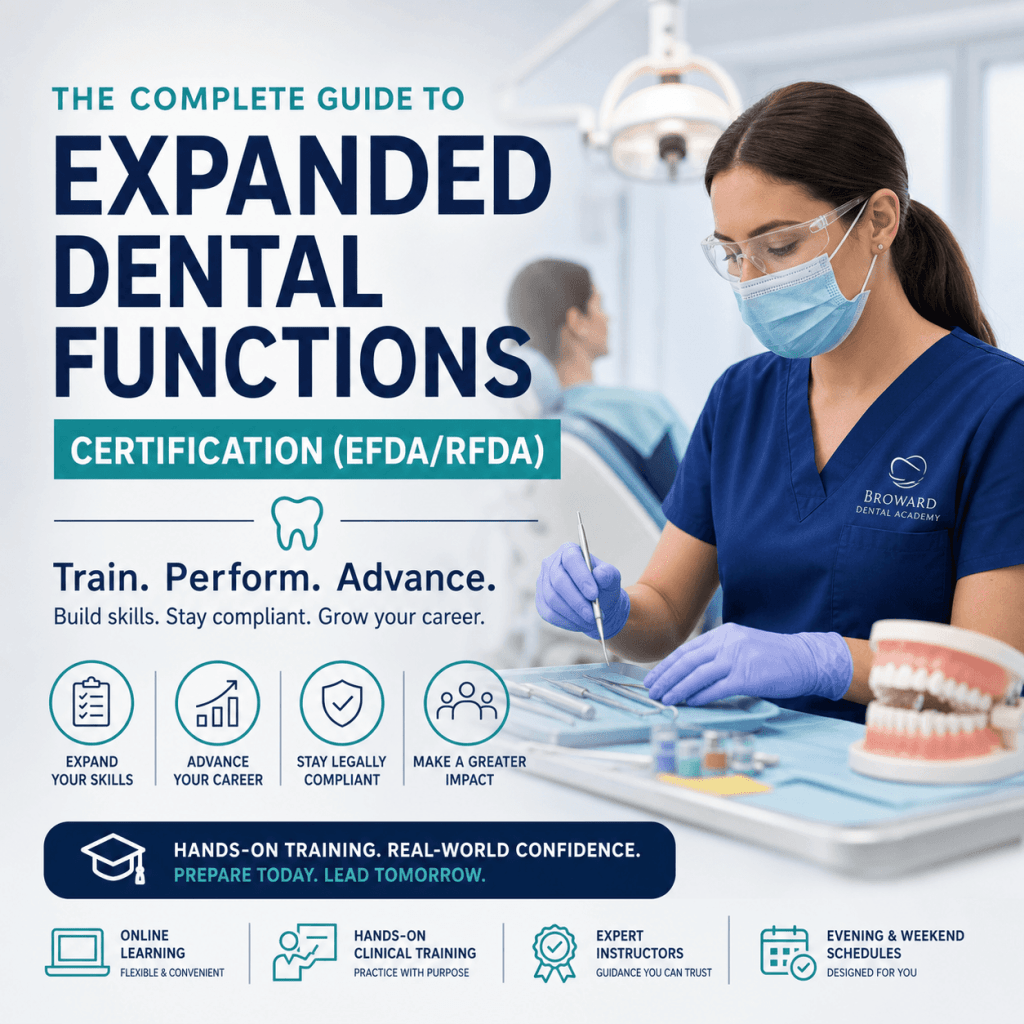
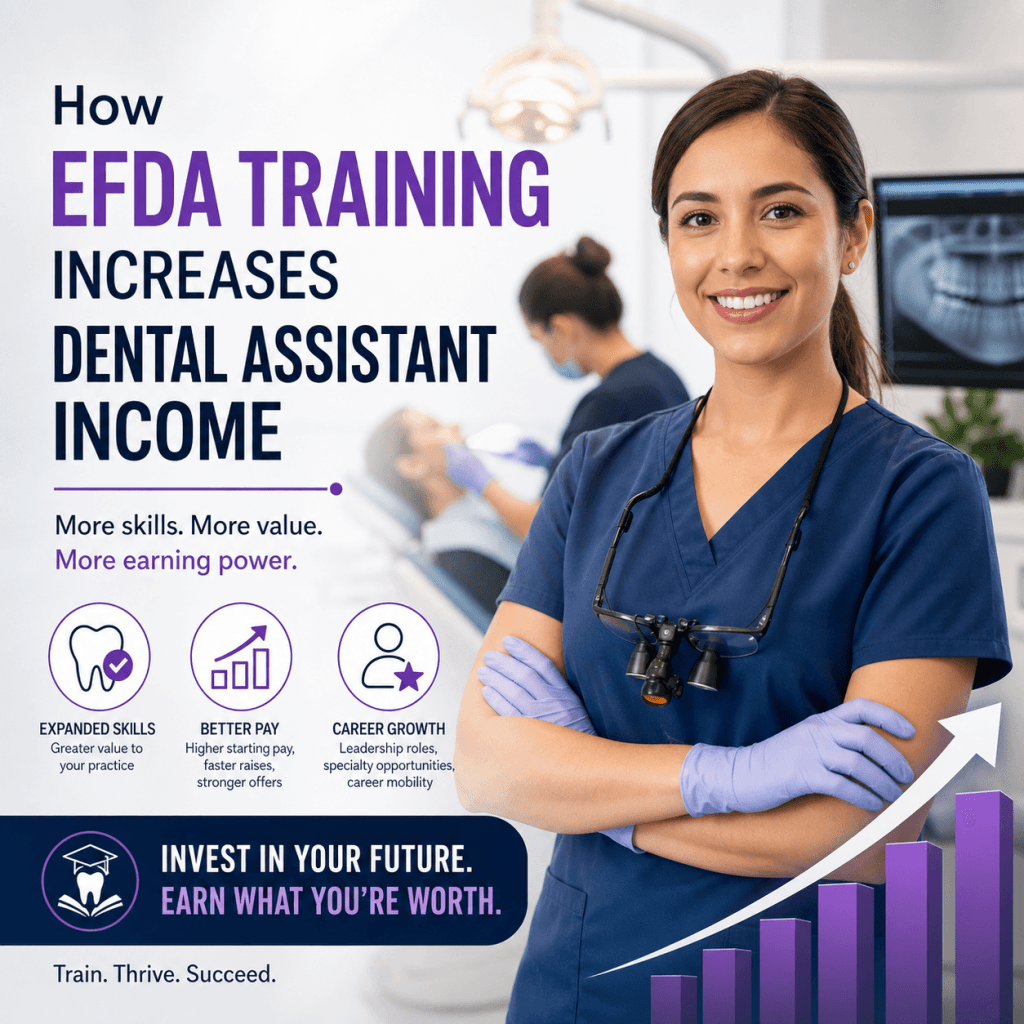
That is why EFDA training, which includes expanded skill sets such as oral surgery, orthodontics, endodontics, and periodontics, is often the fastest path to higher dental assistant pay.
In this guide, you will learn what an EFDA is, how it changes your role inside a modern practice, where income increases typically show up, and how to choose training that employers trust. You will also see how Broward Dental Academy supports income-focused EFDA training designed for real practice performance.

Why is EFDA training the fastest path to higher pay?
Dental assisting is part of one of the fastest-growing healthcare fields, and it comes with real advantages: stable income, flexible schedules, career mobility, and strong demand for skilled professionals.
At the same time, many assistants discover that raises slow down when their scope of duties stays the same year after year. The simplest link is this:
More legally allowed clinical skills = more value to a practice = higher earning power.
EFDA training helps you build those expanded skills in a structured, compliant way, so you are not just “helpful,” you are a clinical team member who can take on more responsibility under the dentist’s supervision.
By the end of this article, you will know:
- What EFDA means in plain language
- Why employers actively seek expanded-functions assistants
- How EFDA training can increase your hourly rate and job options
- What to look for in training if your goal is higher income
What is an EFDA, and why does it matter to employers?
EFDA stands for Expanded Functions Dental Assistant. In simple terms, an EFDA is a dental assistant trained to perform expanded clinical duties as allowed by state rules, under the supervision of a licensed dentist. To become an EFDA, one must undergo a reputable training program that provides the necessary certifications, such as those offered by institutions like the Broward Dental Academy.
The expanded functions vary by state, which is why this training matters. Practices want to ensure that when they hire you, you understand the rules, can follow them, and can perform your duties confidently and consistently.
Why dental practices care so much
Modern dental offices run on efficiency and quality control. When delegation is done correctly, it improves:
- Patient flow
- Chair utilization
- Schedule predictability
- Team coordination
- Consistency of clinical support
In a high-performance office, the dentist and hygienist need to stay focused on the tasks only they can do. An EFDA helps reduce bottlenecks by handling appropriate expanded tasks within legal scope, so the whole appointment moves smoothly.
Just as important, employers want the “legal plus clinical confidence” package. They are looking for professionals who are:
- Thoroughly trained
- Legally compliant
- Clinically confident
- Ready to perform under supervision without constant re-teaching
That combination is exactly what a strong EFDA program is designed to deliver. Such programs are available in various locations, including those offered by the Broward Dental Academy, making it easier for prospective EFDAs to find suitable training near them.

Additionally, pursuing further education such as a Dental Community Health Coordinator program can provide valuable skills that enhance your role in the dental practice even more.
How does EFDA training increase income?
Income increases in dentistry usually follow the value equation.
If your expanded skills help the practice reduce delays, run more predictably, and free up the doctor for higher-level procedures, your role directly supports revenue and throughput. That is why EFDAs often see better pay offers, faster raises, and more mobility.
EFDA training can increase your income because:
- You can contribute more independently (within legal scope)
- You reduce the practice’s training burden and risk
- You become qualified for roles that pay more, including lead and specialty positions
- You become harder to replace in a busy, growing market
Below are the three core reasons that show up again and again in real hiring and pay decisions.
Reason #1: You become qualified for higher-responsibility clinical tasks
EFDA training typically prepares assistants for expanded clinical support that a basic assistant may not be permitted or competent to perform without formal training.
From the employer’s perspective, this matters because higher-responsibility skills reduce handoffs inside an appointment. Fewer handoffs usually means:
- Smoother procedures
- Fewer pauses while someone “catches up”
- Less chair time lost to preventable delays
- A more consistent patient experience
There is also a real confidence factor. Patients can tell when a clinical team is coordinated, prepared, and calm. That polish improves trust, which can influence retention, case acceptance, and referrals. Practices notice the difference, and compensation often follows the people who consistently create that kind of experience.
Reason #2: You help the practice run faster without sacrificing quality
Practices do not pay more just because someone completed training. They pay more because the right person helps the office function at a higher level.
Expanded training can translate into practical productivity improvements such as:
- Quicker room turnover
- More streamlined procedure support
- Better delegation and timing
- Fewer schedule disruptions
When a practice can increase capacity while maintaining quality, the schedule becomes less stressful and more profitable. Team members who reliably reduce friction are valuable, and in a growing industry, productive EFDAs become difficult to replace.
That replacement difficulty strengthens your negotiating power over time, especially in markets where demand for skilled dental professionals continues to rise.
Reason #3: You stand out as “trained, compliant, and ready”
Employer risk is real in dentistry. Compliance mistakes can lead to costly consequences, and clinical mistakes can damage patient trust. That is why many offices prefer assistants who are trained to do things correctly the first time.
A reputable EFDA program does more than help you pass an exam. It builds real readiness, including:
- Clinical judgment under supervision
- Clear communication and teamwork
- Ethical decision-making
- Understanding of legal scope and documentation expectations
Understanding the legal scope and documentation expectations is crucial for reducing employer risk. When you can walk into an interview and explain your training, your clinical exposure, and the boundaries of your permitted duties as outlined in resources like this comprehensive guide, you sound like a professional who will reduce risk, not increase it. That often translates into better offers.
Where does the money actually show up?
Income gains from EFDA training tend to show up in a few predictable pathways. Some happen inside your current job. Others happen when you move to a practice that specifically values expanded-functions skill sets.
Common ways EFDA training can increase income include:
- Higher starting pay when you are hired into an expanded role
- Faster raises because you contribute more sooner
- Promotions into senior or lead roles
- Better job offers in high-performing general practices or specialty offices
- More consistent hours and schedule stability
- Access to benefits in larger practices, depending on the employer
Results vary by location, experience, and state scope of practice, but the direction is consistent: expanded, compliant skills expand earning power.

Higher starting pay when you’re hired
Hiring managers compare candidates quickly. When two assistants have similar experience, the one with expanded training and demonstrated clinical readiness often looks like the safer and stronger choice.
EFDA training can support a higher offer because it can shorten onboarding and reduce the supervision burden. In practical terms, the practice is often thinking:
- Will this person need constant reminders?
- Can they step into our pace without slowing us down?
- Do they understand legal scope and how we document?
What to bring to interviews so you can convert training into higher pay:
- Program completion documentation
- A clear explanation of your expanded scope (based on your state rules)
- Specific examples of hands-on training or internship exposure
- Confidence explaining how you support efficiency and patient flow
Faster raises because you contribute more sooner
Raises are often tied to performance signals that are easy for an employer to see:
- Reliability and consistency
- Speed with accuracy
- Patient experience
- Team impact
- Reduced rework and fewer delays
EFDA skills can create visible wins early, which positions you well for faster pay increases. If you want to make your value obvious, keep track of outcomes in a simple way, such as:
- Where you reduced chair time or appointment friction
- How you improved room turnover or tray readiness
- When your support helped keep production on schedule
- How you prevented delays by anticipating steps
You do not need to overcomplicate it. You just need proof that your expanded training is creating measurable impact.
Access to leadership roles and specialty opportunities
EFDA training also supports career mobility. Over time, it can open doors to roles such as:
- Senior or lead dental assistant
- Clinical coordinator support roles
- Specialty practices that prefer deeper clinical skill sets
Leadership is often where income growth becomes more consistent because responsibility increases. When you are mentoring others, maintaining standards, and helping the clinical day run smoothly, you are no longer seen as interchangeable. You are seen as a key operator in the practice.
What should you look for if income is the goal?
Not all EFDA programs translate into higher pay. Employers tend to value programs that produce real clinical readiness and strong compliance habits.
If your goal is higher income, look for a program that signals:
- Modern curriculum aligned with today’s dentistry
- Hands-on clinical training, not just theory
- Real-world scenarios that mirror practice pace
- Professionalism standards and ethical decision-making
- Learning formats that fit working adults
- Documentation and structure employers recognize
Hands-on clinical training (not just theory)
Clinical repetition is what turns knowledge into confidence, speed, and accuracy under supervision.
In a real office, “clinically confident” often looks like:
- Anticipating the next step without being asked
- Maintaining asepsis and clean technique consistently
- Communicating clearly with the doctor and team
- Staying within legal scope without cutting corners
- Knowing when to ask questions and when to act
Employers favor candidates who have practiced in realistic setups, not just watched demonstrations or completed short lectures. For more insights on what employers typically look for, you can refer to this frequently asked questions page.
Internship or in-office exposure that feels like a real job
In-office internships help bridge the gap between training and employment. They teach the pace of a real day, teamwork habits, patient interaction, and how to adapt to dentist preferences.
Internship experience can translate to income because less ramp-up time often means faster trust. Faster trust means you are given more responsibility sooner, and responsibility is closely tied to pay.
It also helps you show up as a polished professional who understands how modern practices operate.
Up-to-date learning format that fits a working adult schedule
Many dental assistants train while working. Flexibility is not just convenient, it keeps momentum.
Modern eLearning lesson plans can support stronger retention because you can review material on your schedule, repeat what you need, and stay consistent without having to pause your career. Dentistry already offers flexible schedules, and training that fits that reality makes it easier to move forward without delays.
How does Broward Dental Academy support this training?
Broward Dental Academy offers a wide range of dental courses and advanced dental training designed for real practice performance, not just test performance. Their approach is built around what employers are actively looking for right now:
- Thorough training
- Legal compliance
- Clinical confidence
- Professionals who can thrive in a modern, high-performance dental practice
Students are trained to think critically, act ethically, and perform confidently, with programs designed to develop well-rounded dental professionals through immediate immersion in online and clinical settings.
Key elements that support income-focused outcomes include:
- Latest eLearning lesson plans incorporated for remote training
- In-office internships that build real-world readiness
- A fully engaged training environment aimed at producing accomplished, polished dental professionals
- Multiple course options (Broward Dental Academy offers 07 courses)
- Flexible financing to reduce barriers to career advancement
If your goal is not only to get certified, but to become the kind of assistant a busy practice can trust quickly, that training style matters. For those interested in expanding their skill set, the Expanded Functions Dental Assistant Level 03 (EFDA) program is an excellent pathway.

What is a realistic plan to turn training into a raise?
EFDA training can raise your income, but it works best when you approach it with a simple plan. This could involve considering other relevant courses offered by the academy such as the Dental Assistant Level 02 or Dental Assistant Hygienists Level 03, which can further enhance your qualifications and earning potential.
Step 1: Identify the expanded functions valued by the practices you want
Different offices value different skills. A high-volume general practice may prioritize speed and flow. A specialty office may prioritize precision and deep clinical support.
Look at job postings in your area and note what comes up repeatedly. That becomes your roadmap.
Step 2: Enroll in EFDA training that emphasizes compliance and real clinical competence
Choose training that aligns with your state’s rules and produces documentation employers respect. Avoid programs that feel like they only teach to the exam. You want readiness that holds up in a real schedule with real patients.
Step 3: Update your resume and interview story around outcomes
Employers respond to outcomes, not titles. Position your EFDA training around:
- Efficiency improvements
- Patient flow support
- Readiness to contribute with less supervision
- Professionalism and communication
Step 4: Negotiate confidently using the practice’s language
When you negotiate, focus on value drivers that matter to the business:
- Increased productivity and smoother appointments
- Reliability and accuracy
- Reduced training time
- Clear understanding of legal scope and delegation
Be prepared to describe exactly what you can do, what you cannot do, and how you stay compliant.
Step 5: Keep growing after training
The highest earners in dental assisting keep expanding their impact. After training:
- Ask for new responsibilities when appropriate
- Track improvements you create in the clinical day
- Look for career mobility opportunities in stronger practices
Is EFDA training worth the investment?
EFDA training increases dental assistant income by expanding what you can do, improving practice efficiency, and making you a more valuable, compliant, confident professional.
The industry tailwinds are strong. Demand for skilled dental professionals continues to rise, and dental practices are actively looking for team members who can perform at a high level while staying within legal scope. In that environment, advanced training becomes more valuable, not less.
If you are ready to break past the pay ceiling and build real career mobility, explore the Expanded Functions Dental Assistant Level 03 (EFDA) program at Broward Dental Academy. Additionally, starting with the Dental Assistant Level 01 program could provide a solid foundation before advancing to more specialized training.
Don’t delay, enroll today, you will be glad that you did!
FAQs (Frequently Asked Questions)
What is an EFDA and why is it important for dental assistants?
EFDA stands for Expanded Functions Dental Assistant. It refers to a dental assistant trained to perform expanded clinical duties allowed by state laws under a licensed dentist’s supervision. Becoming an EFDA enhances your skills, increases your value to dental practices, and opens up higher-paying job opportunities.
How does EFDA training help increase a dental assistant’s pay?
EFDA training equips dental assistants with expanded clinical skills that allow them to take on more responsibilities legally. This increased capability improves practice efficiency, supports higher patient throughput, and reduces the dentist’s workload, all of which translate into higher earning potential for the assistant.
Why do dental practices seek expanded-functions dental assistants?
Dental practices value EFDAs because they improve patient flow, chair utilization, schedule predictability, and team coordination. EFDAs enable dentists and hygienists to focus on tasks only they can perform while ensuring clinical support is thorough, legally compliant, and confident, boosting overall practice performance.
What should I look for in an EFDA training program if my goal is higher income?
Choose an EFDA training program that offers comprehensive instruction in state-allowed expanded functions, provides recognized certifications, emphasizes legal compliance and clinical confidence, and has a strong reputation among employers. Programs like those offered by Broward Dental Academy are designed to support income-focused EFDA training aligned with real practice needs.
Can EFDA training lead to career mobility within the dental field?
Yes. By gaining advanced clinical skills through EFDA training, dental assistants become qualified for roles with greater responsibility, including lead positions and specialties such as oral surgery or orthodontics. This expanded scope not only increases income but also enhances career growth opportunities.
Are expanded functions the same in every state?
No. The scope of expanded functions that a dental assistant can perform varies by state due to differing regulations. Therefore, it’s important to pursue EFDA training that is compliant with your state’s rules to ensure you are legally qualified and trusted by employers in your area.